Home » 2020 (Page 10)

Book Review: Night of the Mannequins by Stephen Graham Jones

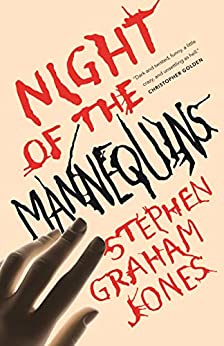
cover art for Night of the Mannequins by Stephen Graham Jones

Night of the Mannequins by Stephen Graham Jones (  Bookshop.org  |  Amazon.com )

Tor.com, 2020

ISBN-13 : 978-1250752079

Available: Paperback, Kindle edition


Night of the Mannequins is a short book, a rocket-fuel ride from beginning to end. It is narrated by teenage Sawyer, one of an offbeat, close-knit group of friends who have known each other forever and are about to graduate high school and go their separate ways. Stephen Graham Jones does a genius job with Sawyer’s narrative voice: it really feels like he is talking right to you. After they’re thrown out of a movie theater where their friend Shanna works, the friends come up with the idea of sneaking a discarded mannequin in to prank Shanna and the manager. Instead, the prank fizzles, the mannequin disappears, and Sawyer is certain he saw it walk out of the theater. After one of the Shanna is killed, along with her family, when a truck plows into her house, Sawyer is convinced the mannequin is the culprit and that he and his friends and their families are all in danger of death by mannequin. He is certain he has seen the mannequin and that the mannequin is stealing and eating Miracle-Gro to turn into a gigantic monster. Sawyer decides he has to act before the monster mannequin can. Jones takes us far down the rabbit hole in this surreal and disturbing tale as Sawyer’s perceptions become more and more skewed,  especially once he starts covering his face with a mannequin mask.

We don’t get to know the other friends well, but Sawyer’s feelings for them seem genuine, so you feel for them and their families when gory tragedy strikes. And wow, does it strike. Sawyer describes it in detail, and Jones does not pull his punches.

This is not intended to be a YA book but it very easily could appeal to YA horror readers looking for a bite-sized read. It’s short, fast-paced, and, unusual in YA horror these days, has a teenage boy as protagonist. With Night of the Mannequins you could hook someone who loves slasher movies but hasn’t shown much interest in reading.  Recommended for ages 15+


Book Review: Don’t Turn Out the Lights: A Tribute to Alvin Schwartz’s Scary Stories to Tell in the Dark edited by Jonathan Maberry

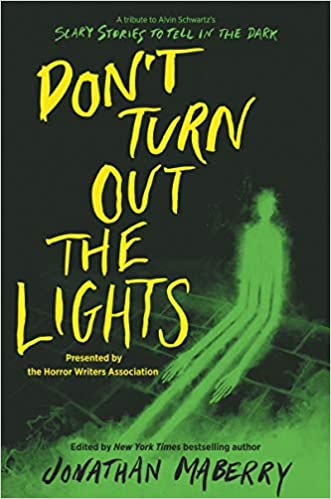
cover art for Don't Turn Out The Lights: A Tribute to Alvin Schwartz's Scary Stories to Tell in the Dark edited by Jonathan Maberry  ( Bookshop.org  |  Amazon.com )

Don’t Turn Out the Lights: A Tribute to Alvin Schwartz’s Scary Stories to Tell in the Dark edited by Jonathan Maberry

HarperCollins, 2020

ISBN-13 : 978-0062877673

Available: Hardcover, paperback, Kindle edition, audiobook


Don’t Turn Out the Lights is an anthology of stories by a variety of diverse horror writers, mostly of YA horror, inspired mainly by their nostalgia over Alvin Schwartz’s notable collections of urban legends and folktales, Scary Stories to Tell in the Dark (writers include Linda Addison, Amy Lukavics, Courtney Alameda, Tannarive Due, Kami Garcia, and R.L. Stine). Schwartz’s writing was spare, providing just the bare bones of the stories he shared, and Stephen Gammell provided terrifying black-and-white pen and pencil drawings to accompany each one It is unfortunate that the artist for the book is not credited, so far as I can tell. Nobody can be Stephen Gammell, but the interior illustrations suggest the artist studied his style. The artwork is outstanding and integrates well into the design of the book and the storytelling.

Unlike Schwartz’s collections, there aren’t a lot of jump-scares or gruesome rhymes: these are tribute stories rather than an attempt to recreate his work. As expected in a collection of 35 stories, each by a different author, some are better than others. Some stories stick closer to Schwartz’s style and choice of subject, with the feeling of a folktale, such as T.J. Wooldridge’s “The Skelly-Horse”, or “Jingle Jangle”, while others, like “The Funeral Portrait” were more reminiscent of Poe. A few manage to stick to the urban legend feel of the original while updating it for tweens today, like “Tag, You’re It,” by N.R. Lambert, which plays on social media anxieties, and “The House on the Hill”, which brings mystery emails and cell phones into play in a tale of peer pressure and surveillance in a haunted house. “The Neighbor” managed the fine line of evoking Schwartz’s tales in a contemporary context beautifully. Editor Jonathan Maberry’s introductory essay was very interesting, as he did not grow up with the stories but read them as an adult.

One of this book’s greatest faults is its length. The original Scary Stories books were relatively short in length, with plenty of white space and relatively large print on each page. Stories were usually very short and heavily illustrated. Don’t Turn Out the Lights is over 400 pages long, with most stories obviously intended to be read on the page instead of told at a campfire.  While the Scary Stories books are read by kids as young as third grade, the length of the book and of the stories suggests to me that Don’t Turn Out the Lights is aimed at a slightly older audience of tweens and middle-schoolers, and also the adult audience feeling the same kind of nostalgia for the Scary Stories books that the authors did. Recommended for grades 4+.

Contains: gore, violence, body horror, murder


NetGalley temporarily provided a review copy of this book.


Book Review: The City We Became by N.K. Jemisin

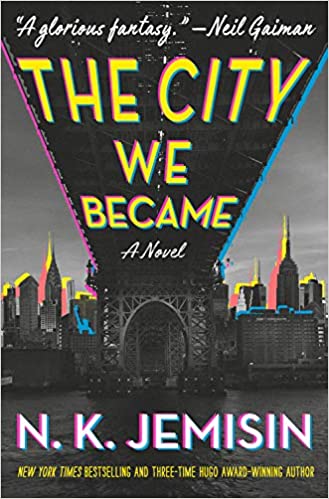
cover art for The City We Became by N.K. Jemisin

The City We Became by N.K. Jemisin   (   Bookshop.orgAmazon.com  )

Orbit, 2020

ISBN-13 : 978-0316509848

Available: Hardcover, paperback, Kindle edition


The City We Became is the first book in a trilogy based on a short story by N.K. Jemisin titled “The City Born Great”, which focused on a young homeless Black man who becomes the avatar for New York City as it literally comes alive, and successfully battles a cosmic attack aimed at killing the city at great expense to himself.

The book begins after the events of the story, and if you haven’t read the story the beginning may be a little disorienting. The exhausted avatar of New York City, who sustained significant damage to himself, is hidden away and sleeping. It turns out that one person is not enough to sustain the life of an entire city. The five boroughs of New York, each with a distinct character, each have an avatar come alive that can defend their borough, and when they come together, they will be able to find and wake the avatar for New York City with their combined strength. They just have to find each other, choose to take on the responsibility of being their city as well as themselves, and overcome the “Woman in White,” a powerful representative from a cosmic force in an alternate reality. With one exception they are a colorful, multiracial, and argumentative group, but when push comes to shove, they are all New Yorkers who stand together. Manhattan is a younger, gay man who developed amnesia when he entered the city, but who obviously had a background steeped in violence.  He has come to New York to work on a graduate degree in political science. Brooklyn is an older Black woman who was a rap artist in the early years of rap music but is now a mother and member of the city council. The Bronx is a no-nonsense part-Lenape feminist lesbian professor of fine arts who directs a nonprofit arts center for marginalized artists and members of the community. Queens is an undocumented Indian student with a gift for math who is interning on Wall Street in hopes of gaining a path to citizenship.

But Staten Island stands back from the rest of the city. She is a young white woman living in a conventional family with a father who is an abusive, xenophobic, racist cop and a mother who is a passive alcoholic housewife. She barely qualifies to work at the library, and has been cautioned about the awful people in the city and the terrible things that could happen to her there.  When someone encourages her to read Lovecraft, his work confirms for her what “those people” are like (anyone who has ever said “it’s just fiction, not life” please take note). Despite the awful things that have happened to her within the walls of her own home (ranging from smashed self-esteen to attempted rape), she is more concerned with keeping others out than escaping it herself. As a white woman, it was heartbreaking for me to see her ignorance and obvious complicity with not just human but cosmic evil. I’m not familiar with Staten Island, but I really hope the portrayal here is not totally congruent with reality,

In The City We Became, extradimensional evil has grown more complex: better at planning in a way that, when cities begin to come alive, groundwork to kill it is already in place. The art gallery is attacked online by alt-right “artists” funded by a clearly sinister foundation led by the “Woman in White”, resulting in the staff getting doxxed and recieving death threats, and the building nearly burned down (this part of the book is terrifying). Brooklyn and her family are evicted from property they own outright by the same foundation, in the name of gentrification. Every chain store that replaced a community institution and changed the character of the boroughs and the city is killing it. Will Manhattan, Brooklyn, the Bronx, and Queens be able to revive the avatar of New York and save the city without the help of Staten Island, or will the city die, to be replaced with something more sinister and destructive?

While The City We Became touched on a lot of important issues (gentrification being a big one) it is also a love letter to New York City and its boroughs. Seeing the people Jemisin imagined as being these cities brought a new vividness into the way I think about the city and I loved meeting her main characters. I do feel like this book left a lot of loose ends. Who is Manhattan, really? Will we see more of his roommate? Where will the homeless avatar for New York go next? What finally happens to Staten Island? How do things change for the avatars when they go back to their daily lives? This is the first book in a trilogy, so I hope we’ll find out shortly.  Recommended.


Contains: attempted rape, domestic abuse, violence, racism, body horror, tentacles