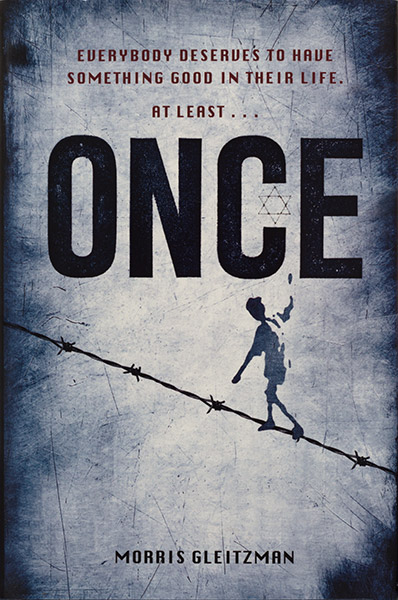
 Henry Holt and Co. (BYR); First Edition edition, 2010
ISBN-13: 978-0805090260
Available: New and Used
Once there was a boy who told stories, whose parents left him in an orphanage in the mountains and didn’t say why. He lived there for nearly four years, until one day he saw professional librarians arrive and burn all the books in the library. Except they weren’t librarians, and they were burning all the Jewish books they could find, not just in the library there, but everywhere. The boy decided to find his parents, Jewish booksellers, and help them save their books.
What he didn’t know, and readers will know almost immediately, is that the book burners didn’t just destroy Jewish books… they were Nazis, bent on killing off the Jews. The narrator’s innocence on his journey to join his parents creates a sense of dread long before he encounters the first obvious results of violence, and his description of events that he doesn’t understand is wrenching to the reader. While he makes sense of the world for himself and for others with imaginative storytelling, what’s most terrifying is when he finally recognizes the situation and is unable to tell stories anymore, when other people need to believe them most.
What is astonishing about this book is that for nearly a third of the story, the main character’s most terrible imaginings are of the destruction of books and persecution of bookstore owners and customers. He is unable to conceive that there’s anything that could be worse, in spite of the trucks packed with unhappy prisoners, soldiers, guns, and burning houses he encounters. Even when he finally recognizes the reality of what’s happening, he clings to his own notebook of stories. His notebook, and his ability to tell stories changes lives and makes tragedy a little more bearable. In the end, the fate of the characters is unknown, although for most it appears to be inevitable. Stories can’t save everyone. But there’s always the possibility that a book, a story, the power of imagination, will save someone, and destroying them also leads to the destruction of hope.
Contains: violence, murder, brutality, book burning, death camps, killing of children, Holocaust setting.