Home » Posts tagged "YA horror" (Page 13)

Book Review: Pet by Akwaeke Emezi

Pet by Akwake Emezi

Make Me A World, 2019

ISBN-13: 978-0525647072

Available: Hardcover, paperback, Kindle edition, audio CD, audiobook


There was a time before the angels came when monsters caged children, polluted the environment, refused to send aid to hurricane victims and refugees, bombed civilians in other countries, shot up schools, and hurt and killed the people around them. The angels led a revolution, changed the laws, and replaced the monuments. Jam’s teachers tell her these angels took their names from angels who weren’t human: but they were imperfect humans doing their best to create a more compassionate, safer, and more just world, and by the time Jam, our protagonist, was born, there are no more monsters.

Or are there?

Jam, curious about the original angels, heads to the library and asks about them, but the pictures she finds are terrifying, not beautiful. She wonders, if angels are terrifying, what do monsters look like? And how would you know? Jam’s mother, Bitter, tells her, “Monsters don’t look like anything… That’s the whole point.” Bitter, an artist, has been consumed with creating a painting of a bloody, goat-legged, horned creature with metallic feathers, and after it is finished, Jam sneaks in to Bitter’s studio and accidentally cuts herself on a razor blade Bitter has embedded in the canvas. Bleeding over it opens a portal, and the creature pushes through, telling Jam to call it Pet.  Pet is a hunter of monsters, called through by her because there is a monster in her friend Redemption’s house that needs hunting, but the adults in Jam’s life are not willing to recognize that a monster could still be in their midst.

I feel like this is Emezi’s response to N.K. Jemisin’s “The Ones That Stay and Fight”, which takes place in a utopian alien society where all people are respected for who they are, but knowledge of the outside world is illegal. That story ends with “social workers” executing a man found to be communicating with the less enlightened people of Earth in front of his daughter and taking her into custody to also become a social worker. In that story, questioning is not allowed and people are willing to live in ignorance of the evils of the past in order to live in their ideal society, and a child who gains that knowledge must become part of enforcing the need for that ignorance.

Pet, while it takes place in our near future, reflects some of this abstract speculative thinking, but as a book written for children, it needs to be set out in a concrete way. Emezi has created a society that is a little different from Jemisin’s: many of the people who live in the community remember the time of the monsters, before the revolution eliminated them, but they choose to believe the monsters are gone. The children born after the revolution learn about that time, but aren’t curious about it. Even knowing that they should remember the past, the people are focused on the the blessings of the present. In visiting her friend Redemption’s house, which has always seemed a loving place, Pet encourages Jam to look past the surface to see the unseen. It is uncomfortable for Jam to question what she has always seen and felt there, even knowing there is a monster in the house, and to tell Redemption about it. It is scary to learn about the monsters that existed in families in the past and realize they are still around. It is terrifying to confront trusted adults and have them refuse to believe. No one actually stops Jam and Redemption, but the adults don’t believe the monster exists, even knowing a child is suffering. Pet is there to end the hunt, and the monster, but Jam has to decide exactly what that means. Pet has a more positive vision for the future than Jemisin saw, but it is clear about the perils of believing that there can be an ideal world where monsters no longer exist.

Pet also n9rmalizes and celebrates differences without going into detail about them. Jam is a 16 year old black trans girl who is a selective mute; Redemption has three parents, one of whom is nonbinary; the librarian whizzes around in a wheelchair.  Emezi does not stick with standard English. Language is very individual and informal, and dialogue is sometimes almost musical. Without going into graphic detail. Emezi is able to communicate who the monster in Redemption’s house is, and what he has done.

While Jam is supposed to be 16, she neither acts or is treated like a 16 year old. Her thoughts and actions are more like what I would expect from a 10-12 year old, and I think she may have been “aged up” to make it possible for her to have used puberty blockers and had transition surgery (neither of these details are necessary to establish her as a transgender character, so if that was Emezi’s reasoning, the story would have benefited from aging Jam’s character down). While the story does get very dark, I think kids as young as fifth grade might be able to manage this book. At this point, fifth graders have certainly been exposed to the news, and this book gives them a way to process what they’re seeing in the media from a different perspective.  Certainly, my children both read The Giver, which has similar themes, at that age. This is a very relevant book, and while not typical horror, it does have unsettling and disturbing moments. Highly recommended.

Contains: Violence, references to rape and child sexual abuse


Book Review: Only Ashes Remain (Market of Monsters #2) by Rebecca Schaeffer


Only Ashes Remain by Rebecca Schaeffer

HMH Books for Young Readers, 2019

ISBN-13: 978-1328863553

Available: Hardcover,  Kindle edition, audio CD


Only Ashes Remain is the follow-up to Not Even Bones (previously reviewed here). At the beginning of this book, Nita and Kovit have escaped from the Death Market, leaving chaos and over a hundred deaths in their wake. Kovit, a former mob torturer, goes on the run, and Nita turns herself over to INHUP, the international organization charged with policing “unnaturals” and eliminating the dangerous ones. Shortly thereafter, she discovers that the boy she freed from her mother,Fabricio, who betrayed her to the Death Market, is also the son of someone high up in a mob family, and is on the run from them as well. In the first of many incidents in the book, Nita has to make decisions about whether vengeance, and death for those who threaten her, is worth the price. Taking advantage of INHUP’s willingness to take her to her closest relatives, she decides to contact her mother in Toronto, who saves her from a police investigation. Nita is unwilling to go back to the role her mother wants her to play in hunting and killing unnaturals, and leaves her, connecting with Kovit once again. Video of Nita with her ability to heal has been shared on the Internet, and her anonymity has been compromised, leaving her in constant danger from bounty hunters. Nita has some desperate choices to make, and feelings that she must come to terms with, about herself, Kovit, and who she can trust.

Many of the characters here tread questionable moral ground. Where previously Nita was a complicit but passive participant in the murders her mother committed, then a desperate victim of a black market dealer willing to do terrible things to escape and survive, now she has agency. And, as might be expected from a traumatized teenager raised in a home where murder is the norm, her impulsivity causes some serious problems, and her judgment is really, really poor.  Crossing her line of when it’s acceptable to kill becomes easier and easier for her, so much so that even Kovit warns her about what she is becoming– and Kovit never lets go of the knowledge that he is truly a monster. Nita, while she can’t witness Kovit’s enjoyment in torturing others without fear and disgust, also can’t break the connection she has with him. Only Ashes Remain is still gory and graphic in places, but in terms of torture, dissection, and body horror, much more is implied than shown (that doesn’t mean it isn’t shown at all, but it wasn’t quite as hard for me to handle).

Although Kovit’s background is considerably fleshed out, we’re already pretty clear on what kind of relationship he has now with Nita. Nita is a less sympathetic character, probably because she is claiming her agency in some pretty murderous ways and keeps doing exactly the wrong thing after being told not to do it. Still, the plot races along, characters new and old add some interesting flavor, with a few loose ends possibly showing up again in the third book. We’re left wondering what’s reallly going on at INHUP, how Fabricio and his family play into the story, if the mob will catch up with Kovit, what role Nita’s mother plays in all of this, and how Nita and Kovit’s story will end. Despite the fact that Kovit is a monster who feeds off people’s pain and Nita is now responsible for multiple murders, Schaeffer has been a virtuoso in drawing them as characters that the reader still wants to make it.

There’s a lot of moral gray area to navigate in this book, as well as the gore, murder, and torture, so, again, it will take a special kind of reader to appreciate it.  For those readers, though, Only Ashes Remain is a solid sequel to the first book in the series. Highly recommended.


Musings: Thoughts on Why There Aren’t More Male Protagonists in YA Horror

Over at Ginger Nuts of Horror, school librarian and YA dark fiction reviewer Tony Jones gave his thoughts on why there aren’t more strong male protagonists in current young adult dark fiction.  You should read his article first, because these are my thoughts after reading it. Tony knows a lot more than I do about YA horror, but Monster Librarian has been around since 2005 and I’ve read and written about a fair amount of YA and middle grade horror in that time period. Here’s a list of titles I put together in June, and as you can see, most of them are not very recent.

Tony suggests that the paranormal romance trend kicked off by Twilight at about that time turned a lot of boys off from reading horror, and I’m sure that was true,  at the time. In 2019, though, some teenagers might not even be aware of Twilight (quote from my daughter: “I’m not sure what it’s about. Doesn’t it have a black cover with a disembodied hand holding an apple?”). Amelia Atwater-Rhodes was a big name before Stephenie Meyer came along, and what kid knows her books now?  There were a couple of other trends that hit in the 2000s as well, the biggest one being Harry Potter. I will say that in 1999 I never would have guessed it would take of like it did, but Harry Potter has had an enduring effect on fantasy literature, complete with fearsome and bizarre creatures and terrifying sorcerers. That kind of fantasy quest fiction with a dark edge overwhemed a lot of the series horror popular in the 1990s with fantasy quest knockoffs. Tony brought up The Hunger Games as an influence, and we did start seeing a lot of dystopian and post-apocalyptic fiction around that time, with zombies becoming popular as well. There was more focus on relationships, and sometimes romance, but there were probably at least an equal number of zombie and dystopian titles with girls and boys as protagonists.

So what’s happening now that is different? Well, we’ve kind of moved through that fear of a far future apocalypse because it seems imminent, and the problems and fears kids are facing today have once again changed. And one of the ways they have changed is that the fears of girls, women, and other marginalized groups are taking up space that they didn’t before. and privilege has complicated the dynamic.  A lot of the books we see coming out have to do with agency being stolen, reproductive rights being limited, and things that are spinning out of control for people who already didn’t have much. With women writing most of YA horror, I’m guessing that’s where much of the horror lies.  Privilege is more complicated than just that, though, as evidenced by the clueless half-white, half Puerto Rican female protagonist from Vermont in her interactions with Puerto Rican residents in Five Midnights by Ann Cardinal Davila or wealthy Hanna and undocumented Nick in Gemina by Amie Kaufman and Jay Kristoff. It is possible to write characters of teenage boys with nuance, and as the mother of a teenage boy, I am desperate to see it.  The #OwnVoices movement, focused on finding and publishing diverse stories by diverse authors, especially in children’s and young adult literature, has also picked up some steam. Pitch Dark by Courtney Alameda is a great example of that, with both male and female point of view characters.

I agree with Tony that there are a lot of kids who skip straight from Goosebumps to Stephen King: in fact, research by Jo Worthy from more than 20 years back documents conversations between middle schoolers who do. In fact, teen readers are even likely to read and recommend adult fiction to their peers, if the “YA Council Recommends” shelves at my public library are any indication. At the same time, there are plenty of kids who don’t want to make that jump all at once. The Last Kids on Earth, Diary of a Wimpy Kid, and Captain Underpants  remain popular at the middle school level, and graphic novels of any kind are constantly checking out.  Rick Riordan’s quest narratives also stay popular, because they allow kids to gradually level up, with the first Percy Jackson series appropriate for elementary kids and the most recent series, Trials of Apolloof interest even to adults. Riordan isn’t writing horror, although there are certainly horrific and gruesome elements in his work, as well as comedy and in-jokes. Even when Riordan has a male point of view character, though, we get to see the uncertainties and growth that take place in his protagonists– they aren’t stock characters. Kids devour those books– I have been hearing about the release of the newest one for what feels like eons now.

Back to those kids who skip over YA and go straight to the adult stuff: while lots of us may remember reading adult horror at a relatively young age, it probably wasn’t checked out from the school library. It’s not a recent thing that middle school libraries aren’t stocking Stephen King. If you headed over to the high school in my community, it looks like they have his complete collection, but while an informal poll I did awhile back showed that Gen Xers and millenials as young as 8 had read IT, that doesn’t mean they were getting it at their school library, or even that they’d want to, and definitely they are not finding in in the middle school collections here. Some books are “underground reading”, the kind that you want to pass around with your friends without actually telling the adults in your life about, and Stephen King, before he gained respectability, used to be one of those authors. Roland Smith writes “creature thriller” type books, such as the Cryptid Hunters series and others of his books, but there’s not much in YA horror that I can find for those who love the “man vs. nature” conflict. There doesn’t seem to be a Guy N. Smith for the YA crowd (if there is, I want to know). Those readers do really have to move on to the kinds of titles that used to be found in the horror sections of used bookstores.


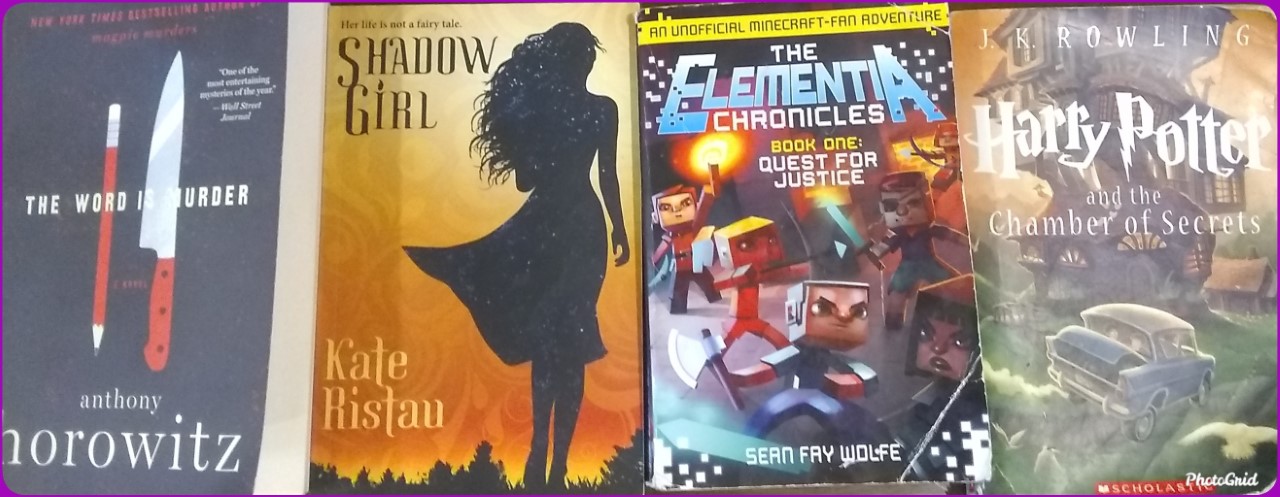
Reading choices made by my 13 year old son: Anthony Horowitz (chosen but not read) Shadow Girl (read only at home) Chronicles of Elementia (his favorite book ever, at least on Monday) and Harry Potter and the Chamber of Secrets.

Tony also discusses the gendering of book covers. It really is true that people judge books by their covers. Tony suggests that girls are more likely to pick up a book with a cover that is designed to appeal to boys than the other way around. That may be true in some cases, but I don’t think that is necessarily the case. Kids look for clues from book covers. I’ve got The Word Is Murder by Anthony Horowitz sitting next to my sofa. It has a black cover with a shiny knife and a pencil on the front. The cover is what got my son to bring it home (not read it, but bring it home), and my daughter instantly backed away.  I also have a copy of Shadow Girl by Kate Ristau, which has an orange cover with a black silhouette of a girl on it. He read this one secretly (he even tried to hide it from me) but wouldn’t take it out of the house.  I feel like a lot of this is a cultural issue– that boys might be more likely to pick up books with girls on the cover if they didn’t think other kids would embarrass them for doing so.  It’s sad that boys and girls are shamed for things like the art on the book they’re reading.

There are many fewer male protagonists in YA horror, for sure. It would be great to see this disparity addressed, but as publishers work on increasing diversity I think this is something that is going to require thoughtful discussion in the YA literature community, as there is a feeling right now that publishing has been centering male protagonists and male authors for long enough. Rudine Sims Bishop writes that books should be both windows and mirrors, which is a great analogy, but Uma Krishnaswami takes it a step further and suggests that they can be prisms: not just showing an unfamiliar world or reflecting your own back exactly, but looking at things from a different perspective. I see this as the way that YA is going to have to move in order for boys to find themselves once again as heroes in horror fiction.