Home » Posts tagged "speculative fiction" (Page 2)

Book Review: The City We Became by N.K. Jemisin

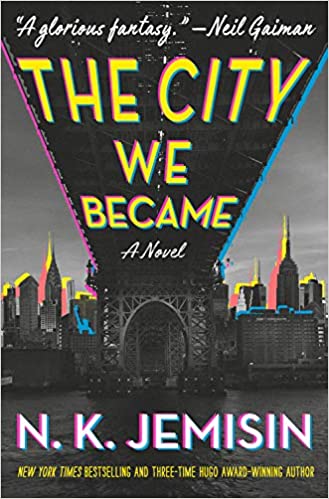
cover art for The City We Became by N.K. Jemisin

The City We Became by N.K. Jemisin   (   Bookshop.orgAmazon.com  )

Orbit, 2020

ISBN-13 : 978-0316509848

Available: Hardcover, paperback, Kindle edition


The City We Became is the first book in a trilogy based on a short story by N.K. Jemisin titled “The City Born Great”, which focused on a young homeless Black man who becomes the avatar for New York City as it literally comes alive, and successfully battles a cosmic attack aimed at killing the city at great expense to himself.

The book begins after the events of the story, and if you haven’t read the story the beginning may be a little disorienting. The exhausted avatar of New York City, who sustained significant damage to himself, is hidden away and sleeping. It turns out that one person is not enough to sustain the life of an entire city. The five boroughs of New York, each with a distinct character, each have an avatar come alive that can defend their borough, and when they come together, they will be able to find and wake the avatar for New York City with their combined strength. They just have to find each other, choose to take on the responsibility of being their city as well as themselves, and overcome the “Woman in White,” a powerful representative from a cosmic force in an alternate reality. With one exception they are a colorful, multiracial, and argumentative group, but when push comes to shove, they are all New Yorkers who stand together. Manhattan is a younger, gay man who developed amnesia when he entered the city, but who obviously had a background steeped in violence.  He has come to New York to work on a graduate degree in political science. Brooklyn is an older Black woman who was a rap artist in the early years of rap music but is now a mother and member of the city council. The Bronx is a no-nonsense part-Lenape feminist lesbian professor of fine arts who directs a nonprofit arts center for marginalized artists and members of the community. Queens is an undocumented Indian student with a gift for math who is interning on Wall Street in hopes of gaining a path to citizenship.

But Staten Island stands back from the rest of the city. She is a young white woman living in a conventional family with a father who is an abusive, xenophobic, racist cop and a mother who is a passive alcoholic housewife. She barely qualifies to work at the library, and has been cautioned about the awful people in the city and the terrible things that could happen to her there.  When someone encourages her to read Lovecraft, his work confirms for her what “those people” are like (anyone who has ever said “it’s just fiction, not life” please take note). Despite the awful things that have happened to her within the walls of her own home (ranging from smashed self-esteen to attempted rape), she is more concerned with keeping others out than escaping it herself. As a white woman, it was heartbreaking for me to see her ignorance and obvious complicity with not just human but cosmic evil. I’m not familiar with Staten Island, but I really hope the portrayal here is not totally congruent with reality,

In The City We Became, extradimensional evil has grown more complex: better at planning in a way that, when cities begin to come alive, groundwork to kill it is already in place. The art gallery is attacked online by alt-right “artists” funded by a clearly sinister foundation led by the “Woman in White”, resulting in the staff getting doxxed and recieving death threats, and the building nearly burned down (this part of the book is terrifying). Brooklyn and her family are evicted from property they own outright by the same foundation, in the name of gentrification. Every chain store that replaced a community institution and changed the character of the boroughs and the city is killing it. Will Manhattan, Brooklyn, the Bronx, and Queens be able to revive the avatar of New York and save the city without the help of Staten Island, or will the city die, to be replaced with something more sinister and destructive?

While The City We Became touched on a lot of important issues (gentrification being a big one) it is also a love letter to New York City and its boroughs. Seeing the people Jemisin imagined as being these cities brought a new vividness into the way I think about the city and I loved meeting her main characters. I do feel like this book left a lot of loose ends. Who is Manhattan, really? Will we see more of his roommate? Where will the homeless avatar for New York go next? What finally happens to Staten Island? How do things change for the avatars when they go back to their daily lives? This is the first book in a trilogy, so I hope we’ll find out shortly.  Recommended.


Contains: attempted rape, domestic abuse, violence, racism, body horror, tentacles


Book List: Black Authors of Speculative Fiction

This is not so much a book list as a list that will lead you to books.


I like to browse at the library (a pastime, unfortunately, that is on hold for the time being) and have discovered a lot of interesting authors that way. The new books section there is how I discovered Nnedi Okorafor, Rivers Solomon, and C.L. Polk. While I was encountering these authors for the first time, there was also a push for readers to deliberately work on including more diverse writers in their reading material.  Both then and now there’s an argument made that readers should just read what they want, without considering the race of the author.  It is valid to read just what you want to read, or to read the same kind of thing (or the same book) over and over– as Ranganathan says, every reader his book. But why not push your boundaries a little? If what you’re looking for is a good story, there are a lot of good stories you might miss out on if you aren’t deliberately seeking out Black authors. There is frequently a different aesthetic to their books, and the stories can catch you in ways you don’t expect. This difference leads to looking at speculative fiction genres through a new lens. In the case of Black people in the African diaspora, that aesthetic is generally referred to as Afrofuturism, a term first coined by Mark Dery. Nigerian writer Nnedi Okorafor recently differentiated that from the writing of Black Africans, which she identifies as Africanfuturism (you can read about that on her website, which I’ve linked to below, just scroll down to her name). Definitely, not everything Black writers come out with falls into this aesthetic. Considered althogether, Black speculative fiction covers a broad range of approaches to science fiction, fantasy, folkloric, and fluid fiction (a term coined by literary theorist Kinitra Brooks).  If you haven’t tried it,  look up some of these authors. I think you’ll find something you like.

I’m going to note that these are extremely brief and incomplete summaries, and it is a far from complete list. To learn more about these authors and their books click on the links. Enjoy!


Steven Barnes (Goodreads):  Barnes writes alternative history, science fiction. horror, nonfiction, sometimes with Tannarive Due or other co-authors.

Tannarive Due (author website) : Due writes horror and nonfiction, sometimes with Steven Barnes. Due is an academic who teaches and writes about Black speculative fiction, particularly horror.

Jewelle Gomez (author website) : Jewelle Gomez is best known as the author of The Gilda Stories, about a black lesbian vampire. She has written poetry, plays, and essays.

N.K. Jemisin (author website): N.K. Jemisin writes Afrofuturistic science fiction and fantasy. Jemisin won three consecutive Hugo awards for Best Novel for the books in her Broken Earth Trilogy.

Walter Mosely (author website): mysteries, science fiction, nonfiction.  Mosely is best known for his Easy Rawlins mystery series but has written in a variety of genres.

Samuel R. Delany (author website): science fiction, LGBTQ+ fiction, nonfiction. Delaney is the first Black person to be recognized as a modern science fiction writer.

Wrath James White (publisher website). interviews at Monster Librarian : extreme horror. Click on these links to see our reviews: Yaccub’s CurseSucculent PreyThe ResurrectionistSacrificeSloppy Seconds,and Vicious Romantic

Sumiko Saulson (author website): horror, graphic novels, nonfiction on black women in horror. In addition to writing fiction, Saulson is the compiler of 100 Black Women in Horror (click here to see our review)and editor of the anthology Black Magic Women: Terrifying Tales by Scary Sisters. 

Octavia Butler (official website of the Octavia Butler Estate): science fiction, alternative history, dystopian fiction Butler was the first recognized black woman author of modern science fiction and an inspiration for many Afrofuturist authors. See our review of her Earthseed Trilogy, which includes Parable of the Sower and Parable of the Talents here.

Tomi Adeyemi (author website) : YA Africanfuturist fantasy. Adeyemi is the bestselling author of the Legacy of Orisha series.

Evan Winter (Goodreads)interview at Tor.com: Africanfuturist epic fantasy.

Nnedi Okorafor (author website), Goodreads: Okorafor is an award-winning Nigerian-American science fiction and fantasy author who defines herself as an Africanfuturist and Africanjujuist (visit her author website for her explanation)

P. Djeli Clark (author website): Clark is an academic who writes nonfiction on Black speculative fiction, as well as a writer of Black speculative fiction, including alternative history, science fiction, and fantasy.

Victor LaValle (author website): Lavalle teaches at Columbia University. He writes horror, science fiction, and fantasy. Lavalle has won the Bram Stoker Award for his novella The Ballad of Black Tom (for our review click here) and the graphic novel Victor Lavalle’s Destroyer (for our review, click here).

Nalo Hopkinson (author website): Born in Jamaica, Nalo Hopkinson describes herself as a writer of fantastical fiction. She’s written nine books, including the award-winning Brown Girl in the Ring. She’s a professor of creative writing at the Univeristy of California Riverside.

Alaya Dawn Johnson (author website): is the author of YA and adult urban fantasy and speculative fiction, including the Andre Norton award-winning Love Is the Drug at the Nebula Awards.

C.L. Polk (author website): C.L. Polk is the author of the Kingston Cycle, a fantasy which takes p;ace in a steampunk-like setting similar to Edwardian England. The first book, Witchmark, won the World Fantasy Award and was nominated for the Lambda, Nebula, Locus, and Aurora awards.

Daniel Jose Older (author website) : Daniel Jose Older’s writing includes historical fantasy for middle-graders, the award winning YA Shadowshaper series, and adult urban fantasy .

C.T. Rwizi: C.T. Rwizi is originally from Zimbabwe and Swaziland, lived in Costa Rica and the United States, and now resides in South Africa. His debut fantasy novel, Scarlet Odyssey, was just released. Read our review here.

L.L. McKinney (author website): McKinney is the author of the YA Nightmare-verse dark fantasy books, beginning with A Blade So Black.

Rivers Solomon (author website): Solomon’s first book, An Unkindness of Ghosts, was a finalist for the Lambda, Tiptree, Locus, and Hurston/Wright awards and won a Firecracker Award. Their novella, The Deep, a collaboration with the musical group Clipping (which includes Daveed Diggs, formerly of Hamilton) is an outstanding work of Black speculative fiction. Read our review here.

Valjeanne Jeffers (Goodreads), (author website): Jeffers is the author of the Immortals series. She has published fantasy, science fiction, and erotica, particularly in Afrofuturist subgenres such as steamfunk and cyberfunk

Justina Ireland (author website): Ireland is the author of the YA alternate history horror novel Dread Nation and its sequel, Deathless Divide. She has also written other YA fantasy novels and writes for the Star Wars franchise.

Nicky Drayden (author website): Drayden writes Afrofuturist science fiction and fantasy.

Andrea Hairston (author website):  Hairston is a playwright, novelist, and professor of theatre and Africana at Smith College. She is a feminist science fiction writer who has published novels, plays, and essays. Her book Redwood and Wildfire won the Tiptree and Carl Brandon Society awards.

Rebecca Roanhorse (author website): Roanhorse is an award-winning speculative fiction writer who has both Ohkay Owingeh Pueblo and African-American heritage. She has written post-apocalyptic urban fantasy and middle-grade fantasy, and writes for the Star Wars franchise.


Book Review: Searching for Sycorax: Black Women’s Hauntings of Contemporary Horror by Kinitra D. Brooks

Searching for Sycorax: Black Women’s Hauntings of Contemporary Horror by Kinitra D. Brooks

Rutgers University Press, 2017

ISBN-13: 978-0813584614

Available: Hardcover, paperback


In Searching for Sycorax, Kinitra Brooks argues that horror has excluded black women except as an “absent presence” (such as the witch Sycorax from Shakespeare’s The Tempest, who has shaped the characters through her prior actions but does not appear in the play) and must allow black women a space that historically they have not been granted.  Brooks contends that black women characters in horror are constructed problematically to further the character development of other characters, especially white women, through an examination of the characters of Selena from 28 Days Later and Michonne from The Walking Dead. Brooks notes that much critical examination of horror is focused on the experiences of white men and their binaries (white women and black men). Black women, then, are unseen in a great deal of critical horror theory simply because they fall outside these binaries.

Brooks then examines how black feminist literary theorists, in their work to have black women writers included in the canon, have excluded genre fiction and authors (such as Octavia Butler) from critical examination, even though there are horror elements in many classic works of black women’s writing. While black feminist literary theorists have often chosen to examine black women’s writing through the lens of trauma theory or a magical realist framework, Brooks makes an argument for using a critical horror studies approach to black women’s literary works, carving out a place specifically for black women’s genre fiction which she calls “fluid fiction”, using it to explore the works of Nalo Hopkinson. Brooks defines fluid fiction as fiction by black women writers that blurs the boundaries of speculative genres and challenges mainstream genre limitations. It centers black women, reflects the intersections of their oppressions,  and is grounded in African religious practices and folkloric elements.

Brooks then suggests that the flowing nature of black women’s fiction, music, and art, can be used to redefine the horror genre using the framework of “folkloric horror”. Folkloric horror highlights and centers traditional African religions, such as Vodou and Santeria, treating them with respect; includes an acceptance of spirit possession; focuses on a young woman’s spiritual journey and discovery of the self, under the guidance of elders; and celebrates the black spiritual feminine. Many works by black women writers (such as Toni Morrison’s Beloved and Gloria Naylor’s Mama Day) explore horror tropes such as ghosts and curses in the context of the folkloric horror framework.

I have seen a lot of people recently saying that anybody should be able to write from any point of view. Searching for Sycorax argues that black women have a unique view that until recently has not only been unappreciated but has actually been unseen, despite its influence on genre writing. As I’m currently reading a companion collection of short stories I will say that I am finding the stories of black women writers of horror that I have read overall are fresh, genuine, and original in a genre that often depends on tired tropes without challenging them. It is difficult for me to imagine someone else writing them. Since Brooks’ book was initially published there has been work done to make the horror genre more inclusive, but it’s necessary to move beyond the argument that quality work will naturally rise to the top, and make a specific effort to seek out and promote quality work by black women to both widen the audience for horror and bring it to the attention of members of the horror community who may not be aware of it.

This is an academic book and the writing reflects that. Also, because Brooks is wide-ranging in the texts she covers, including some titles that may be more familiar to people in the horror community and some that may be more familiar to black feminist literary critics and readers, it requires some patience and work to read it through and understand (it is not easy to read literary criticism even if you are familiar with the texts being discussed). It is worth the effort to read this, as a continued effort is made for the horror community to grow as an inclusive space. This is an original and thoughtful exploration of a topic that has received little attention; it is the only book I have been able to find that focuses critically on the work of black women writers of horror fiction, and belongs in the collection of any academic library, although I hope it will find a much wider audience. Very much recommended.