Home » Posts tagged "speculative fiction"

Book Review: Uncertainties 7 edited by Carly Holmes

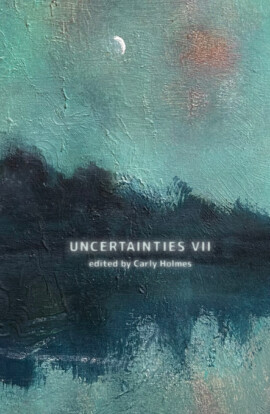
Cover art for Uncertainties 7 edited by Carly Holmes

Uncertainties 7 edited by Carly Holmes

Swan River Press 2024

ISBN: 0781783800506

Available: Hardcover

Buy: Swan River Press


This is the seventh volume in the ongoing anthology series published by the excellent Irish imprint Swan River Press, collecting “strange”, unsettling stories penned by writers from the UK, Europe and USA.


The first, successful, six volumes have assembled a number of noteworthy authors and editors, trying their hand at every possible subgenre of speculative fiction: ghost stories, horror tales, science fiction, fantasy and more.


And since it’s normal that not everything pleases everybody, I will point out the stories which, in my opinion,are the best in the present volume.


In the intriguing and sinister “Pond Scum” by Tyler Keevil, two brothers vacationing in Tuscany are involved in a scary paranormal experience revolving around an unusual pond. This is one of the very few cases of fiction in English  where sentences in Italian are reproduced  and spelled correctly…


“Sad Face”, by the prolific Mark Morris, is a disturbing, atmospheric piece where a widower searching for peace in a wild and secluded resort place ends up being literally engulfed in an unwanted embrace.


“The Winding of the Willows” by Steve Toase is an effective mix of horror and SF, depicting how the water of a stream brings about disease and death in a small village.


“The Good Old Days” by Craig Rosenberg is a kind of neat “ Twilight Zone” story, in which an Aussie man relocated to the USA has to face the past while taking a vacation back in his hometown.


I am looking forward to volume number 8.


Reviewed by Mario Guslandi


New Review: Black Moon: Graphic Speculative Flash Fiction by Eugen Bacon, illustrated by Elena Betti

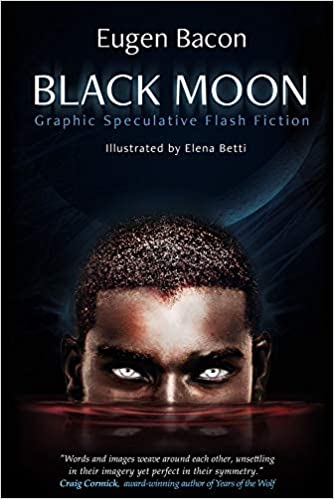
cover art for Black Moon by Eugen Bacon and Elena Betti

Black Moon: Graphic Speculative Flash Fiction by Eugen Bacon, illustrated by Elena Betti

IFWG Publishing, 2020

ISBN: 978-1925956658

Available: Paperback  Amazon.com )


With evocative illustrations and fabulous cover art by Elena Betti, the soft-hued blue pages of Black Moon by Eugen Bacon invite us to experience a pastiche of speculative poetry, prose, narratives and images. The titles of this collection of short pieces, such as “Cinders in Her Hair,” “Unlearning the Sea,” and “The Book of Unfinished Parables,” spark the imagination and tease the intellect. The widely diverse themes run from societal issues to personal experience and even fantasy. The tone varies from serious, to playful, to philosophical, to dark. Eugen clearly has eclectic interests and tastes and reveals them in an uninhibited, relatively unstructured fashion.


The poetic hybrids Eugen experiments with are definitely worth extra attention, but they seem to be in the middle of development. It is difficult to discern whether Bacon intentionally leaves the reader to her own devices in creating meaning in Black Moon or whether that effect is inadvertently caused by the writer’s artistic choices. Some of the pieces are quick snapshots of moments or ideas, but they do not include that particular magic of word choice or arrangement which little gems require. Other pieces are a bit longer and provide more context but seem unsatisfyingly without purpose or incomplete in some vague way.


Reading this book is like taking a stroll through a dream in which you recognize familiar objects but realize they are somehow out of context. It is also, at times, like reading a book in another language and trying to figure out a word you don’t know by comparing it to words that seem similar but end up having quite a different meaning. This abstract quality has its charm: eyes that are “serenading” and that are “shifting” “like an opal,” but sometimes it is just confusing: a window that “floundered” back to “her” house where she “locked herself to” tears.


Overall, Black Moon is a visual fusion that projects the author’s vision in such a way that the writer’s words become more concrete for the reader and the illustrations become more meaningful for the viewer. This is a natural synthesis that has the potential to evolve into a form that lovers of both poetry and art will enjoy.


Reviewed by Nova Hadley


Women in Horror Month: Of One Blood: The Hidden Self by Pauline Hopkins, edited by Eric J. Guignard and Leslie Klinger, introduction by Nisi Shawl

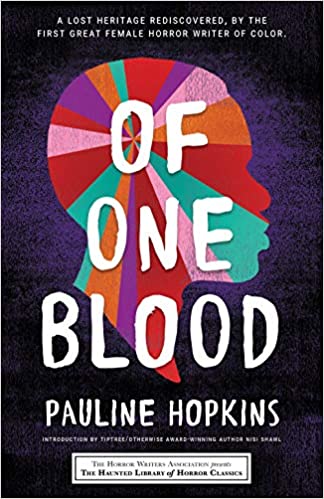
cover art of Of One Blood: The Hidden Self by Pauline Hopkins

Of One Blood: The Hidden Self  (Haunted Library Horror Classics) by Pauline Hopkins, edited by Eric J. Guignard and Leslie S. Klinger, introduction by Nisi Shawl

Poisoned Pen Press, 2021

ISBN-13 : 978-1464215063

Available: Paperback, Kindle edition


This new edition of Of One Blood is part of a series published by Poisoned Pen Press in partnership with the Horror Writers of America.  Author Pauline Hopkins was an African-American writer of the early 20th century,  and Nisi Shawl introduces the book, originally published in chapters as a serial in The Colored American magazine during 1902-1903, as an early speculative fiction novel combining the popular genre of “society novels” with a “lost world” narrative. revolutionary because the “lost world” is an advanced society consisting entirely of Black individuals, and promoting the thesis, novel at the time, that Africa is where the arts and technology have their origins.

Set in Boston in 1891 (my best guess based on the footnotes), Reuel Briggs is an impoverished medical student passing as white who is obsessed with the hidden forces of the supernatural and how to control them enough to reanimate the recently dead (shades of Victor Frankenstein). He is given the opportunity to put his theories into practice when the beautiful African-American singer Dianthe Lusk is killed in a car accident. While he is successful at bringing her back to life, she has lost her memory, and Reuel, his wealthy friend Aubrey, and Aubrey’s fiance Molly, set out to rebuild her into a new person. Molly becomes close friends with Dianthe, and Dianthe and Reuel fall in love and marry. To support her, he appeals to Aubrey for help in finding work. Aubrey, secretly in love with Dianthe, gets Reuel to sign on to a two year expedition to Africa to get him out of the way so he can marry Dianthe himself.

As Reuel journeys through Africa he sees its greatness, vividly described by Hopkins. The white men he is traveling with are surprised and at first dismayed to realize that African civilizations and peoples are the cradle of culture, as they have always believed that Africans were lesser than white people. Through Aubrey’s machinations, Reuel and Dianthe receive letters informing them that the other is dead, but while Reuel’s supernatural and mystical powers grow,  Dianthe feels more and more lost and traumatized, especially as she learns more about her tangled family tree.

There are many books now that deal with the intergenerational trauma, tangled family trees, and family separation caused by slavery, including Octavia Butler’s speculative novel Kindred,  Yaa Gyasi’s Homegoing, and Maisy Card’s These Ghosts Are Family.  In Of One Blood, we see a fantastical, awe-inspiring world, that contrasts the glories of African civilization rising again with the results of  the terrible treatment, taken for granted, of African-Americans. Dianthe in particular goes through unbelievable trauma: she is killed, re-animated, separated from everything she knows, nearly drowned, grieving a friend and a husband, and under tremendous pressure from Aubrey already, when the additional information about her family comes to light. In her case, it only takes one generation to destabilize her and poison her interactions with her environment. Shawl described this novel as science fiction, but to me it seems more to combine the “lost world”  utopian narrative Reuel experiences in Africa with the Gothic horror experienced by Dianthe.

Occasional footnotes are helpful in dating the time period of the book and understanding vocabulary and literary references. A brief but detailed biographical note about the author,  discussion questions, and a wide-ranging list of recommended further reading follow the story.

This is a good choice for readers interested in the beginnings of Afrofuturism and African-American speculative fiction and horror, Gothic horror, lost world and utopian narratives, and early 20th century African-American and women writers. In addition, Of One Blood would be a unique choice for the increasing number of book clubs focusing on anti-racist titles, which, in my experience, generally avoid genre fiction. Highly recommended.

Contains: incest


Reviewed by Kirsten Kowalewski