Home » Posts tagged "short stories" (Page 6)

Book Review: Miscreations: Gods, Monstrosities, and Other Horrors edited by Doug Murano and Michael Bailey

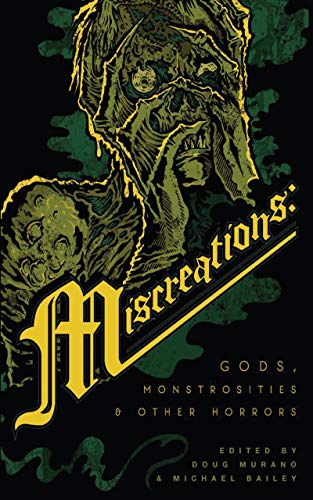
cover art for Miscreations edited by Doug Murano and Michael Bailey

Bookshop.org |  Amazon.com )

Miscreations: Gods, Monstrosities, and Other Horrors edited by Doug Murano and Michael Bailey

Written Backwards, 2020

ISBN-13 : 978-1732724464

Available: Hardcover, paperback, Kindle edition


In the foreword to Miscreations, Alma Katsu writes that “we’re told from childhood that monsters exist… we don’t need anyone to tell us they’re real”. Collected within the pages are 23 tales of monsters of all kinds, from the traditional to the unconventional, from the literary to the personal.  Interspersed is artwork from HagCult, who also did the cover art for the book.

Josh Malerman gives us a werewolf tale in “One Last Transformation” with an engaging, murderous narrator addicted to the change, and a number of writers approach the Frankenstein story in different ways. My favorites of these tales were Stephanie M. Wytovich’s poem “A Benediction of Corpses”  in which the Creature addresses his creator directly, and “Frankenstein’s Daughter”, by Theodora Goss, with its surprising and satisfying ending. Christina Sng takes an unconventional approach to an evil Russian water spirit in “Vodoyanoy”.

More personal monsters also appeared.  Michael Wehunt’s “A Heart Arrhythmia Creeping Into A Dark Room” was an effective and creepy tale about the anxiety and dread that accompany someone living in the shadow of a potential heart attack. The story was flawed by the author’s insertion of a fictionalized monster and victim in a story that was far too realistic. Victor Lavalle’s “Spectral Evidence” touched on the way grief lives on, and Scott Edelman’s “Only Bruises Are Permanent” tells the story of a woman who has the bruises left from an incident of domestic violence tattooed on her body.

Monstrous mothers also appear, in Joanna Parypinski’s brutal “Matryoshka”, in which a family tradition of giving each mother and daughter a matryoshka doll goes dramatically wrong, and Mercedes M. Yardley’s ironic “The Making of Asylum Ophelia”, in which a mother raises her daughter to resemble Hamlet’s Ophelia with plans to also replicate her fate.

Other strong stories I especially enjoyed include Nadia Bulkin’s “Operations Other Than War”, Usman T. Malik’s “Resurrection Points”,  Lisa Morton’s “Imperfect Clay”, and the disturbing “My Knowing Glance” by Lucy A. Snyder, which went in a much different direction than I expected it to.

Miscreations is overall a strong collection. The authors have come up with imaginative creatures using a variety of creative approaches, and readers will find sitting down with it well worth their time. Highly recommended.

Contains: murder, torture, violence, gore, body horror


Reviewed by Kirsten Kowalewski


Editor’s note: Miscreations: Gods, Monsters, and Other Horrors is a nominee on the final ballot for the 2020 Bram Stoker Award for Superior Achievement in an Anthology. 
Book Review: Conquer (John Conquer Series, Book 1) by Edward M. Erdelac

Bookshop.org |  Amazon.com )

Conquer (John Conquer Series, Book 1) by Edward M. Erdelac

Independently published, 2020

ISBN: 9798579334848

Available : Paperback, Kindle edition


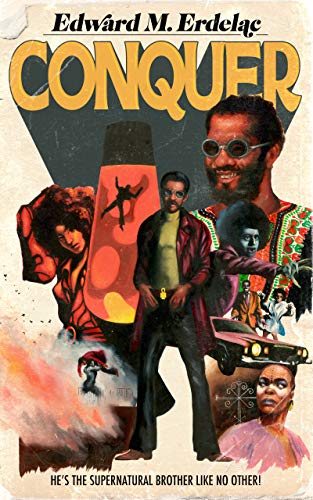
Harlem, 1976: an era of bad clothes, bad habits, and bad music.  From this scene emerges John Conquer, private investigator, and the baddest brother around.  How bad?  Well, “didn’t he kung-fu Frankenstein off the marquee at the Apollo, and bust him to pieces with John Henry’s hammer?  Didn’t he go fishin’ and catch the Creature from the Black Lagoon, and throw him back because he was too small!  He played ball with Dr. J in Rucker Park, and let him win!”  Conquer is a folk hero to Harlem, and his exploits have grown into legend among the locals.  These are his stories.


Conquer consists of seven short stories, three were previously published in Occult Detective Quarterly in 2017.  The stories are consistently entertaining, if a bit formulaic at the beginning of each story.  They usually start with Detective Lou Lazzaroni of the NYPD being assigned a case.  Lou realizes that the cases have a supernatural bent to them, and that’s where John Conquer steps in.  Although he’s a standard PI, Conquer also has a deep knowledge of voodoo, hoodoo, and all kinds of occult stuff, as he was partially raised in Louisiana, America’s capital of pagan weirdness.  It’s up to Conquer to solve the cases and save the day.


Author Erdelac has done a nice job writing a horror period piece: his portrayal of the late 1970s feels quite authentic, both in terms of setting (ox-blood leather coats, linoleum, lava lamps, etc.) and dialogue.  The dialogue feels very accurate with its terminology and phrasing, and does a good job transporting the reader back to another time in American history.  After Conquer is brought onto each case, the author shifts gears and shows a strong flair for creativity.  Readers might assume that voodoo automatically means zombies, but only one story actually has the undead.  Instead, Erdelac does a nice job cross-pollinating various African and Asian mythologies into the story.  Examples include a Slip-Skin Hag (or ‘boo hag’), a Popobawa (a bat-wing creature) and a monster based on Dahomeyan beliefs that defies easy categorization.  He did an excellent job researching these creatures for the book, but there are times when a little more explanation would have helped.  Unless you’ve read Wade Davis’s The Serpent and the Rainbow, terms like bokor, vodoun, veve, and Papa Legba are likely to sail over the heads of most readers, sending them scrambling for Wikipedia.


The stories are fast with no wasted time. Conquer dives right into the action, destroying villains with often-creative methods, such as cigarettes laced with sage for exorcising demons, and a pocket-coating powder that renders pickpockets immobile and subject to Conquer’s commands.  Part of the character’s appeal is that he doesn’t just blast away with his Colt Python, but often relies on his own magic methods to beat the baddies at their own game.  Special mention must be made of a fantastic secondary character, in the form of the ghost of a dead pimp that haunts Conquer’s car, and speaks to him through the radio.   This also allows Conquer to control the car through voice command, when the ghost agrees.  It’s like a bizarre 1970s version of the television show Knight Rider, and the back and forth squabbling provides unexpected and welcome hilarity.


Overall, Conquer is a welcome horror novel throwback to another era.  Let’s hope for more from Conquer and company in the future.  Recommended.


Contains:  violence, profanity


Reviewed by Murray Samuelson

Women in Horror Month: Drive, She Said: and Other Stories by Tracie McBride

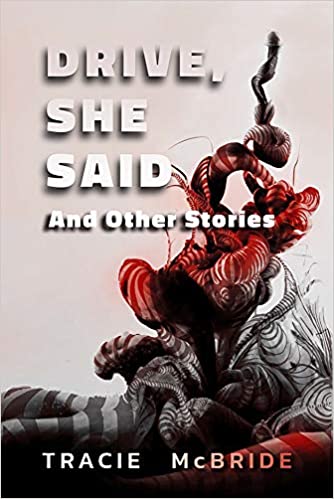
cover art for Drive, She Said by Tracie McBride

(  Bookshop.org |  Amazon.com )

Drive, She Said and Other Stories by Tracie McBride

IFWG Publishing Australia, 2020

ISBN-13: 9781925956689

Available: Paperback, Kindle


This book contains eighteen short stories of horror and dark fantasy written by the author. The tales feature women as protagonists, doomed heroines, and villains. While all the stories in this collection are well executed and well written, a few of them stood out above the others for me.


The tale “Breaking Windows” treats possession as a virus transmitted somehow through sight. Treatment is an ocular prosthesis that are programmed with demonic spectrum detectors. Jess’ partner, Leo, opts to get them implanted and he does his best to persuade her to do the same. As the statistics look grimmer, and a pregnancy test comes out positive, Jess must make her choice.


In “Ugly”, Janine has a growth on her face that, after treatment, continues to grow…and grow…and grow. This story in particular has some gruesome body horror involved.


In “The Changing Tree”, Sten, Liath, and the other boys of age are counting the days until ‘Changing Day’. The priestesses who guard the Changing House don’t allow anyone in the grounds unless they are chosen. All that Sten knows is that the chosen walk in boys and walk out as women. All of the women of the village had the same origin. What unfolds is a touching story of the two friends as they grapple with the changes of identity, gender, and sexuality.


Lara and Maxine are sisters who share a dark secret in “Slither and Squeeze”. The story opens on a subway with Lara trying to calm down an old homeless man who is yelling about a snake, disrupting other passengers. After she gets him calmed down, the sisters have a conversation about what to do about the situation. He witnessed the Change, something the sisters can’t abide. However, they are at odds about what to do: kill him or leave him as his words are only the drivel of a deranged old man.


In “Life in Miniature”, Michael is picked up by a middle-aged woman, thinking this will be some kind of favours traded for a meal and a shower kind of thing, but discovers too late that she has a more specialized use for him. She has so many realistic dolls in the house, but they do not look quite right around the faces.


This is just a small offering that Tracie McBride offers in her book. She has a concise way of writing her short stories that did not leave me wanting more at the end. I don’t want to say she ties everything up nicely at the end. That does not quite fit. It’s more like she provides just enough in each tale for the reader to digest. I will definitely be picking up more of McBride’s work. Recommended.

Contains: blood, body horror, sex


Reviewed by Lizzy Walker