Home » Posts tagged "short stories" (Page 3)

Into the Forest: Tales of the Baba Yaga edited by Lindy Ryan with a foreword by Christina Henry

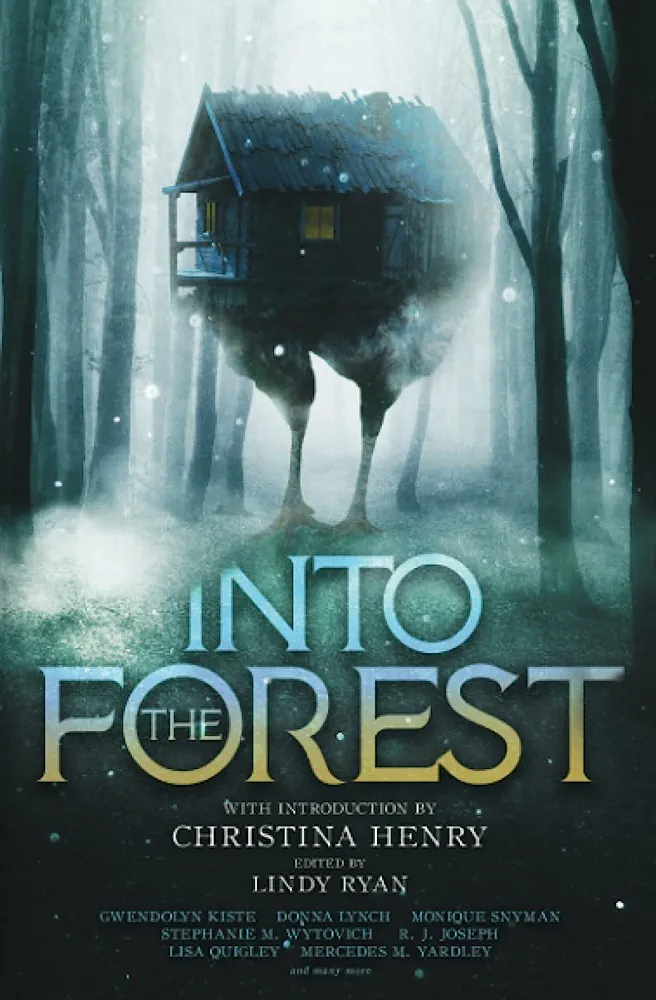
Cover art for Into the Forest; Tales of the Baba Yaga edited by Lindy Ryan

Into the Forest: Tales of the Baba Yaga with a foreword by Christina Henry, edited by Lindy Ryan

Black Spot Books, 2022

ISBN-13 ‎978-1645481232

Available: Paperback, Kindle edition, audiobook, audio CD  Bookshop.orgAmazon.com )


This anthology collects stories inspired by the Slavic folk character Baba Yaga, a child-eating witch with iron teeth who lives deep in the woods in a house with chicken feet, rides in a mortar and pestle, and can either help or hurt visitors, especially women, for a price, and depending on her whim. All the stories are by women writers of horror.


Standout pieces include Stephanie M. Wytovich’s vivid poem “Dinner Plans with Baba Yaga”; Gwendolyn Kiste’s “Last Tour into the Hungering Moonlight”, a real estate pitch that draws neighborhood women into the woods; Sara Tantlinger’s “Of Moonlight and Moss”, a fairytale that isn’t; “Wormwood” by Lindz MacLeod, and “Flood Zone” by Donna Lynch, both with the witch as justice-bringer, in very different ways; “Sugar and Spice and the Old Witch’s Price” is a dread-inducing counterpart to Kiste’s earlier story; “Herald the Knight” by Mercedes M. Yardley is Baba Yaga’s love story; Jill Baguchinsky’s “All Bitterness Burned Away” is an interesting reversal of Hansel and Gretel; “A Trail of Feathers, A Trail of Blood” by Stephanie M. Wytovich is a heartbreaking story that explores the true meaning of sacrifice; “Baba Yaga Learns to Shave, Gets Her Period, and Comes Into Her Own” by Jess Hagemann reflects the teenage girl’s experience of being trained to conform;  EV Knight’s memorable and powerful “Stork Bites”, in which Roe vs Wade has been dismantled, leaving an unusual method of illegal abortion, with disturbing consequences, as the only resort for ending a pregnancy; “Where The Horizon Meets the Sky” by R.J. Joseph is a sort of “Monkey’s Paw” tale; the vivid and gruesome “Maw Maw Yaga and the Hunter” by Alexandrea Weis; and the descriptive, poetic stories “Baba Yaga in Repose” by Heather Miller and “Shadow and Branch, Ghost Fruit Among The Lullabies” by Saba Syed Razvi.

There is a lot of variety in approach and interpretation. If you have an interest in Baba Yaga, witches, folklore, or supporting women writers, this is a collection to enjoy. Recommended.


Reviewed by Kirsten Kowalewski
Book Review: Attack From the ’80s edited by Eugene Johnson

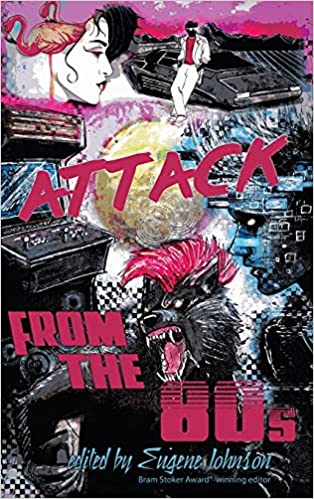
cover art for Attack from the '80s edited by Eugene Johnson

Attack From the ’80s edited by Eugene Johnson

Raw Dog Screaming Press, 2021

ISBN-13: 978-1735664446

Available: Hardcover  Bookshop.org  |  Amazon.com )


Eugene Johnson brings together 22 incredible short stories and poems as a fitting tribute to the horror of the 1980s. There is something for everyone in this collection. “Top Guns of the Frontier” by Weston Ochse, a strong open to this anthology, tells the story of friends coming face to face with an ancient evil. In “Snapshot” by Joe R. Lansdale and Kasey Lansdale, Gracie and Trevor, the famous Snapshot Burglars, rob the wrong house. Jess Landry’s “Catastrophe Queens” takes place on the movie set of an ’80s SS werewolf horror film. Pink fake blood starts to take over people…and anything it touches. In “Your Picture Here” by John Skipp, a couple decides to take in a double feature of horror movies only to discover one of the films is closer to the truth. Lee Murray’s “Permanent Damage” invites us to a bridal party at a salon that turns into a bloodbath. “Munchies” by Lucy A. Snyder is a great story about a group of drag queens and the terror that was Nancy Reagan who has come to deliver a check to the local high school’s antidrug drive.


No ’80s horror anthology would be complete without the topic of D&D. In “Demonic Denizens” by Cullen Bunn, friends at summer camp discover a new game to play after the counselors forbid them to play any more of that “satanic” Dungeons & Dragons. “Ghetto Blaster”, by Jeff Strand, presents Clyde, who is cursed to carry a rather heavy ghetto blaster until he learns his lesson about loud music in public spaces. Everyone, check your candy before reading “Stranger Danger” by Grady Hendrix. A group of boys, hell-bent on taking revenge on the Judge, discover an army of Yoda-costumed children who have their own havoc to create, with apples containing razor blades the treat of the night. In Lisa Morton’s “The Garden of Dr. Moreau”, a biology experiment on corn plants is a success, but it could be at a deadly cost for life on Earth.


Other authors in the anthology include Ben Monroe, Linda Addison, Thomas F. Monteleone, Tim Waggoner, Stephen Graham Jones, Vince A. Liaguno, Rena Mason, Cindy O’Quinn, F. Paul Wilson, Christina Sng, Mort Castle, and Stephanie M. Wytovich. Pick this up if you need a good dose of 80s horror reading. Highly recommended.


Reviewed by Lizzy Walker

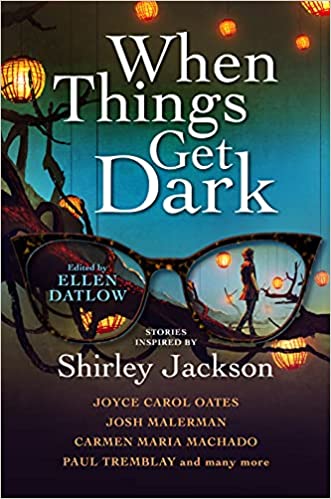
Book Review: When Things Get Dark: Stories Inspired by Shirley Jackson edited by Ellen Datlow

cover art for When Things Get Dark edited by Ellen Datlow

When Things Get Dark: Stories Inspired by Shirley Jackson edited by Ellen Datlow

Titan Books, 2021

ISBN-13 ‏ : ‎ 978-1789097153

Available: Hardcover, Kindle edition, audiobook Bookshop.org  | Amazon.com  )


Shirley Jackson couldn’t have known the impact her writing would have on the horror genre, speculative fiction, and literature in general: she was writing to pay the bills. Yet her work has resonated with readers and writers for both its depictions of domesticity, such as her fictionalized memoir, Life Among the Savages, and of the uncanny, seen in short stories like “The Lottery” and her most famous novels, The Haunting of Hill House and We Have Always Lived in the Castle (and sometimes both together). In When Things Get Dark, well-known anthology editor Ellen Datlow has collected tales by talented writers of horror, the uncanny, and the weird, inspired by Shirley Jackson’s work.


A number of stories take place within suburbia, with the uncanny just beneath a placid surface. Laird Barron’s “Tiptoe” focuses on uneasy family dynamics and the necessity of keeping up appearances, and “For Sale By Owner” by Elizabeth Hand, is a meandering story about three elderly women with a habit of breaking into empty summer houses who hold a sleepover in an empty, beautiful old house, which turns out to be a disorienting and disturbing experience. In Richard Kadrey’s “A Trip to Paris”, a nod to We Have Always Lived in the Castle, a recent widow planning her escape from her mundane life has her nefarious actions revealed by a stubborn, growing patch of mold on her wall, while Jeffrey Ford’s “The Door in the Fence” documents the strange and surprising changes in the narrator’s next door neighbor after her husband dies.


Some stories take direct inspiration from Jackson’s work, such as Carmen Maria Machado’s “A Hundred Miles and a Mile”, which references the “cup of stars” from The Haunting of Hill House, and stories such as “Quiet Dead Things” by Cassandra Khaw and “Hag” by Benjamin Percy that describe insular communities and their deadly rituals like the one in “The Lottery”.

With others, it’s sometimes hard to see the connection, although the stories are interesting. In Seanan McGuire’s dark fairytale “In the Deep Woods; The Light is Different There”, a woman escaping an abusive husband retreats to her family’s lake house, where she discovers the caretakers are not what they seem. John Langan produces a compelling, surreal tale of family, the occult, and mythological creatures in “Something Like Living Creatures”. In the dread-inducing “Money of the Dead”, Karen Heuler addresses the problems with resurrection and obsessive love; Joyce Carol Oates’ “Take Me, I Am Free” is a bleak, heartbreaking story about a child whose angry mother attempts to throw her away; in Josh Malerman’s dystopian “Special Meal”, a young girl discovers the difficulties, and consequences, of hiding knowledge. Genevieve Valentine’s “Sooner or Later, Your Wife Will Drive Home” is a cleverly constructed story about smart women in unlucky situations they can’t escape, something Jackson could certainly relate to. There were a few stories that didn’t hit the mark: “Funeral Birds” petered out at the end, “Refinery Road” and “The Party” left me confused, and “Pear of Anguish” didn’t seem to fit the theme or mood of the anthology.


While there are many excellent stories, the three that stood out to me were the previously mentioned “Tiptoe”; “Take Me, I Am Free”, a bleak, heartbreaking story about a child whose angry mother attempts to give her away; and Kelly Link’s “Skinder’s Veil”, a strange tale about a graduate student struggling with writing his dissertation who takes a housesitting job in rural Vermont, with the only rules being that anyone knocking at the back door must be invited in, but the front door should never be opened. Those who come to the back door are an unusual bunch, and the consequences of that summer are significant for him.


It’s not necessary to be a fan of Shirley Jackson to enjoy this book, but it does help, especially with Machado’s story, which depends on context from The Haunting of Hill House. If you do pick up When Things Get Dark without having read Jackson first, you will want to by the time you finish. Recommended.


Contains: self-harm, torture, suicide, murder


Reviewed by Kirsten Kowalewski