Home » Posts tagged "short stories" (Page 2)

Graphic Novel Review: Lovesickness: Junji Ito Story Collection by Junji Ito

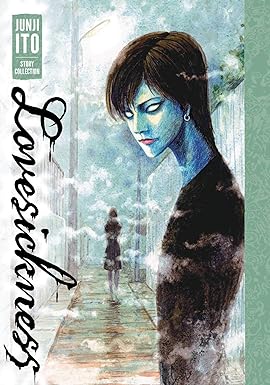
Cover art for Lovesickness: Junji Ito Story Collection by Junji Ito


Lovesickness: Junji Ito Story Collection by Junji Ito

Viz Media, 2021

ISBN: 9781974719846

Available:  Hardcover, Kindle edition

Buy: Bookshop.orgAmazon.com


In Lovesickness, originally published in 1996 and told in 5 parts, Ryusuke Fukuda and his parents move back to the town of Nazumi after his father accepts a job there. The story opens with a teenage girl approaching the crossroads of an empty street where a man is emerging from the fog. She quickly places her notebook over her face and asks for a fortune. The older man responds and they part ways. When the man meets his family at the Nazumi train station, it is revealed that he is Ryusuke’s father. He relates the story to his wife and son, the latter shaken by the chance meeting.


When he starts at school the next day, he is greeted by an old friend, Midori. Eventually the topic of rumors comes up regarding teenage girls committing suicide after encountering a mysterious handsome young man. Ryusuke, in an attempt to calm his own guilty conscience when he reveals a terrible fortune he gave to a woman in distress, which led to a grisly suicide, hunts for the shadowy figure delivering his own tragic fortunes to innocent strangers at the crossroads.


The artwork in Lovesickness is probably some of my favorite in Ito’s work. The effect of the fog and shadows is excellent, and the body horror is fantastic. The handsome stranger is eerily beautiful. The character design reminds me of Fukusuke from the visual kei band Metronome.


Four other stories are included in this volume. “The Strange Hikizuri Siblings,” told in two parts, are a strange family, often at odds with each other while still trying to support each other the best they know how… to a degree. The first story, “Narumi’s Boyfriend”, shows the cruelty of the siblings and how they all take part in driving Kotani, the titular boyfriend, albeit in a forced relationship, to madness. In “The Séance”, we see family power dynamics play out in the worst possible way, with the two eldest brothers being just awful people.


The next story in the collection, “The Mansion of Phantom Pain”, relates the story of Kozeki, a young man employed to be a live-in caretaker for Yusuke, the son of a wealthy family. Yusuke’s condition is a strange phantom pain that extends beyond his normal body. A team of caretakers who can never leave the bricked up mansion manage the boy’s pain, day and night. When they start to experience their own maladies, and the death of Yusuke’s father, his mother still refuses to let them leave. Some of the caretakers slowly succumb to infections and hallucinations, but those remaining can’t leave, with the promise of the family’s wealth at stake, no matter how much Kozeki pleads for doctors.


Following that is “The Rib Woman”,  a cautionary tale of rib removal surgery and  obsession with the perfect figure. Yuki laments the lack of an hourglass figure like her friend Ruriko’s, and decides surgery is the best option. Throughout the story, Ruriko is tormented by strange and discordant music. One evening Yuki and her brother, who is also dating Ruriko, find the latter in agony on the sidewalk as she is trying to find the source of the song. They offer to help, and when they do find the source, they see a mysterious woman in the park playing a small instrument. She flees and leaves behind her instrument, which looks to be a large rib. After Yuki’s surgery, she too can hear the music. She also finds the woman and discovers there is more to the story than she believed. There is some deliciously good body horror in this one.


The final story in the collection is the inexplicable “Memories of Real Poop.” It’s the shortest chapter in this collection, at only four pages, but it’s memorable. I’ll just leave it at that. Highly recommended.


Reviewed by Lizzy Walker
Book Review: More Deadly Than the Male: Masterpieces from the Queens of Horror edited by Graeme Davis

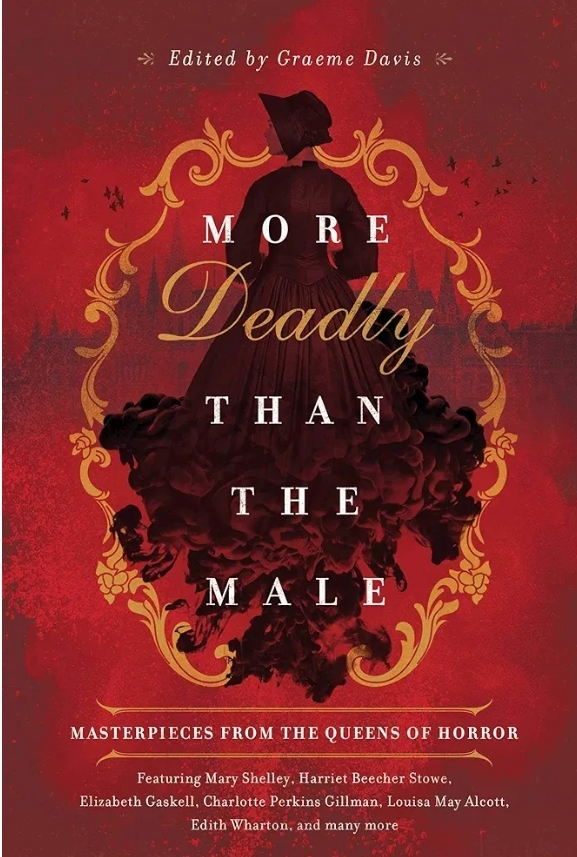
More Deadly Than the Male: Masterpieces from the Queens of Horror edited by Graeme Davis

Pegasus Books Ltd., 2019

ISBN-13: 9781643130118

Available: Hardcover, Kindle, audiobook, audio CD

Buy: Amazon.com


More Deadly Than the Male gives us 26 tales of terror written by women between 1830-1908. Some of my favorite Gothic and horror tales were written around this time period. Davis has selected some great stories in this anthology by well-known, and some not as well-known, women authors. In addition to select stories, Davis includes brief biographies with information about the authors’ lives and challenges they faced as women writers, and about the stories themselves. While I enjoyed all of the stories in More Deadly Than the Male, there are several that stand out. Some of my favorite tales include the following.


The volume opens with Mary Shelley’s “The Transformation,” in which Guido, seeking revenge, makes a deal with a monstrous being to trade bodies. What will become of the man trapped in a monster’s body?


In “Lost in a Pyramid, or the Mummy’s Curse” by Louisa May Alcott, Evelyn begs Forsyth to tell her how he came to be in possession of an ancient and strange gold box. He tells a tale of exploration, colonization, greed, hubris, and the mummy of an ancient sorceress and mysterious seeds found in the box.


Edith Nesbit’s “The Mass for the Dead” is a haunting story about a couple who change their history because of a vision. Jasper mourns that the woman he loves, Kate, is to marry someone else. When she reveals she is not marrying for love, but for wealth, he still insists that she should break her engagement. Out of familial obligation, she refuses to end the engagement in order to help her father with his finances. When she shares her vision of a mass for the dead with Jasper, they believe it to be a sign of her impending marriage. Later, when he reveals his own vision to Kate, they find they may have misinterpreted the vision entirely.


“The Vacant Lot” by Mary E. Wilkins-Freeman is a lovely ghost story. The Townsend family has decided to move to Boston, and the man of the house has purchased a home for a more than reasonable cost, originally $25,000 for a mere $5,000. The family wonders what the catch is with such a low dollar amount. After a month goes by, they find out. There are strange happenings in the vacant lot next door, and shadows moving about with nobody to cast them.


Other authors include Charlotte Perkins Gilman, Mary Austen, Elizabeth Gaskell, Edith Wharton, Eliza Lynn Linton, Margaret Oliphant, Vernon Lee, Mary Louisa Molesworth, Ada Travenion, Edith Wharton, and more.


It’s not new or controversial to say that horror is subjective. When we read the Gothic or older horror tales of the past, we may not be frightened, we may not get the spine tingles we are looking for or may scoff at the fainting or other what we would deem as “quaint behaviors” of the heroines. Descriptions tend to be much longer and go too far for modern audiences. I, for one, love Gothic and older horror stories, thanks to my late grandmother Phyllis, so these early stories were great to read. I just recently heard about a subgenre called “cozy horror,” and I believe these would qualify. Also, not only would this be a good addition to a Gothic fiction collection, but it would also be an interesting addition to a Gothic novels course.


Highly recommended

Reviewed by Lizzy Walker


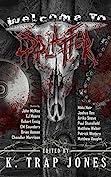
Book Review: Welcome to the Splatter Club, Vol. 1, edited by K. Trap Jones

Welcome to the Splatter Club, Vol. 1, by various authors, edited by K. Trap Jones

Blood Bound Publishing, 2020

ISBN: 9781940250434

Available: Paperback, Kindle edition  ( Amazon.com )


The main thing Welcome to the Splatter Club has in common with its sequel (Welcome to the Splatter Club, Vol. 2, previously reviewed here) is the high level of originality.  The thirteen stories are quite loopy, and are all over the place for plotlines.  However, it is an uneven collection: as good as the ideas are, a number of the stories don’t have enough bang and pop to keep the reader interested and the pages flipping at a quick speed.  The first half of the book is clearly the better half. The best stories include:


“23 to 46”: the most original, the most entertaining, and also the funniest.  The sperm housed in Matt’s balls suddenly start talking to him, and make his life impossible for the rest of the story.  They are mad he isn’t reproducing, and Matt has no interest in kids.  This is a hilarious romp that gives new meaning to the term ‘body politics.’


“The Woman in the Ditch”: A rural area legend, the blond woman only appears swimming in the ditch alongside country roads when there is enough rain, and of course it only happens in certain years.  What does she want?  Go to her and find out…but it may not be what you desire.  This could almost be a dark version of a Disney fairy tale.  


“Code Black”: Tired of juveniles committing heinous crimes and getting away with them due to an overly liberal justice system?  So are the people of Trapper Valley, especially when a kid unleashes a monster from the Abyss.  However, this town has Code Black…which will do what the justice system won’t.  


“Dickey Dykstra”: Ever wanted to beat the tar out of your boss, just because he’s a total jackass?  So does a certain employee, but his boss, the aforementioned Dickey, has problems WAY bigger than being a dick at work.  Let’s just say they involve hobbyhorses, and prepare yourself for the unexpected.  When Dickey’s secret comes to light, he makes Leatherface seem like a normal, well-adjusted human being.


“The Big Bad Boy”: We all know that Twinkies, Snowballs, and Ho-Hos are never going to be found in the FDA’s food pyramid for a balanced diet, but what happens when they really will kill you?  One poor convenience store clerk is going to find out.


There are a few other good ones, but there’s also a chunk of stories that just don’t quite do it.  When it’s good, it’s quite good, but the lackluster ones are frustrating.  If you’re on the fence about buying this, just go for Vol. 2 in the series instead, which is a “can’t miss” collection of stories.


Reviewed by Murray Samuelson