Home » Posts tagged "series books"

Knight of Gaelgara: War of Souls Apocrypha Book 1 by Gary J. Martin

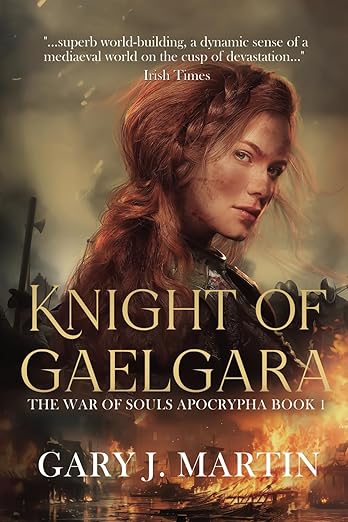
Cover art for Knight of Gaelgara by Gary Martin

Knight of Gaelgara: War of Souls Apocrypha Book 1, by Gary J. Martin

Temple Dark Publishing, 2024

ISBN: ‎ 9781738467617

Available: Paperback, audiobook, audio CD

Buy: Amazon.com | Bookshop.org


Knight of Gaelgara is yet another stunning debut to a series published by Temple Dark Publishing. It’s firmly set in the realm of medieval fantasy and contains some of the elements that made the Game of Thrones series so enjoyable. With a layered narrative, numerous characters, and a feeling true to life of the medieval period, this is one the Thrones fans will not want to miss.


A simple synopsis of a complex plot is that Sir Rosalind Radsvinn, newly anointed knight, returns to her home, the portside city of Akkson. The city is ruled by her father, Baron Feylan Radsvinn, on the continent of Gaelgara. In a torrid 48 hours, the city is torn apart by the combined assault of invaders from the outside, and the internal strife and rebellion of the people of Akkson.


There is a LOT going on in the book, but I don’t want to give it away. The story is written in third person, but told from the perspective of multiple narrators, each with their own agenda for the city of Akkson. That’s where the plot complexity comes in: few of the characters are united in how they view things, and that keeps the narrative engrossing. There are loyalists, flat-out traitors, and those on the fence, and the author makes sure to provide reasons for each. The main turncoat out to destroy the Baron’s family may be a bad guy, but he certainly has some justification for what he does, even if you don’t agree with it. Many of the characters are written in shades of gray, and it’s what keeps the story so interesting. The Baron’s family alone is a study in dysfunction. Rosalind remains loyal to her father, Baron Radsvinn, although he hasn’t done a good job of running the city, while her brother, Ulrik, is an opportunist who may swing to either side, depending on how it benefits him. From the top-level characters to the basic foot soldiers, all the characters are complex and feel true to life. Thankfully, there is a character appendix at the beginning of the book for readers who start to feel overwhelmed by the scope of it all.


As far as the writing, this is seriously immersive stuff that will make you think the author must have lived through the period. It feels real, from the trebuchets and ballistae being used to destroy the city walls, to the hard, messy, and ugly battles. These are not glamorous battles like in movies: people get stabbed through the armpits or under the chin through the skull, the kind of places a warrior would actually target, since they are unprotected. It’s the same with the characters that use war-hammers: they go for the joints, and crush them. It’s a good reminder that medieval warfare was hardly honorable. It was unpleasant and a bloody mess. Interesting note: poison gas is actually used as a siege weapon in the book, a very creative touch. There are also some well-written naval battles in the book, something medieval fantasy writers rarely include. Truth be told, these might have been my favorite battle scenes of the book.


What also sets this one apart from the others are the original touches in terms of humanoids. The character Thorn is a cougari, a cat-man humanoid, and the Whale Riders are water-breathing humanoids who live in the ocean and ride into battle on whales decked out in armor. Those races add an interesting new element to the medieval style. Let’s hope the Whale Riders keep playing a role, as they were one of the best parts of the book

.

Bottom line: for the readers that felt a void in their lives when it became apparent that the Game of Thrones series will probably never be finished, fear not. Gary J. Martin is here, and continues the genre in his own spectacular, original, fashion. This one makes my list of “can’t miss” titles for the year, alongside Ishmael Soledad’s Diathesis, Christopher Micklos’s Tick Town, and J.R. Konkol’s The Guardian’s Gambit. Now, let’s hope we don’t have to wait ten years for the next installment in this series! Beyond highly recommended.


Reviewed by Murray Samuelson


Book Review: Summer at East End: Double Eclipse by Melissa de la Cruz

Summer at East End: Double Eclipse by Melissa de la Cruz
G.P. Putnam’s Sons Books for Young Readers, 2016
ISBN-13: 978-0399173561
Available: Hardcover, Kindle edition

Double Eclipse is the second book in Summer at East End,  a YA spinoff series of Melissa de la Cruz’s adult urban fantasy series Witches of East End, which was about three sisters who discover they are Norse goddesses with witchy powers. Summer at East End  takes place ten years later and focuses on their teenage nieces, twin daughters of Thor, Mardi and Molly, who are human/goddess hybrids. As background, Norse gods and goddesses live as humans, and when they die they are reincarnated in another human body without memories or powers; these manifest in their teen and young adult years in a process called Reawakening. Mardi and Molly are brand new goddesses in their first lifetime, so they’ve never had to go through this and won’t acquire “grown-up” memories like the other gods do, because they don’t have them.  The premise of this book is that the girls learn their mother is the famous tennis player Janet Steele, who moves to East End after purchasing their family home and throwing their relatives out of the house, on the pretense of developing a relationship with her daughters.

I wasn’t sent Triple Moon, the first book in the series, but Double Eclipse does a fairly good job of standing on its own (although I have read the original Witches of East End books, and without that background I might be lost, so for teens unfamiliar with the previously written adult series or the television show, it might be more important). Unfortunately, even given the background from the previous series (which I enjoyed) I found this book to be disappointing.

I think a large part of the problem is that it’s difficult to relate to the characters. The sweet twin/bad twin trope can work and even be kind of fun, which is what makes the Sweet Valley High books work. It can even work when the girls in question are ridiculously wealthy (like the sisters in Hotlanta) but on some level, the characters have got to be relatable, and have at least a semblance of a believable relationship with each other. Twin Molly is the sweet one interested in fashion, makeup, and boys. She’s also easily bought by Janet, instantly loving her and moving in without a second thought, especially after she’s offered expensive shopping trips and the use of a Maserati. Mardi is the cynical one, suspicious of Janet’s sudden interest, particularly since she’s evicted Mardi’s boyfriend (yes, there’s an ick factor there, in dating one of your relatives who just happens to be reincarnated into a seventeen year old boy’s body). Caught in the middle is cute boy Rocky McLaughlin, who is carried away by Molly’s sweetness (and her Maserati) and baffled when she stops texting him. Due to misunderstandings over said cute boy and a spell cast over everyone’s cell phones, disaster ensues.

Molly, as the “good twin” is supposed to by a sympathetic character, but she was totally insufferable and so superficial and self-centered she almost forgot that her boyfriend was grieving his mother. Mardi was slightly more likable, but her rebelliousness basically consisted of “I don’t wear makeup” and grudgingly working in a sandwich shop while hitting on her sister’s boyfriend, after she spent most of the book moping over her boyfriend breaking up with her when he realized the essential “ick” factor of his dating a teenager. Also, much of the plot hinged on a lack of communication between the two girls. While they weren’t in constant contact through texting, nobody ever suggested they meet face-to-face, although they actually lived on the same small island, interacting with the same people. It also seemed unrealistic that their only same-age peer was the boy they were fighting over. As a side note, these two girls were constantly being offered alcoholic drinks by their relatives, and sucking them down as if this were no big deal. Even in fiction, yes, it totally is. They aren’t in school anyway, so why not just make them 21?

Honestly, having read both her adult fiction and her children’s books, I expect better from de la Cruz. She had a great opportunity here to take advantage of a growing young adult interest in books with mythological settings, thanks to Rick Riordan’s expansion into the world of Norse mythology, the Loki’s Wolves series by K.L. Armstrong and M.A. Marr, and Kate O’Hearn’s Valkyrie, and I feel that she really squandered it by turning it into a series about two material girls who also happen to be goddesses, rather than digging deeper into the mythology and providing a little more action, character growth, and connection to the mythology, or even just exploring more of their family connections. I hope there’s more to the next book than there is to this one. However, with Melissa de la Cruz being as popular as she is, and with the interest in Witches of East End, it probably will be in demand.

Contains: mild sexual situations, violence

Reviewed by Kirsten Kowalewski


Halloween “Chapter Books” for Children and Tweens

In setting out to put together some lists of suggested Halloween chapter books, I discovered I’d already done it. These are a few years old, but classics remain classics. Check these out if you’re looking for Halloween reading for your school-aged independent reader. And if you have suggestions for an update, let me know!

“It Happened At Halloween”” is a list of chapter books with pivotal scenes that take place at Halloween. When I wrote it, I recommended these for ages 10-14, but at this point I’ve read The Egypt Game with my daughter, who is 9, and I think the age range for these books is more like ages 9-12. Your mileage may vary.

“Halloween Scares for Beginning Series Readers” lists mildly scary series books written for independent readers in the early grades and individual titles in a children’s book series that take place at Halloween.

“Halloween Book List for Kids”: This list is sort of a mess, because our “kids” section is for ages 0-12, and obviously there is a huge difference between what a baby and a 12 year old want (at least as far as reading material is concerned). There are lots of titles listed, and these include picture books, chapter books, and nonfiction. Some have been reviewed and some haven’t been. There are plenty of Halloween-related titles here, but there are also books that aren’t specifically Halloween themed that might be fun to read at this time of year. This is actually a different list than our “Scary Books for Kids” page, although some titles can be found in both places.

And a little encouragement here to read with your kid (or any kid) this month, from Spook House Dave and Monster Librarian.

Enjoy!