Home » Posts tagged "Satanic Panic"

Book Review: That Very Witch: Fear, Feminism, and the American Witch Film by Payton McCarty-Simas

cover art for That Very Witch by Payton McCarty-Simas


That Very Witch: Fear, Feminism, and the American Witch Film by Payton McCarty-Simas

Luna Press Publishing, 2025

ISBN-13: 9781915556608

Available: Paperback, Kindle edition

Buy: Bookshop.org | Amazon.com


Payton McCarty-Simas’ That Very Witch: Fear, Feminism, and the American Witch Movie analyzes the cinematic witch’s evolution and relationship to feminist movements from the 1960s to the 2020s. Using historical, social, and feminist models for basis of analysis, they examine how the witch became viewed as both the feminist representation of empowerment and fear. McCarty-Simas’ analysis of the witch film reveals how the witch has been portrayed over time, reflecting significant changes in American culture and politics.


A brief history of early European witches, and their associated witch hunts, or “crazes,” driven by bigotry, misogyny, and racism, creates the basis for the contents of the book, as these are central to the concept of the witch. The author addresses the concept of the witch as a symbol in feminist circles, what can be learned from various witch cycles through history, whether witches through time can be considered feminist figures, and more, in their analysis of witch films.


In Part 1, “Season of the Witch: The Countercultural Witch Films of the Long Sixties,” the author explores witch films from 1960 through 1973, including the birth and death of the witchsploitation film in the context of the sociopolitical climate of the era. Part 2, “Unpleasant Dreams: Feminism, Satanic Panic and the Witch Films of the 1980s,” takes the reader through the rise and decline of the Satanic Panic. McCarty-Simas expands on how this era’s witch films responded to the earlier witch cycle film, the Panic’s effect on the figure and evolution of the witch and Satan, and antifeminist rhetoric pushed by conservatives that the role of working women, as well as the innovation of home video technology and the VHS, were to blame for Satanic cults lurking around every corner. Particularly interesting in this section is that McCarty-Simas highlights the “Satanic Panic specials,” framing them as horror comedies. For readers who have seen clips or the full version of such shows, you know why the author includes these as horror comedies. Over-the-top “reporting,” alleged experts on Satanic Ritual Abuse who spread disinformation, and decrying explicit material in horror movies while in the same show describing in great detail what happened to alleged victims, are just a few of the reasons the author correctly includes them here.


“Interlude: Notes on the Postfeminist Witch Film (1990-2013)” focuses on the witch film in terms of Third Wave feminism, Riot Grrrls, girl power, the commodification of witches to teenagers, and the bitchification of the witch. The author presents an insightful analysis of
The Craft a
nd its overall failure at intersectionality, and discusses girl and women witches in the Harry Potter franchise. The author includes some television series from this time period as examples of dark fairy tales, highlighting American Horror Story: Coven and its successful portrayal of feminism, race, and intersectionality.


Part 3, “Gender, Genre, Psychedelics, and Abjection in the 2010s ‘Witch’ Horror Cycle,” examines 2010s witch films, tying the “demonic woman” to the cycles in previous chapters. A major visual the author uses as a tool for analysis is the smile of the heroine or final girl at the end of horror films, comparing them to how the meaning of this expression can be interpreted on the face of a witch at the end of her film.


I would be remiss if I did not address a significant issue with the text, that being the “Works Cited” section. There are links that point the reader to academic library databases where an account is needed to access the articles or books, Google Books links, and broken links, rather than using DOIs (digital object identifiers) or stable URLs. Correct citations bolster the text and provide readers with further information. This includes directing readers to the resource itself.


Regardless of the problems with the citations, That Very Witch would be a good resource for readers interested in the history of the American witch film in terms of particular political climates, social movements, and historical context. It provides an extensive film and mediography that has increased my watch list. Recommended.


Reviewed by Lizzy Walker
Graphic Novel Review: Let Me Out by Emmett Nahil, illustrations by George Williams

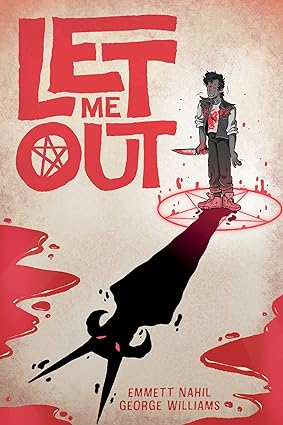
cover art for Let Me Out by Emmett Nahil


Let Me Out by Emmett Nahil, illustrations by George Williams

Oni Press, 2023

ISBN: 9781637152362

Available: Paperback, KIndle edition

Buy: Bookshop.orgAmazon.com


It’s 1979. Mitch wakes up after a terrible assault near the local Y. His friends scold him for going there alone and take him home to recuperate. There’s also been a murder in the quiet suburb of Columbiana, New Jersey. The body of Pastor Holley’s wife, Kelly, has been found with demonic sigils carved into her body.


New Jersey Sheriff Mullen and FBI Agent Garrett partner up to investigate the case. At least, that’s how it appears to the locals. Behind the scenes, they are devising a Satanic Panic cover to conceal their own crimes. They set their sights on a group of queer punks; Mitch, Lupe, Terri, and Jackson.


Sheriff Mullen hears a rumor that Pastor Holley records extra sermons for himself, and confronts the priest about them. It takes a little convincing, but Father Holley turns over some of the tapes to be played on the local radio station. A federal agent issues a warning, announcing the lurid details of satanic rituals, and asks teenagers to keep an eye out for anyone different. After a violent altercation between Lupe and the manager on duty at the local grocery store, the authorities quickly pin Kelly’s murder on the teens. When the friends flee to a cabin in the woods, they find the building gone and a bloodstained pentacle embedded in the ground. Mitch knows they aren’t alone out there.


I love a good Satanic Panic plot. With a diverse cast of characters, each with a unique personality and story, Let Me Out has a unique angle on the “devil in the details”. There is good LGBTQ+ representation, as well as people of color. There are parents and adults who are not accepting of their children, which is difficult to stomach, but is a painful reality some LGBTQ+ teens face. As hard as it was to confront on the page, I am glad that Nahil didn’t shy away from that. The character designs were really good and well rendered, as were the backgrounds and sweeping landscapes.


Nahil and Williams opted to include trigger warnings at the beginning of the book. I know there have been conversations in the horror community about the idea of including these warnings in general. My view is that if it makes someone’s enjoyment of a book better to have a warning, I have no problem with that. For those of us who are library workers, we are probably familiar with Ranganathan’s Five Laws of Library Science. Content warnings align well with three of the five laws: every reader their book; every book its reader; and save the time of the reader. Highly recommended.


Reviewed by Lizzy Walker

 

Book Review: Litani by Jess Lourey

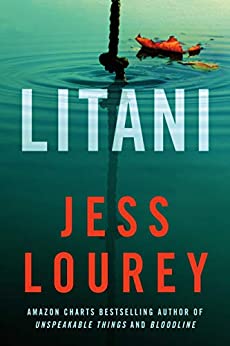
cover art for Litani by Jess Lourey

Litani by Jess Lourey

Thomas & Mercer, 2021 (release date: Oct. 19)

ISBN: 9781542027014

Available: Paperback, Kindle edition, compact disc, MP3   Bookshop.org  |  Amazon.com )


Set in the mid-1980s, Litani is a mystery/thriller dealing with the unpleasant subject of child molesters, but the book is couched into language that will work for younger readers.  While written for adults, it has value as a “crossover” title to the young adult crowd. Fourteen-year-old Francesca “Frankie” Jubilee moves in with her mom after her dad’s untimely demise.  She is quickly beaten up by three 10 year old girls. The girls allude to The Game, something many kids know about and fear.  Frankie finds her town to be one with an unpleasant past that centers around children that have gone missing over time.  The story follows a fairly predictable path, with Frankie trying to find the truth, and getting it in bits and pieces.  There’s a minor story thread of Satanism, but it’s really just window-dressing and could have been left out.  There’s a big reveal at the end to explain it all, and everything ends up okay, more or less.


The writing is simple and to the point, and the plot devices are familiar: Frankie’s past may have secrets, she makes one friend with a troubled past of his own, she doesn’t get along with her mom due to her being absent from her life for years, etc.  The Game itself is no big mystery, and most of the characters act in a pretty predictable manner. The predictability and basic nature of the writing may not be enough for adult readers to get caught up in the story, but for high school kids, it’s perfect. Entertaining enough to keep teens enthralled, there’s mystery, some excitement, a dead body, characters that kids will understand, and nothing too violent or graphic.  Example: while some of the characters are child molesters, the author wisely doesn’t use any graphic firsthand descriptions of molestation.  Same goes for the Satanic angle: no elaborate ceremonies or sacrifices, just a few pentagrams and candles.  It takes skill to write about vile subjects for a younger age bracket, and Jess Lourey does it extremely well.  The violence is also mild: a couple fights, a rock to the head, nothing over the top.  All of the above and the straightforward nature of Litani make it a good choice for teen readers.


Recommended for high school readers.


Reviewed by Murray Samuelson