Home » Posts tagged "neurodivergent character"

Book Review: Blood Cypress (Selected Papers from the Consortium for the Study of Anomalous Phenomena #7) by Elizabeth Broadbent

Blood Cypress (Selected Papers from the Consortium of Anomalous Phenomena #7) by Elizabeth Broadbent

Blood Cypress Selected Papers from the Consortium for the Study of Anomalous Phenomena #7) by Elizabeth Broadbent.

Raw Dog Screaming Press, 2025

ISBN-13 ‏ : ‎ 978-1947879881

Available: Paperback, Kindle edition

Buy:  Bookshop.org. |  Amazon.com


The swamp has always been a welcome setting for horror – and why wouldn’t it be? The sucking humidity, the stifling embrace of the flora, the mystery of what’s behind the next shadow as the sun is erased from its world… It’s home to many a southern gothic, and for good reason. Nobody knows what lies within, and those who have experienced it are often too frightened to speak of it.


In Lower Congeree, South Carolina, there’s a rule most people are wise enough to follow stay out of the swamp.


The Carson family is a reflection of the hard truths in many of our homes. The relationships are strained, although some semblance of love creeps through their the interactions. As a bisexual girl in a backwoods town that is a stronghold of repressed sensibilitiies, Lila struggles to survive in the backwoods town, and aches to break free.


Lila’s world twists like the tangled roots that grow in the swamp when her ten-year-old brother, Beau, vanishes. Nobody cares much about a neurodivergent boy who many believe is useless, especially a Carson. Lila is reminded quickly that ignorance in the town has more in common with the society of a hundred years ago than in the current day, from the sheriff to her delinquent mom to the townsfolk, and realizes that her journey will be a solo endeavor. She will have to break that cardinal rule if she is to find Beau alive.


Broadbent entered the horror fray with Ink Vine, a stunning entry into what hopefully will be a long career.  Her greatest strength is the ability to breathe life into the setting and listen to how it speaks to the characters and readers. She harnesses the dark magic of the swamp and lets it become a major character, one that is ambiguous, untrustworthy, and dangerous. Its embrace is sought by some but feared by most.


As a journalist, her words hit the mark. In the novella form, this works perfectly. Everything matters and she is able to succinctly capture the flavor of this rotted southern town with apparent ease.


At this length, Broadbent shines. It gives her just enough space to explore and resolve the multiple conflicts within the story: the inner family tension, the dynamics of small-town life, and the apathetic darkness of the swamp, and allows the misfit Carson family and their secrets to grow. It’s a claustrophobic but intriguing read.


Comparisons have been made to Flannery O’ Connor, but Elizabeth Broadbent has her own style. Think Darcy Coates by way of Crista Carmen and Michael McDowell.


Raw Dog Screaming Press always produces quality products that sidestep the typical trappings of genre. As the seventh installment in the Selected Papers from the Consortium for the Study of Anomalous Phenomena series, this is a highly recommended reading, and their decision to bring Broadbent into the stable works just right.


Reviewed by David Simms
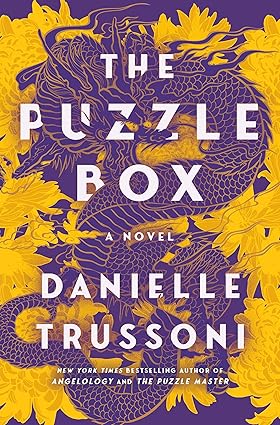
 

Book Review: The Puzzle Box by Danielle Trussoni

Cover art for The Puzzle Box by Danielle Trussoni

The Puzzle Box by Danielle Trussoni

Random House, 2024

ISBN: 9780593595321

Available: Hardcover, Kindle edition

Buy: Bookshop.org  |  Amazon.com


Part mystery, part puzzle, and all thrills, The Puzzle Box is a knockout.  For all those that loved The Da Vinci Code, this one’s for you.  With maddening puzzles, a genius as the protagonist, and a wild pursuit around the country of Japan, it’s just as good, and in some ways, better.


The lead, Mike Brink, is a mathematical genius with an eidetic memory, who gained his ability after a brain injury.  It’s called “acquired savant syndrome”, and it’s a real thing.  Mike is contacted by the Emperor of Japan for help in solving a sacred puzzle box that has bedeviled the imperial family for centuries.  Inside may be a secret important to the future of Japan as a nation.  The problem is that the puzzle box is not only difficult, it’s lethal.  If Mike makes a mistake opening it, he can’t try again: he won’t be around for another attempt.


What makes this a great story?  The pace is frenetic: it never slows a whit, right up to the end.  The author does an outstanding job of incorporating the history of  Japanese emperors, shoguns and samurai into the story.  The book’s setting, with ancient shrines, forgotten buildings, and snow-covered bamboo forests, is the perfect backdrop for a treasure hunt, much better than just using a series of cities, as in The Da Vinci Code.


The pursuit angle adds urgency to the pacing, as the Emperor isn’t the only one interested in the puzzle box contents.  Artificial intelligence is a big part of the chase, and the story credibly shows how AI can easily be more dangerous than any mortal element in our technology-enslaved world.  A cautionary tale, perhaps?  As for the puzzles… it’s more than the puzzle box itself:  that’s just the start of the clues that lead Brink and his cohorts across Japan, racing to beat the clock.  There is a window of time that the puzzle can be solved in, which helps drive the book’s pacing even faster.  The puzzle box itself doesn’t do anything magic, but it’s just as dangerous as the Lemarchand Configuration from the Hellraiser series.  Mistakes opening the box (and some of the other puzzles) can lead to amputated digits, poisoning, and more.  The puzzles are the perfect backbone to build one hell of a thrill ride on, and The Puzzle Box is all of that, and more.


What more do you really need to know?  The chances of readers not liking this book are approximately zero. It should take the country by storm the way The Da Vinci Code did…and that’s the BOTTOM LINE!  Highly recommended.


Reviewed by Murray Samuelson