Home » Posts tagged "media tie-ins" (Page 10)

Women in Horror Fiction: Barbie Wilde

Image of Barbie WildeThe horror genre actually has the capability of being a welcoming place for women, because it offers opportunities for participation in a variety of approaches to the genre. Barbie Wilde is an example of a woman who has successfully transitioned from acting to writing, with her role as the Female Cenobite in Hellbound: Hellraiser II leading to the publication of her short story “Sister Cilice” in Hellbound Hearts, an anthology themed around the Hellraiser mythology created by Clive Barker, on which the movie franchise is based. Barbie has since published short stories in a variety of anthologies and recently came out with a book, The Venus Complex, which we reviewed here. It’s great to see the horror genre lifting up women in the horror community so that they can take advantage of all it has to offer, and I can only hope that not only continues, but becomes much more common.


1. Can you give our readers a brief introduction?

My name is Barbie Wilde. As an actress, I’m best known for playing the Female Cenobite in Clive Barker’s cult horror movie, Hellbound: Hellraiser II. I’ve also appeared in Death Wish 3Grizzly II: The Concert (along with then unknowns George Clooney, Charlie Sheen and Laura Dern) and numerous TV shows in the UK as either an actress, a mime artist or a host-presenter.

So far, I’ve written eight short horror stories published in eight different anthologies, as well as my debut dark crime-real life horror novel,The Venus Complex. Fangoria magazine has called me “one of the finest purveyors of erotically charged horror around.” (My mother would’ve been so proud, I’m sure!)


2. Why do you write horror?  What draws you to the genre?

I didn’t actually start out as a horror writer. I was always more interested in crime, particularly the psychology of the scariest monster on the planet: man.

Then Paul Kane (who interviewed me for his book, The Hellraiser Films and Their Legacy) asked me to contribute to an anthology that he was editing with Marie O’Regan called Hellbound Hearts. All the stories in the antho had to be based on Clive Barker’s mythology that he created for his novel, The Hellbound Heart, which the Hellraiser film franchise is based on.

When Paul contacted me about writing a horror story, I was initially reluctant, as I didn’t think I could write horror. However, two weeks later, I finished my first horror story, “Sister Cilice”, about the making of a female cenobite. I’m actually planning a Cilicium Trilogy and the second part, “The Cilicium Pandoric”, is appearing in Fangoria’s Gorezone #30.

So quite a few horror stories down the line, why am I drawn to the genre? I think that there is a great leeway for your imagination to take flight in horror. You can use all sorts of mythological, literary and historical research and then turn these sources into something (hopefully) unique. Also, I was very influenced and disturbed by horror and science fiction movies when I was a kid and they made their mark on me, fueling all sorts of uneasy and paranoid fantasies. Movies like The Thing From Another World (1951), Invaders from Mars (1953), Psycho (1960), The Innocents (1961) and The Haunting (1963) made a big impression on me. And of course, TV shows like The Twilight ZoneThe Outer LimitsOne Step BeyondDark Shadows and Night Gallery were also very influential.


3. Can you describe your writing style or the tone you prefer to set for your stories?

I like to keep things as simple as possible– I love spare and muscular writing. [See influences below.] There is a strong erotic thread through my stories, which I’d like to think is more sensual than romantic. Also, even when I’m writing about the most horrific crimes and events, there is always a sense of humour in there somewhere.


4. Who are some of your influences?  Are there any women authors who have particularly inspired you to write?

Influences: Rod Serling, Raymond Chandler, Dashiell Hammett, Hemingway, Clive Barker, Colin Wilson (for his crime non-fiction, like The Criminal History of Mankind and The Order of the Assassins).
Influential women authors: Patricia Highsmith, Shirley Jackson and Margaret Atwood. I’m also inspired by writer-directors such as The Soska Twins, Jovanka Vuckovic, Mary Harron, Kathryn Bigelow and Ida Lupino.


5. What authors do you like to read?  Any recommendations?

All of the above authors, as well as Paul Kane. I just finished his latest compelling novella Rainbow Man and really enjoyed it. Other Kane books that I can recommend are The Gemini Factor and Red. All of Paul’s books are written so beautifully and so descriptively that you can just imagine movies been adapted from them. I also love the work of John Skipp and Craig Spector. Their novel, Light at the End, was a very cool and unusual take on the vampire genre.

My top pick of 2013 was the evocative and brilliant written Whitstable by Stephen Volk. The main character of the novella is Peter Cushing and it’s almost spooky how Stephen has channeled Cushing as a character in the story.


6. Where can readers find your work?

You can buy The Venus Complex as a paperback and Kindle on all the Amazons, as well as Barnes & Noble (online only). All the short stories that I’ve written are available in the following anthologies on Amazon. Most are published as both paperback and Kindle:
“Sister Cilice” (Hellbound Hearts)
“Uranophophia” (Phobophobia)
“American Mutant: Hands of Dominion” (Mutation Nation)
“Polyp” (The Mammoth Book of Body Horror and as a reprint for The Unspoken)
“A is for Alpdruck” (Demonologia Biblica)
“Z is for Zulu Zombies” (Bestiarum Vocabulum and as a reprint for Gorezone #29)
The following stories will be available soon:
“The Cilicium Pandoric” (Gorezone #30)
“Botophobia” (Phobophobias)


7. Is there anything else you’d like to share with librarians and readers?

If your readers would like to read more news, reviews and interviews, then please go to:
www.barbiewilde.com
Follow me on Twitter at: @barbiewilde
Facebook: www.facebook.com/barbie.wilde
Facebook Author-Actress Page: www.facebook.com/BarbieWildeAuthorActress

I’ve got some interesting writing projects and appearances coming up in the future, so please keep an eye out for news on either Facebook or my website.


Interested in learning more? Visit Barbie Wilde’s Amazon page, her website, her Facebook page, or her Author-Actress Facebook page, or follow her on Twitter at @barbiewilde.
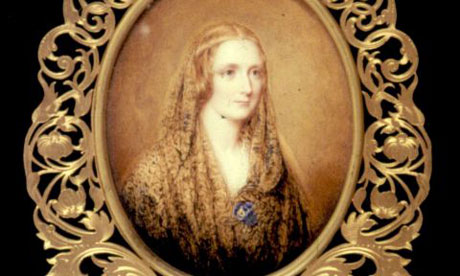
Women in Horror Fiction: What Would Mary Shelley Think?

Miniature of Mary Shelley Frankenstein author by Reginald Easton


Any time the topic of women in horror fiction comes up, someone almost immediately mentions Mary Wollstonecraft Shelley. It’s a little frustrating to me because usually she’s the only one, or one of a very select few, whose names are repeated over and over, even though there are a wide variety of women writing horror. But I can certainly understand it. She wrote a novel that has resonated with countless individuals on many levels,  reimagined in a variety of media, with varying interpretations. Even people who don’t know who Mary Shelley is and have never read the book are familiar, in some way, with the Frankenstein story. It is that ingrained into our culture. It is an incredible accomplishment that a teenage girl not only had a terrifying vision– we all have nightmares at some point– but that she penned her story with such passion and horror that, if you can get past the clunky beginning, it stirs the reader’s emotions and twists at the heart. In her own words:

When I placed my head on my pillow, I did not sleep, nor could I be said to think. My imagination, unbidden, possessed and guided me, gifting the successive images that arose in my mind with a vividness far beyond the usual bound of reverie. I saw – with shut eyes, but acute mental vision – I saw the pale student of unhallowed arts kneeling beside the thing he had put together; I saw the hideous phantasm of a man stretched out; and then, on the working of some powerful engine, show signs of life, and stir with an uneasy, half-vital motion.

Frightful must it be; for supremely frightful would be the effect of any human endeavour to mock the stupendous mechanism of the creator of the world. His success would terrify the artist; he would rush away from his odious handiwork, horror-stricken. He would hope that, left to itself, the slight spark of life which he had communicated would fade – that this thing, which had received such imperfect animation, would subside into dead matter, and he might sleep in the belief that the silence of the grave would quench for ever the transient existence of the hideous corpse which he had looked upon as the cradle of life. He sleeps, but he is awakened; he opens his eyes, behold the horrid thing stands at his bedside, opening his curtains, and looking on him with yellow, watery, but speculative eyes! I opened mine in terror.

The idea so possessed my mind that a thrill of terror ran through me…

I returned to my ghost story – my tiresome unlucky ghost story! O! if I could only contrive one which would frighten my reader as I myself had been frightened that night! Swift as light and as cheering was the idea that broke in upon me. “I have found it! What terrified me will terrify others; and I need only describe the spectre which had haunted my midnight pillow.”

In The Monsters: Mary Shelley and the Curse of Frankenstein, Thomas and Dorothy Hoobler describe Mary’s life in great detail. At eighteen, Mary Wollstonecraft Godwin, not yet married to Shelley, was intimately familiar with the creation and destruction of life. Her mother, Mary Wollstonecraft died eleven days after she was born, an event which shaped the rest of her life.When her father remarried, she was displaced by a stepbrother. At sixteen, she had already run off with Percy Shelley, who was already married (although estranged from his pregnant wife). Before the summer of 1816, she had borne two children, the first of whom died before she had even been named. By the age of eighteen, Mary was very familiar with how easily life can slip away. Percy Shelley, unstable but brilliant, was fascinated with the supernatural and Gothic and also with science, interests that he did not seem to find at odds. Their companions during the “Haunted Summer” of 1816, Lord Byron and John Polidori, were similarly fascinated with both: Polidori, a medical doctor, also began the story that became the classic horror novel The Vampyre that summer. The idea that science, when bent to the manipulation of creating and animating (or, particularly, re-animating) life, could be as destructive and frightening as any supernatural force, was her nightmare, and she made it ours.

I, Frankenstein, yet another interpretation of the Frankenstein story, comes out in movie theaters this Friday. The reviews I’ve seen haven’t been great. Honestly, some of the other versions of the Frankenstein story that have appeared over the years have moved far away from the waking vision Mary Shelley had on a dark and stormy night. Whatever her other tragedies, and there were many in her life, her creation, and her Creature, has changed and grown, and whatever else it has become, there is no doubt that with her novel, she brought them to life. Would she look upon the many incarnations today the way that Victor Frankenstein did when he first saw his creation come to life? Would she be amazed by the tremendous impact a little novel she had to publish anonymously has had on the world?  What would Mary Shelley think of the way so many people have co-opted her “midnight spectre?”

Women in Horror Fiction: Elizabeth Massie

Elizabeth Massie’s works are mostly in the horror genre. Her debut novel, Sineater, and her novella, Stephen have both won the Bram Stoker Award. I was surprised to discover that she also writes historical fiction and educational books for children (including Rigby readers– so if you have elementary aged children they may have read one of her books already) but she also writes mainstream fiction, media tie-ins and poetry. Her Tudors novelization (season 3) won the Scribe Award. She is now working on Ameri-Scares (Crossroad Press), a 50 novel series of spooky books for middle grade readers (a few of these are available on Kindle), as well as new novels and short works for adults. Her short story “Abed” has been made into a short film. Her most recent works include the novels Hell Gate (DarkFuse, 2013) ) and Desper Hollow (Apex Books, 2013).


1. Can you give our readers a brief introduction?

I’m a ninth generation Virginian…not a deep Southerner as in Spanish moss, ‘gators, and bayous, but more of a “bless your heart,” don’t-honk-your-car-horn-at-someone-unless-he’s-getting-ready-to-run-into-you, and eat Sunday lunch at Grandma’s house kind of Southern. I live in the country four miles from where I was born, so you could say I’m rooted. Of course, you could say lots of other stuff, too, but let’s move on.

I have written stories since I was old enough to hold a pencil, and I love stories in all their forms…books, magazines, plays, film, dance, mime– well, not so much mime. I don’t have an e-book reader but might get one some day. Anyhoo, I’ve been writing and selling horror fiction since the mid-1980’s. My first two short stories were published by the great, legendary magazine, The Horror Show, edited by David Silva. Since then, I’ve had published nine horror novels for adults, four horror novels for younger readers, six collections of horror fiction, and more than 100 short stories in various magazines and anthologies. I also write tons of other stuff, too, but again, let’s move on.


2. Why do you write horror?  What draws you to the genre? 

I was a scaredey-cat at a kid. Ultra-sensitive to the world around me. I don’t mean I just sat in the corner and screamed, but it was like going around with a layer of skin rubbed off. Frightening things were everywhere. There was a witch who lived down the street. There was a creepy family who lived across the street, a family we as kids knew would kidnap you and lock you in their attic if you crossed their lawn. There was a disembodied head that lived on top of the radiator in my bedroom, but only at night. There were things in the shadows in the basement that had no form but were just as happy to catch you and chew you up.

And so I’m thinking I got into writing horror because it gave me a way to look at a scary thing and deal with it and sometimes figure a way out of it or even defeat it. In fact, one of my more recent collections– Sundown (Necon E-books) – is dedicated to “All Who Stare Long and Hard into the Darkness to Better Appreciate the Light.” But then again, maybe there are other reasons I, and people like me, write horror. Reasons we’ll never really understand.


3. Can you describe your writing style or the tone you prefer to set  for your stories?

It really depends on the story, the market, and my mood when I come up with an idea. More often than not, I write horror that is more character-driven and introspective. I do that because, for the most part, it’s the kind of horror I like to read. Now, I don’t mean soft or mild horror. For example, my short story “Abed” (originally published in Still Dead and now a short film by Ryan Lieske) has been called “one of the most disturbing horror stories ever written.” Yet, it is not a slam-bam, action-packed tale. It’s claustrophobic and terrifying and actually quite sad. That said, I can write– and have written– slam-bam, action-packed horror, too, when that seems to suit the story.

&nbsp

4. Who are some of your influences?  Are there any women authors who have particularly inspired you to write?

I’m influenced one way or other by most everyone I’ve read. Either, “That person can really write!” and so what can I learn from her/him? Or “That story or novel pretty much sucks!” and so what can I learn that?

Growing up in the 50’s and 60’s, I adored several kids’ mystery series like The Happy Hollisters (Jerry West) and Trixie Belden (originally Julie Campbell but then in-house writers picked it up – most likely women and men, both.) By the time I was ten, I was seeking out scary things to read, like the old Alfred Hitchcock anthologies (such as the Ghostly Gallery) and Gold Key’s The Twilight Zone comic books. In looking back, it seems most if not all the Alfred Hitchcock stories were penned by men. From what I can tell, The Twilight Zone comics were written and illustrated by men.

As a young teen I went on to read adult horror and science fiction novels by men such as Ray Bradbury, John Hersey, Julian Gloag, and Robert Bloch. I didn’t discover women horror writers until I was a young adult– Shirley Jackson and Flannery O’Connor, primarily. They seemed like an afterthought among all the male authors. Yet, that imbalance didn’t strike me at the time. I wasn’t tuned into the gender discrepancy. I guess I was more about what made an engaging, terrifying, story rather than if the author was male or female.

So as to which women authors inspired me to write, I’d have to say none, really. I started writing very early… stories were inside me that needed to be told. Then again, maybe I was inspired by every female author I ever read whose name didn’t register on my radar because I was more concerned with the story than with who wrote it.

I was and continue to be inspired by good writing, whomever it is who creates it.


5. What authors do you like to read?  Any recommendations?

These days, more women are writing horror than when I was growing up. Or at least more are being published than when I was growing up. I think there will always be more men in the field, though, because I think men generally are more interested in horror than women. It’s just an observation… few women I know (and I know quite a few) enjoy and seek out horror. Many more men friends do. Is that me being naïve or sexist toward my own sex? I don’t think so. But because fewer women are in the field, they do tend to get overlooked more often. There aren’t as many books by “us” on the shelves. And it could be that some readers think women won’t attack horror as boldly as men.

That said, let me recommend the writings of Lisa Mannetti, Billie Sue Mosiman, Nancy Holder, Nancy Kilpatrick, Poppy Z. Brite (now Billy Martin), Yvonne Navarro, Linda Addison, Chesya Burke, Lisa Morton, Monica O’Rourke, Fran Friel, Rhodi Hawk, and Mary SanGiovanni, as well as others, have impressed me as both a reader and a writer. Their works are deep, thought-provoking, memorable, gritty, and scary as all hell. These women deserve more bookshelf space.


6. Where can readers find your work?

My most recent works include the novels Hell Gate (DarkFuse, 2013) ) and Desper Hollow (Apex Books, 2013).  I also have short stories out in the 2013 magazine Dark Discoveries #25 and the 2013 anthology Shadow Masters. My website has more listings: www.elizabethmassie.com


7. Is there anything else you’d like to share with librarians and readers?

Sometimes we have to look beyond what publishers push and promote to find other gems among the offerings. They are there, and they may be the surprise we were looking for. And someday, we won’t need a Women in Horror month. Those who write well will be as much in the public eye as their male counterparts, and the gender of an author writing horror won’t be a defining issue anymore.

____

Want to learn more or check out her work? Visit Elizabeth Massie’s Amazon page, her website, or this article on Wikipedia, which, although it doesn’t have multiple sources, does provide biographical information and a fairly comprehensive, easy to read list of her works.

Come visit again soon! We have a great post  coming up soon from librarian Becky Siegel Spratford, queen of reader’s advisory in the horror genre–  you won’t want to miss it!