Home » Posts tagged "horror cinema" (Page 3)

Book Review: It Came From: …The Stories and Novels Behind Classic Horror, Fantasy, and Science Fiction Films by Jim Nemeth and Bob Madison

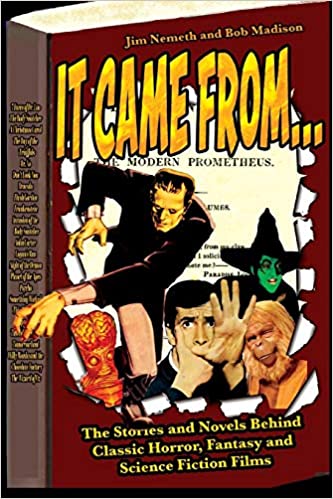
cover art from It Came From... by Jim Nemeth and Bob Madison

(  Bookshop.org )

It Came From:  …The Stories and Novels Behind Classic Horror, Fantasy and Science Fiction Films by Jim Nemeth and Bob Madison

Midnight Marquee Press, Inc., 2020

ISBN-13: 9781644300916

Available: Paperback

In this book, critics Jim Nemeth and Bob Madison explore genre films and the written works that inspired their creation,  Each is presented in its own section, chronologically, and the written works that inspired them. While this book primaritly covered fantasy and science fiction films, this review will concentrate on the aspects of  the horror genre presented. The authors include information on the production of the films, as well as the differences between the texts and the movies. At times they also posit the view that the film may be better than the books, a controversial opinion among some audiences.

The author of the horror section introduction argues that horror is the most difficult genre to adapt because movies “that merely provides a book’s ‘Boo!’ moments are but empty shells, lacking the underlying background and context that frequently makes the literary piece the more satisfying experience” (p. 12). He then moves to his example of The Shining. While I do not necessarily agree completely with the author, he does make some interesting points. Films included in the horror section include The Body Snatcher, Invasion of the Body Snatchers, Night of the Demon, Psycho, The Day of the Triffids, and Don’t Look Now.

Two titles receive special treatment in that they each have a significant chapter devoted to them: Dracula and Frankenstein. The authors look at “several of the best, worst, and most popular of their cinematic incarnations” (p. 11). Dracula films covered range from Nosferatu (1922) to Bram Stoker’s Dracula  (1992), while the Frankenstein films range from the first film version of Frankenstein (1910) to Victor Frankenstein (2015).

My primary criticism of the book is focused more on the overall contents rather than specific chapters. The authors interject their own opinions into the chapters in a way that can be a bit heavy handed. For instance, when it comes to science fiction, one of the authors makes it abundantly clear that he does not like the gritty, darker, current sci-fi storylines. Additionally, while it seems that each chapter is written by an individual author, it is difficult to tell who wrote which one.

This could be a good resource for anyone interested in exploring the literature upon which genre films are based, as long as readers are aware that the authors’  strongly expressed opinions are interspersed throughout.

Recommended with reservations.


Reviewed by Lizzy Walker

Documentary Review: Horror Noire: A History of Black Horror, directed by Xavier Burgen, written and produced by Ashlee Blackwell and Danielle Burrows

Horror Noire: A History of Black Horror, directed by Xavier Burgen, written and produced by Ashlee Blackwell and Danielle Burrows, based on the book Horror Noire: Blacks in American Horror Films From the 1890s to the Present  by Robin R. Means Coleman

Stage 3 Productions, 2019

Not Rated

Run time: 83 minutes

ISBN-13/ASIN: Not Available

Available: Streaming on Amazon, Shudder


“We’ve always loved horror. It’s just that horror, unfortunately, hasn’t always loved us.”

With this opening quote by Tananarive Due, award winning author and UCLA educator (Black Horror, Afrofuturism), viewers begin an essential documentary on Black horror. The film investigates a century of horror films that marginalized, exploited, and eventually accepted and embraced them. Horror Noire is based on University of Michigan professor Robin Means Coleman’s book of the same title. Through new and archival interviews from scholars and creators, we take a horror movie journey through early classics, Blaxplotiation, the Reagan Era, the 90s, and the 2000s. Interviewees include Ashlee Blackwell, who runs the Graveyard Shift Sisters website, Tony Todd, William Crain, Rusty Cundieff, Rachel True, Tina Mabry, Ken Foree, and Jordan Peele.

The documentary starts with a discussion of Black representation in Birth of a Nation and moves into early classics and depiction of Black characters, as slaves, servants, or hapless victims in the 1940s. When the 50s came, horror films basically erased the Black presence, with the exception of Son of Ingara, in Atomic Age science-centered scripts. Change was coming when Night of the Living Dead was released. Blaxploitation provided more screen time for Black actors, but the films remained problematic. The Reagan Era presented the change from “urban to suburban” white flight settings, relegating Black characters to gangsters and villains. In the 90s and 2000s, more Black filmmakers and actors appeared more in the horror genre, with a shift from the focal point of fear to heroes on the big screen.

I recommend this for anyone interested in the sociopolitical history of the horror genre. The use of footage from various civil rights and conflicts that reached the national level interspersed throughout the film helped explain the reception and shift in attitudes about Black horror, and Black horror movies. Highly recommended.


Reviewed by Lizzy Walker

Book Review: Only the Dead Know Burbank by Bradford Tatum

Only the Dead Know Burbank by Bradford Tatum

HarperCollins Publishers, 2016

ISBN: 9780062428752

Available:  Paperback, Kindle edition


Only the Dead Know Burbank starts out in post-World War I Germany, after the Spanish flu epidemic has passed. Maddy Ulm, a young woman whose mother cast a mysterious spell on her before her premature death, pulls herself out of her own grave. She discovers she cannot die, but she also cannot age, and when she eats, she tastes nothing but ash. She knows nothing of where her mother has gone; she is alone. She sets out to find…something? Someone? She’s not quite sure. She eventually meets and joins up with street performers, including Mutter, an injured soldier with a love of theatrics. Together, they perform dramatic traumas and seeming resurrections on the small stage. Then Maddy discovers film, and her love of the horrific. When Universal Pictures discovers one of her masterpieces, Maddy travels to Hollywood. There, she meets and works with some of the Hollywood greats, creating some of the most memorable images in horror history. She channels her innate knowledge of the supernatural, fear, death, and undeath into her art, but is never allowed to head the projects she loves so much. She wants more. Throughout her story, she catches glimpses of her mother, occasionally meeting with her and her father. As the story progresses, Maddy discovers more about herself, her family, and what she is capable of.

I was apprehensive about this at the beginning. Maddy’s childhood is nothing more than a mother providing for her child and surviving the only way she knew how—through sex, death, and art. Maddy was never shielded from anything happening, and was even present at times. It would be fair to say Maddy was never treated as a child. She came into the world observing the adult world through her mother, a very cold woman who withheld any kind of affection from Maddy. Dealing with her mother makes Maddy a survivor, and she develops skills that aid her through the rest of her life, leading her to become an extremely strong female character.

Mutter is another character in this story worth mentioning. Mutter, before his injury, was a German soldier who Maddy encountered briefly when her mother was entertaining the troops. Maddy feels a strong attachment to Mutter, and he acts as a protector to her, providing her with the familial love that she never experienced as a child.

The historic figures written into the story are fantastic. Cheney was given a very respectful characterization, but I think Tatum was even more sensitive to Boris Karloff. Being an avid fan of Karloff’s, I was pleased with the sensitivity and respect he gave to his characterization of one of the genre’s greatest actors. Maddy is especially drawn to him because of the kindness in the man’s eyes, and his physical stature. She was looking for someone to play the creature in Frankenstein, rejecting the director’s demand for the horrific, and instead obtaining someone with a certain sorrow in the eyes, something which Maddy herself comes to grips with along the way in her own life. Tatum clearly did his research on early horror cinema in both Berlin and Hollywood, and combined with his original approach and well-drawn characters, this is a pleasure to read. Recommended.


Contains: physical and psychological abuse, some sex

Reviewed by Lizzy Walker

