Home » Posts tagged "horror cinema" (Page 2)

Graphic Novel Review: Lugosi: The Rise and Fall of Hollywood’s Dracula by Koren Shadmi

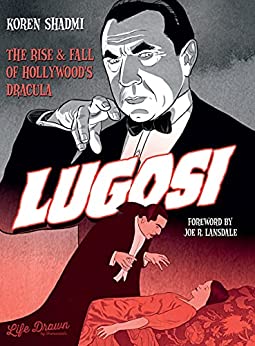
Cover art for Lugosi by Koren Shadmi

Lugosi: The Rise and Fall of Hollywood’s Dracula by Koren Shadmi

Life Drawn, 2021

ISBN-13: 978-1643376615

Available: Paperback, Kindle, comiXology Bookshop.org  |  Amazon.com )


Lugosi: The Rise and Fall of Hollywood’s Dracula is a graphic biography of one of the most recognizable men to portray Dracula, Béla Ferenc Dezső Blaskó, or simply Bela Lugosi. Shadmi tells the story of the young Bela fleeing Hungary after a failed Communist revolution in 1919. Upon coming to the United States, he “reinvents himself”, acting on stage and screen, eventually being cast as the titular vampire count in 1931’s Dracula. However, Lugosi’s constant vices and failed marriages haunted him throughout his career and beyond.


Shadmi did not hold back with Lugosi, opening with Lugosi in 1955 admitting himself to the Motion Picture and Country House Hospital in an attempt to defeat his heroin addiction. From there, we are taken to Lugos, Hungary in 1893 where a young Bela is acting in a field after becoming entranced by a traveling acting troupe that recently left. A group of bullies attack him, and then he returns home to his strict, banal parents. Soon after, Bela faces the death of his father and the hatred of his mother. At this point, he takes some of his possessions and leaves home. The story then switches back to Bela in the hospital where he is facing detox, hallucinations, and the physical and emotional pain that tortures him. The rest of the book follows in this manner, going from sepia colored modern day to crisp black and white telling of the past. More of Bela’s past is revealed, including affairs, drug addiction, arrival in the United States, struggles with Hollywood, his rivalry with Boris Karloff, acting for the notorious Ed Wood, Jr., and more, while Lugosi faces his demons in the hospital. It is a powerful biography fans of Lugosi should read.


Shadmi has become one of my favorite creators. Lugosi: The Rise and Fall of Hollywood’s Dracula will be another graphic biography on my bookshelf. Highly recommended.


Reviewed by Lizzy Walker

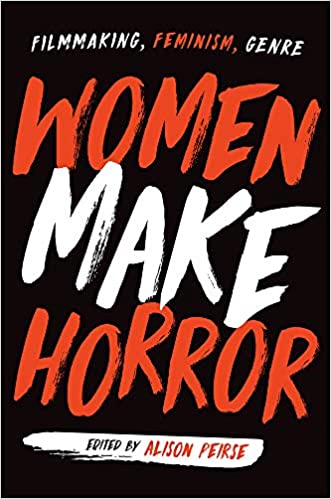
Book Review: Women Make Horror: Filmmaking, Feminism, Genre edited by Alison Peirse

cover art for Women Make Horror edited by Alison Peirse

Women Make Horror: Filmmaking, Feminism, Genre edited by Alison Peirse

Rutgers University Press, 2020

ISBN-13: 9781978805118

Available: Paperback, Kindle edition Bookshop.org | Amazon.com )


Women working in the horror industry today are severely underrepresented. Although they have been making horror for centuries, many women have been cut out of that history and/or had their authorship and creative influence denied. What is more, women also enjoy consuming horror. Women Make Horror explores women’s creation and enjoyment of the genre through analysis of experimental cinema and filmmaking. The book includes seventeen essays, global in scope, discussing creatives, films, and festivals. While I think every one of these chapters deserve attention, I will highlight some that stand out.

“Women Make (Write, Produce, Direct, Shoot, Edit, and Analyze) Horror” by Alison Peirse provides a solid introduction to the text. Peirse discusses how she garnered and selected the texts for this volume. She asked three questions of the writers: why do women make horror; what kinds of stories do women tell in horror; and what makes a horror film a feminist film (p. 8-9). Every contributor has a unique perspective as to how they answered these questions.

“The Secret Beyond the Door” by Martha Shearer discusses Daria Nicolodi’s authorship and, subsequently, creative content of the original Suspiria. In “Why Office Killer Matters”, Dahlia Schweitzer provides valuable information on this film and argues that it is a film that not only restructures the representation of gender representation, but how horror films are expected to conform to specific tropes (p. 89). Donna McRae, in her chapter titled “The Stranger with My Face International Film Festival and the Australian Female Gothic”, discusses the development of this essential film festival, as well as “considers the influence of a female-centric genre filmmaking in Australia today” (p. 146) and how it has been a force for good in creative circles. Erin Harrington’s “Slicing Up the Boys’ Club” provides an excellent analysis of the existing state of anthology and omnibus films and their lack of diversity, as well as a discussion regarding the women-led anthology, XX. Harrington poses some good questions regarding representation for readers as well. “The Transnational Gaze in A Girl Walks Home Alone at Night” by Lindsey Decker presents an analysis through the lens of Hamid Naficy’s Islamicate gaze theory rather than the typical male gaze theory used so often in feminist film analysis.

In “Gender, Genre, and Authorship in Ginger Snaps“, Katarzyna Paskiewicz analyzes the film Ginger Snaps, which makes connections between a werewolf legend and a girl’s coming-of-age story. Paskiewicz describes her study as having two purposes. She seeks to answer how the film might be productively read through a lens that recognizes filmmaking as a collective art form” (p. 106), as well as wanting to “register the significance of women’s film authorship within the horror genre histories in which they have been traditionally overlooked” (p. 106). Early in the chapter, the author argues that directors are not the only creative voice in a film project. Editors, screenwriters, set designers, and more have influence over various aspects of a film (this is precisely why my colleague and I created Women in Film: A Film Index, to recognize other creatives in horror. That the sentiment is recognized in this seminal text is encouraging).

Other chapters cover directors such as Gigi Saul Guerrero, Lucile Hadžihalilović, and Alice Lowe. There are also chapters that focus on the New French Extremity, Korean horror cinema, fans as filmmakers, international films and events, and much more. The end of each chapter includes notes, and there is an extensive index at the end of the book.

Women Make Horror is a much-needed collection of feminist horror film criticism. Some of these essays, such as Molly Kim’s delve into Korean women-made cinema, are the first of their kind. and others showcase someone’s overlooked or misappropriated contributions, such as Alicia Gomez’s chapter on Stephanie Rothman’s The Velvet Vampire, a film originally credited to Roger Corman. Women Make Horror would be an excellent resource for horror scholars or even an addition to a film studies course on the genre. The general reader could enjoy it, but there are many chapters that read more like an academic work.  Highly recommended.


Reviewed by Lizzy Walker


Editor’s note: Women Make Horror: Filmmaking, Feminism, Genre is a nominee on the final ballot for this year’s Bram Stoker Award. 
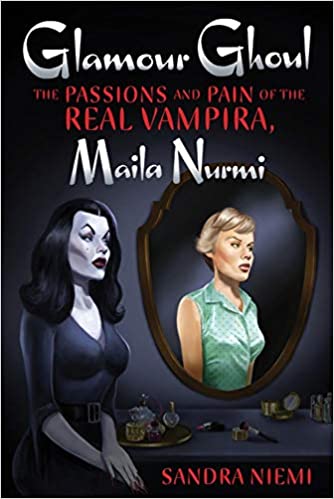
Book Review: Glamour Ghoul: The Passions and Pains of the Real Vampira, Maila Nurmi by Sandra Niemi

cover art for Glamour Girl by Sandra Niemi

Glamour Ghoul: The Passions and Pains of the Real Vampira by Sandra Niemi

Feral House, 2021

ISBN-13: 9781627311007

Available:  Paperback, Kindle Bookshop.com  | Amazon.com )


Glamour Ghoul is the biography of the woman who was Vampira, Maila Nurmi, written by her niece, Sandra Niemi. Pieced together from diaries, notes, family stories, and an unexpected family connection, Niemi weaves a fascinating tale of the late horror icon. She provides a glimpse of her aunt’s childhood,  Maila’s strict Finnish father and alcoholic mother, and how she tried to break free of their grasp. In 1941, Maila began her tumultuous journey into Los Angeles, hoping to find fame and fortune, but instead found heartbreak and betrayal, the first committed by Nurmi’s screen crush Orson Welles.

Nurmi’s creation and development of the Vampira character is discussed in the book. From entering a Halloween costume contest donning an outfit like that of Charles Addams’ Morticia (from his cartoons, not the television show), to appearing on the Red Skelton Show, to her own show and beyond, the tale of Vampira is told. There is also considerable time spent on the lawsuit between Nurmi and Elvira/Cassandra Peterson.

Interspersed between accounts of Nurmi’s life are short biographies of those who entered her life. Her relationships, platonic as well as romantic ones, with Orson Welles, James Dean, Marlon Brando, Anthony Perkins, and Elvis Presley make for an interesting read. Later in life, she was embraced by the punk community, and she, in turn, embraced the community. Her life was not glamourous: she often struggled with poverty, and was barely able to afford to scrape by. She occasionally had to return home, living with her mother and never speaking to her estranged father. Despite that, she lived on her own terms. Niemi is quite candid in telling her aunt’s story, not shying away from such things as a confrontation and violent outburst by Nurmi toward her grand-niece’s snobbish behavior during a visit to Los Angeles. Nurmi was not afraid of making her voice heard. Highly recommended.


Reviewed by Lizzy Walker