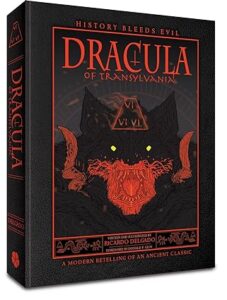
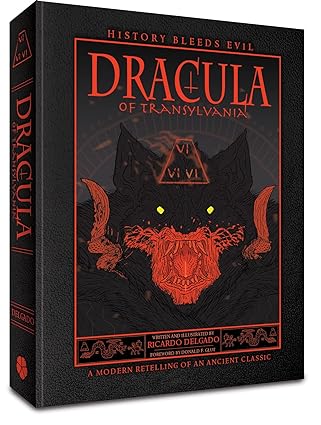
Dracula of Transylvania by Ricardo Delgado
Clover Press, LLC, 2021
ISBN-13: 9781951038229
Available: Hardcover, paperback
Buy: Bookshop.org | Amazon.com
Ricardo Delgado has an impressive resume. He is an American-born artist and writer of Costa Rican descent, and a graduate of, and teacher at, the Art Center College of Design in Pasadena, California. He has worked as a film illustrator on Star Trek: First Contact, Jurassic Park 3, The Matrix Reloaded, Revolution, and others. He has also worked on designs for animated films such as The Emperor’s New Groove, WALL-E, How to Train Your Dragon, and more. His creative endeavors don’t end there. He created the acclaimed comic series Age of Reptiles for Dark Horse, wrote Sam Specter and the Book of Spells, and the hard-boiled science fiction noir Warhead. He decided to take on the subject material of Dracula of Transylvania in a new vision of the classic tale.
Young solicitor Jonathan Harker, headstrong and curious natured Mina, newly engaged Lucy, brave Arthur, timid but honorable Ian, drawling gunslinger Quincy, and old professor and friend Van Helsing brave the supernatural and mundane in their quest to stop the Son of Satan, Dracula of Transylvania, and his three wives, Andromeda, Petra, and Venus, from destroying all of humanity.
I’ll start by discussing the pros of Delgado’s epic retelling. First, the characters are much more fleshed out than they are in Stoker’s work. While Delgado took liberties with such things as character backgrounds (e.g. Jonathan is from America in this version), the changes do not distract from the story. There is much more focus on Mina and her point of view, and frankly, she is my favorite character out of all of them. The reader gets a better feel for the characters and, truly feels invested in what happens to them. Van Helsing is well-developed, and his influence can be felt throughout the journey to find Dracula, even when he is not present in the pages. Even side characters, like the villagers fearing for their lives but wanting to provide Harker and the others with as much aid as they can, come across as being very real and more than merely bit players.
Then, there are the villains of the piece. Dracula, of course, is portrayed as an imposing, cruel master and conqueror, but he is not alone in his travels. His wives follow him wherever he goes, but not out of any love or familial devotion. Andromeda, Petra, and Venus each have distinct personalities and histories, and are welcome improvements from Stoker’s original novel. The reader only gets a glimpse of them in Stoker’s tale, and then they are practically forgotten. In Delgado’s revision, while they are treated as concubines by Dracula, the author gives them more than a passing mention. Another addition to Dracula’s entourage is the skeleton army led by the Roman-clad warrior Primus, also a skeleton, and an ever present swarm of rats. The hulking figure of Renfield is terrifying, and Delgado gives him a backstory that tells the tale of the source of his mental illness, as well as adding a dash of a legendary serial killer who roamed Whitechapel into the mix. War time is hell, and Renfield, Van Helsing, and the other parents were not immune to the trials they experienced.
The pacing is fantastic. Delgado’s action scenes are incredible, and when the characters need to slow down and take a breath or plan their next move, it does not feel forced. It almost feels like it is a break for the reader to catch their breath! Delgado provides ample footnotes throughout the novel that describe Biblical passages and various facts to further embed the reader in the Victorian era.
Now, I’ll discuss the negatives. While there were illustrations between the chapters, they were all black and white. The artwork included in the back of the book were in colour, and gorgeous. I think if Delgado used the same colour palette for the other pieces they would have been more striking and effective. Another aspect that was interesting to begin with but gradually became a distraction and quite daunting was the use of different languages followed by translations that Delgado admits came from using Google Translate. Since I do not read any of the languages used, I cannot determine their accuracy. I know in my own experience using the translation feature can result in terrible mistakes, so I am hoping that Delgado consulted with people who could properly translate to verify accuracy. It would have also benefited the book for another round of editing. There were grammatical, spelling, and punctuation errors throughout that could have been spotted by a careful editor.
Despite the negatives to the book, the story was solid and well executed. The danger of Dracula and his accomplices is much improved from the original story, as is the interaction and growth of the characters, and the action is much more intense and exciting. The accompanying artwork is a welcome addition, and we get a better sense of Delgado’s vision. I recommend this for readers who hoped for a more action packed, character driven story than the source material delivered. Recommended.
Reviewed by Lizzy Walker




Follow Us!