Home » Posts tagged "historical horror" (Page 8)

Book Review: Owl Manor: Abigail (Book Two of the Owl Manor Trilogy) by Zita Harrison

A note from the editor:

We are now in the month of November and Monster Librarian still needs to raise the funds to pay for our hosting fees and postage in 2021. If you like what we’re doing, please take a moment to click on that red “Contribute” button in the sidebar to the right, to help us keep going!  Even five dollars will get us closer to the $195 we need to keep going at the most basic level. We have never accepted paid advertising so you can be guaranteed that our reviews are objective. We’ve been reviewing and supporting the horror community for 15 years now, help us make it another year! Thank you! And now our review of .Owl Manor: Abigail (Book Two of the Owl Manor Trilogy).
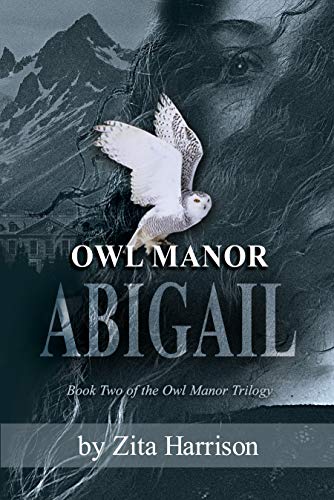
 

cover art for Owl Manor: Abigail by Zita Harrison

Owl Manor: Abigail (Book Two of the Owl Manor Trilogy), by Zita Harrison

Zealous Art Publishing, 2020

ISBN: 979-8675396467

Available: Kindle, Paperback


“And I knew this thing was built of all my fears, was empowered by them, and that it would devour me if it could,” says Abigail, the central character in the second book of Zita Harrison’s Owl Manor Trilogy. Inspired by Gothic suspense classics, this fast-paced psychological thriller about a jilted young woman alone in the world after her mother’s murder, is chock full of malevolent supernatural forces. An eerily evocative Colorado mountain setting, an estate-turned-inn where hovering owls have been known to attack, and a series of unexplained murders, are only the beginning. Readers can find out about Abigail’s childhood in the first book of the trilogy, Owl Manor: The Dawning, which takes place during the Gold Rush, but this second volume deftly takes us into Abigail’s present without disruptive recaps.

Unfortunately for Abigail, her mother Eva’s murderer/dead lover, the insane Rafe Bradstone, has possessed his relative Victor and hopes to be reunited with Eva’s spirit through her daughter. Abigail has already been traumatized by knowing that her mother did not want her, by being at the manor when her mother and Rafe died, and by being left by her fiancé on the day of her wedding. Although the staff at Owl Manor care about her, they are finding it difficult to deal with the ghosts and strange houseguests, and are left to handle the violence without the help of the authorities. Abigail had hoped to prove to herself that she could survive on her own, but the past, for which she was not responsible, comes back to haunt her anyway.

An interesting element woven loosely through the two books Harrison has written so far (the third will be Owl Manor: Nightfall) is the attention to the role of women as wives and mothers, attitudes toward unmarried women (including prostitutes), and the life choices women had in the United States during the 1800’s. Eva is portrayed as a sort of feminist who is determined to leave her restrictive family life and make her own money. Eva pays dearly for her choices, and her daughter is her innocent victim. Abigail wonders, “Is the world, in the end, just a reflection of one’s state of mind?” She does get an answer in this creepy, entertaining book. Recommended.


Reviewed by Nova Hadley
Book Review: The Residence by Andrew Pyper

A note from the editor:

We are more than midway through October and Monster Librarian still needs to raise the funds to pay for our hosting fees and postage in 2021. If you like what we’re doing, please take a moment to click on that red “Contribute” button in the sidebar to the right, to help us keep going!  Even five dollars will get us closer to the $195 we need to keep going at the most basic level. We have never accepted paid advertising so you can be guaranteed that our reviews are objective. We’ve been reviewing and supporting the horror community for 15 years now, help us make it another year! Thank you! And now, David Simms reviews The Residence by Andrew Pyper.


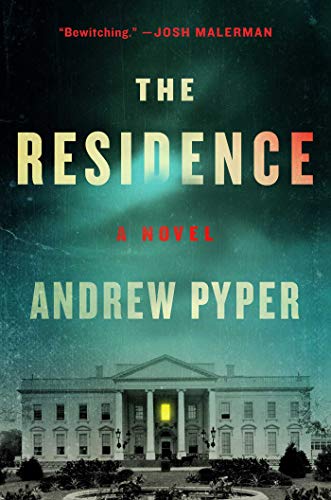
cover art for The Residence by Andrew Pyper


The Residence by Andrew Pyper ( Bookshop.orgAmazon.com )

Simon & Schuster, 2020

ISBN-13 : 978-1982147365

Available: Hardcover, paperback, Kindle edition, compact disc, audiobook

Historical horror can be a mixed bag. The immediacy of the terror tends to be removed in a period piece, while dialogue and characterizations, not to mention obsolete settings, can deflate any true scares or dread from the tale at hand, no matter how well it is written.

However, The Residence rises above these obstacles to take up, well, residence, in the reader’s head. It’s in the vein of The Hunger or The Terror, both of which are recent landmarks in the genre.

Andrew Pyper knows how to deliver the horror in a novel. His Demonologist rivaled the best possession stories, and his other titles have been entertaining, chilling books.

This time out, Pyper ventures into terrifying territory– the White House. No, not the current administration. but that of Franklin Pierce, the 14th president of the United States. Pierce stars as a reluctant leader, one not expected to win, but turns out to be a popular man amongst his fellow Americans. A Democrat, he takes on the task of hoping to mend a divided nation.  Pyper transports the reader back to 1853, when Pierce and his family are headed to Washington for the inauguration. Pierce’s wife, Jane, senses that the move might not help them, especially after she and Franklin have already lost two sons.

Eleven-year old Bennie is excited to stand beside his father at the ceremony and live the dream of any young boy, but the train, and possibly external forces, literally derail any hope of happiness for the Pierce family during his presidency. At the bottom of the ravine, only one casualty is found– Bennie.

Grieving the loss of her son, Jane escapes into herself, building herself a “grief room” within the White House, and refuses any duties of a First Lady. Instead, she calls for a pair of psychics, the Fox sisters, to help communicate with Bennie. and salvage any hope she has for remaining in the land of the living.

What they achieve, though, invites something far more sinister: something that becomes a paranormal entity in the capital that threatens to destroy much more than the Pierce family.

Pyper sidesteps any pitfalls that could undermine the horror in this tight, family-centered story that is closely tied to actual history. The White House is reported to be haunted, by several spirits, and much of what is spun here actually occurred. Pyper doesn’t allow himself to become bogged down with an excess of period details or historical overload, rather focusing on the hauntings and how what is unleashed threatens to destroy the Pierces– and much more. Recommended.


Reviewed by David Simms


Book Review: Whitechapel Rhapsody by Alessandro Manzetti

A note from the editor (that’s me) :

We are midway through October and Monster Librarian still needs to raise the funds to pay for our hosting fees and postage in 2021. If you like what we’re doing, please take a moment to click on that red “Contribute” button in the sidebar to the right, to help us keep going!  Even five dollars will get us closer to the $195 we need to keep going at the most basic level. We have never accepted paid advertising so you can be guaranteed that our reviews are objective. We’ve been reviewing and supporting the horror community for 15 years now, help us make it another year! Thank you! And now our review of Whitechapel Rhapsody by Alessandro Manzetti.

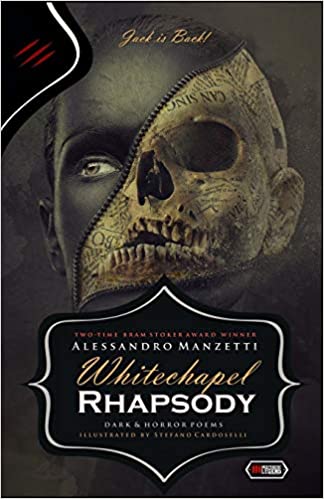
cover art for Whitechapel Rhapsody by Alessandro Manzetti

Whitechapel Rhapsody by Alessandro Manzetti   (Amazon.com)

Independent Legions Publishing,  2020

ISBN: 978-88-31959

Available: Kindle edition, Paperback

Ever since Jack the Ripper prowled the streets, he has been the worst kind of nightmare, the shockingly brutal and chilling reality that monster-men can be living among us unnoticed, watching and freely choosing fresh victims. In his new book of poetry, Whitechapel Rhapsody, Alessandro Manzetti uses words from The Ripper’s letters to the police, information about the women and their possible murderers, and even one of the autopsies to access the mind of a killer who has never been identified for certain.

In “The Lair”, which begins the book, and in the rhapsody poems (“Sick Rhapsody,” “Entangled Rhapsody,” and “Madhouse Rhapsody”) which appear at intervals throughout the collection, we are plunged into the ugly, sordid, sick environment of physical and spiritual contagion that was the setting for the murders, if not the spawning ground of the murderer. Against this background, the poems describe the killer as a macabre artist who vows to his victims, “I will make art of you” and causes them to be “carved” by his “iron brushes,” his “long-bladed knife accurate like a Mozart composition.” True to The Ripper’s artistic vision, there is a focus on color, especially shades of red blood and the textures of the organs of the human body in each “still life.” This is the portrait of a demented artist whose imagination is a “giant” that “can feel the vibrating legs of a grasshopper ready to jump on a leaf of a remote island.”

This extreme sensitivity is on display in “She Knew My Name” which riffs on Poe’s “The Raven.” Both poems are about the narrator’s mind and what is happening inside it, how each is processing his experiences. Both narrators indulge in their madness, and that has an emotional impact on the reader. Manzetti confirms that it is not the facts of blood or death that most inspire terror in a reader but the evil imagination of the poem’s speaker igniting the active imagination of the reader’s “dark side.” This fascination that ordinary people have with horror is apparent in “Madhouse Rhapsody,” a reminder of Bedlam where the English citizenry actually went to enjoy the suffering of the imprisoned mentally ill as live entertainment. Also, many of the poems mention the opium, syphilis, perversions, and abuses which were common at the time and could be the source of madness.

Even though it is unlikely we will ever know Jack the Ripper’s identity or what caused him to kill, Whitechapel Rhapsody pulls back the curtain enough for us to fully feel the evil behind the facts and sense the cold, hard facts behind the dark poetic imagination.

Recommended.


Reviewed by Nova Hadley