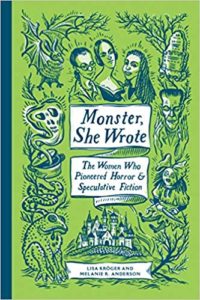
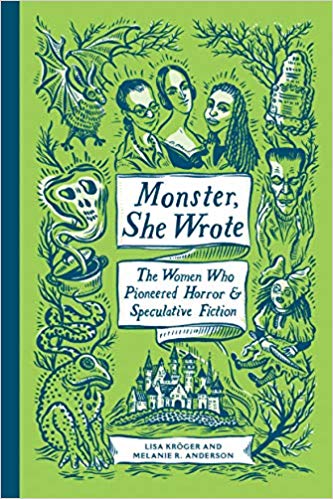
 I’m so pleased that our reviewer David Simms had the opportunity to meet and interview Lisa Kroger and Melanie R. Anderson, the authors of Monster, She Wrote: The Women Who Pioneered Horror and Speculative Fiction. As a librarian, I am really happy to have a reference work that covers women who might not necessarily be in other reference volumes on horror writers. It often can be a puzzle simply to identify them!
Lisa is also a co-host of the bi-monthly horror podcast Know Fear.
Interview with Lisa Kroger and Melanie R. Anderson
David: This is such an important book. What prompted you to write it?
Lisa: I have my PhD in 18th Century British literature, with a focus on the Gothic writers. I suppose my interest began then, when I saw these spooky stories that were predominantly written by women. I have always loved horror, but the names that tend to be discussed are male: King, Poe, Lovecraft. I love them all, but I also wanted to have a discussion about the other giants in the field. I guess you could say that I wanted to write the history of horror, told only with the women writers. I wrote it with my coauthor, Melanie Anderson, who I met in graduate school. We quickly discovered a mutual love for horror and speculative fiction. The earliest seeds of this book started there, at the University of Mississippi in Oxford.
Melanie: Ever since graduate school, and including my first academic book, most of my scholarship has focused on the fiction of women writers, and in particular, supernatural fiction. When you think of Gothic or horror texts of American literature, men’s names come up quite a bit, but there were other voices in conversation with them. I wanted to share these women writers Lisa and I were finding with people who just love to read horror, or the supernatural, or the weird.
David: I’m embarrassed to have never heard of so many of these authors. You have placed these titles front and center to so many readers and writers. Which was your greatest find?
Lisa: The greatest and most frustrating was Eli Colter. We found her when reading through the old Weird Tales issues. Her short story “The Last Horror” is a great example of the “weird Western,” and it holds up even today. It’s an eerie, creepy tale. The problem with Colter is that there is very little known about her today. We had a hard time even finding biographical information on her–some places were still referring to her as “he.” But that is one of the purposes of this book: to reintroduce these women to a new set of readers.
Melanie: I agree with Lisa that Colter was probably our greatest find, and one of the more difficult ones because of lack of information. Many of the pulp writers felt mysterious to me because there was this impermanence to the work. Plus, they were focused on placing stories and not as personally visible. Another interesting find from the early pulp years was Gertrude Barrows Bennett, not because she was completely unknown, though her work had fallen out of print at times, but because she was known primarily under her pen name Francis Stevens. When we think about the beginnings of weird fiction, we have a very male picture in our minds, but that can be expanded a bit.
David: Which of these stories has resonated the strongest with you? How about the lives of the writer?
Lisa: I will always love Shirley Jackson, and I think that her story still resonates with me. She was a brilliant writer, but I think her talents weren’t always recognized. She wrote a few domestic stories, about her time raising her children. There seems to be this tension between what was expected of her as a mother and a professor’s wife and what was expected of her as a writer. It was as if she had two lives that couldn’t co-exist. A story that’s often told of her is when she was in the hospital having one of her children, and the nurse was taking her information at the hospital. The woman asked Shirley Jackson what her occupation was, and Jackson told her she was a writer. The nurse looked perplexed and said, “I’ll just put down housewife.” That is amazing to me! This is the author of The Haunting of Hill House and We Have Always Lived in the Castle, for goodness sake. But I think she resonates with me because I see Jackson as a genius, yet the world around her sometimes didn’t recognize it, and that was probably solely because of her gender. I’m going on a tangent here, and I certainly don’t consider myself on Jackson’s level, but her story resonates with me. I think male writers with less talent have been called a genius when she was often overlooked.
Melanie: It’s hard to choose one woman, but Margery Lawrence’s independence fascinated me. I was familiar with her name from reading occult detective fiction of the early twentieth century. I didn’t, however, know about her interest in the occult, attendance at seances, and ghost hunting activities. While she did marry, she published an article titled “I Don’t Want to be a Mother” in 1929 in Cosmopolitan, and she was not afraid to travel. I think we have this idea of how women of previous generations existed in the world, and women like Lawrence add to and change that traditional image.
David: Which story, or author, did you find most intriguing in your research?
Lisa: I love Margaret St. Clair. Read her stories “The Man Who Sold Ropes to the Gnoles” or “Horrer Howce,” which are so much fun and just well written overall. Plus, her life story is fascinating. Her research led her to basically practice a form of Wicca. She went from growing up in Kansas, the daughter of a politician, to living with her husband in California, spending her days gardening and learning about Wicca and writing about the occult. She just sounds like such a fascinating person.
Melanie: I also was intrigued with Margaret St. Clair. She was one of the first women pulp writers we learned about, and I’ve enjoyed reading her work. Dorothy Macardle was another of my favorites. I like a good haunted house book, and I was surprised I hadn’t heard of her book The Uninvited (also known as Uneasy Freehold). I think I discovered it through reading about the 1944 film adaptation. I find her melding of her knowledge of psychology with actual ghosts in a house to be fascinating. Most writers want to have it be one or the other, even if the end is ambiguous. But Macardle had ghosts that haunted people because of specific reactions to loss and seemed to want to emphasize the connection between hauntings and traumatic memories. Her life was fascinating as well. She was fiercely committed to her political views and to her writing.
David: Lisa, you’re also a writer. I hear you had a recent sale. Anything you can share about it?
Lisa: I have a short story coming out with Cemetery Dance, so look for that in a future issue. I have a few other projects up my sleeve, and I hope I can share some of that news soon.
David: With the uptick of amazing female horror writers, do you predict a resurgence of those written about in Monster, She Wrote?
Lisa: I hope so. But the women in our book are such a small percentage of the women writing horror and its related fields. There are so many more women writers to discover. I hope this book will just be a starting point. I want people to find new authors, but I also want people to be inspired to go and find authors they haven’t read, especially women, because there are so many out there.
David: Which writers do you find most fascinating in the current trend horror literature? Any favorite books?
Lisa: A personal favorite of mine is Carmen Maria Machado. Her Body and Other Parties blew me away when I read it. Every story in that collection is heartbreakingly good. I also love Lauren Beukes. I will read anything she writes.
David: You live in New Orleans, a mecca of gothic fiction. How inspiring do you find this setting for your own writing?
Lisa: I live just outside New Orleans, along the Gulf Coast. It is a Southern Gothic setting through and through. Just along my street, there are giant oak trees with gnarled limbs that hang over the paths, Spanish moss hanging low. There are literal swamps nearby with green water and gators. It’s a beautiful scene, but there’s a deadliness to that beauty, you know? If you’ve ever read Michael McDowell’s book The Elementals, then you know what I mean. That book could take place in my hometown. Plus, New Orleans has its own history and lore, steeped in vampires and ghosts. It’s one of the only places in the world where the “For Sale” signs will say if a house is haunted or not. It’s a selling point. Stories just seem to naturally form in this place, and it is infectious. It’s hard not to fall in love with storytelling in this place.
David: What’s next for you? Would you like to continue bringing to light more unsung heroines or delve deeper into your own fiction?
Lisa: I think I will always be looking for interesting women in history to uncover. I’m drawn to women’s stories, just like I’m drawn to women characters in fiction. I definitely want to explore more nonfiction, maybe a follow-up to Monster, She Wrote or some other aspect of history, but I also want to expand my fiction. I have some short stories I’m working on now. I also am interested in psychological horror, so I’ve been playing around with some novel ideas. I will always love anything to do with a cult, so I wouldn’t be surprised if I don’t write a cult story one day.
David: You’re well versed in so many areas of horror and speculative fiction. Do you have any recommendations for hidden gems in film, television shows, art, comics, etc?
Lisa: Women are the ones to watch in the horror genre. One movie I love is The Invitation, directed by Karyn Kusama. It is so well done. I am often surprised that more people haven’t seen it. Another creator I love is Phoebe Waller-Bridge. It’s not horror, but her television series Fleabag is two perfect seasons of storytelling. For graphic novels, I love the work of Emil Ferris and Emily Carroll. I don’t know if any of these really qualify as “hidden gems,” but I will always recommend their work.
Editor’s note: Check out our review of Monster, She Wrote here.





Follow Us!