Home » Posts tagged "ghost stories" (Page 6)

Book Review: Violet by Scott Thomas

Violet by Scott Thomas

Inkshares Press, 2019

ISBN: 978-1-947848-36-8

Available: Paperback, Kindle, audiobook


Scott Thomas’s sophomore novel, Violet, came with a mound of high expectations attached to it.  His debut novel, Kill Creek, was one of the best horror novels of 2017.   Critics everywhere praised it, and even had some proclaiming Thomas as the possible heir to the Throne of King.  Needless to say, his second novel had a lot to live up to.  Unfortunately, the material does not meet the expectations, and judgment on whether he is the heir apparent will have to wait another book or two.  Violet showcases the author’s excellent descriptive writing, but the book is dragged down by its slow pace and lack of an exciting finish.


Kris Barlow and her eight year old daughter, Sadie, are retreating to the lake house that Kris inherited from her parents.  The goal is recovery, as her husband Jonah just died in a car accident.  Worth noting: Kris didn’t like him that much anyhow.  The setting seems perfect for a ride of suspense: the town is small, and the lake was mysteriously formed years ago when construction workers dug into a hidden chasm, releasing enough water to make a lake suddenly appear and flood half the town.  The house is in disrepair, as everyone that rented it left after a few days out of fear, and even the realtor won’t go near the place.  While there, odd happenings such as handprints all over the inside windows start to occur.  While settling into small town life, Kris learns of the mysterious disappearances of young girls in the area.  Some of the bodies were recovered, some not.  The ghostly occurrences increase, people drop mysterious warnings, and Kris soon learns that her daughter may be a target of the town’s evil forces.


As noted, Thomas is an excellent writer, with a real flair for descriptive narration.  He paints pictures with words so well you can see the whole book running on the movie screen in your mind.  The dialogue is also quite good, but it’s the narration where Thomas really shines.  He skates right up close to the edge of excess with his description, but he never crosses the line.  As a result, the story leaps right off the page at you.  The problem is, the story itself simply isn’t that compelling.  This book is an EXTREMELY slow burn, and it takes until around 300 pages before the story starts to move a little bit.  Even when it does, it doesn’t move much.  A thrilling climax might have been enough to justify the previous 400 pages, but even that gets denied.  In all likelihood, the end will leave the reader with more questions than answers.  It’s really a shame, because the setting and backstory seemed perfect for Thomas to apply his considerable skill at suspense writing.  All the elements are there: ghostly figures, mysterious neighbors, townies who seem to be hiding something, strange occurrences with animals, the list goes on.  Despite all of the available parts, for some reason, Thomas simply can’t get this one off the ground.  The best that can be said is, the talent is there, and let’s hope for better next time.

Contains: mild violence, mild profanity.


Reviewed by Murray Samuelson


Musings: 2020 Is Nearly Here! The Classics Are Coming!

phantom       

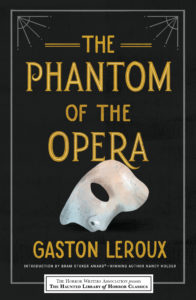
It’s been a big year for looking back, with the establishment of the Paperbacks from Hell imprint, Looking forward to 2020, it appears that it will be a big year for looking even further back.  The publication of several books of ghost and Gothic tales in 2019 looks like it was the beginnings of a return to the classics of the genre. 2020 will bring the first volume of HWA’s Haunted Library series that will be published in conjunction with Poisoned Pen Press, The Phantom of the Opera by Gaston Leroux. In addition, Crystal Lake has just announced that they’ll be publishing Crystal Classics, dark tales from the late 19th and early 20th century,  with occasional titles that “challenge” a classic title, and the covers look lovely. Their December newsletter says the first three of these are out in paperback and will also be available as ebooks: they are The Great God Pan by Arthur Machen, with an introduction by William Meikle;  Dagon Rising, a “challenge” to Lovecraft by William Meikle; and The Willows by Algernon Blackwood, with an introduction by Jasper Bark. I’ve been watching over the past several years now as some of the older or lesser-known writers are starting to be introduced to readers who may never have encountered them before, and I think we’ll continue to see this appreciation of writers from earlier times. Given the publication of books like Monster, She Wrote this year, which set a focus on lesser-known women writers (or women writers whose supernatural work was lesser-known) I think we can be sure that there will be more to uncover and appreciate! Of course, time, and literature, and our fears, move on forward, and I think we’ll see more diversity among contemporary writers in 2020 as well, if what I’m already seeing is any indication. It’s an exciting time to be a writer, publisher, librarian, researcher, and reader, and I can’t wait to see what directions the genre goes in next.


Book Review: Ghost Stories: Classic Tales of Horror and Suspense edited by Lisa Morton and Leslie S. Klinger

Ghost Stories: Classic Tales of Horror and Suspense edited by Lisa Morton and Leslie S. Klinger

Pegasus Books, 2019

ISBN-13: 978-1643130200

Available: Hardcover, Kindle edition


‘Tis the season for ghost stories, and with so many out there, Lisa Morton and Leslie S. Klinger had some difficult choices about what to include in this anthology. They have chosen eighteen tales of the supernatural with varying tone, from comic to terrifying, by authors well-known for their ability with supernatural fiction, authors from both Europe and America, authors well-known for their other works who also wrote supernatural fiction, and some authors barely known to the reading public at all.  There is a brief introduction, and each story is preceded with a short paragraph about the author and his works. When necessary, the editors included annotations, but the annotations do not impede the flow of the story; rather, they enrich it.

The anthology begins with a ballad, “Sweet William’s Ghost”,  which is followed by a gothic tale by Johann August Apel, whose work may have inspired the beginnings of Mary Shelley’s Frankenstein. Sir Walter Scott’s “The Tapestried Chamber”, which Morton and Klinger identify as the first modern ghost story, is next.  They then cross the ocean to America for the next two stories, “The Gray Champion” by Nathaniel Hawthorne and “Ligieia” by Edgar Allan Poe. Certainly no one can argue with either Poe’s brilliance or madness in his writing, and both are depicted in full force here.

Three lesser-known  women writers of supernatural fiction all write powerfully of ghosts driven by their emotions towards the ones they left behind. “Since I Died” by Elizabeth Stuart Phelps is a compelling vision of what follows death, narrated by a just-deceased woman observing her lover’s grief, and is one of the outstanding stories in the book. “The Shell of Sense” by the little-known Olivia Howard Dunbar, details the vengeance, and eventually forgiveness, of a recently-deceased wife on her husband and sister when she discovers they have fallen in love.  In Georgia Wood Pangborn’s “The Substitute”, a lonely woman is visited by a friend who is desperately in need of her help.

Charles Dickens, M.R. James, Edith Wharton, Henry James, and Charlotte  (Mrs. J.H.) Riddell all tell stories of mysterious and terrifying ghosts.  Ambrose Bierce creats a nightmarish, fantastical world in “An Inhabitant of Carcosa”, and Frank Stockton’s “The Philosophy of Relative Existences” is almost science-fictional in nature, a thoughtful puzzle of a story.  Arthur Machen’s “The Bowmen” , based on actual news reports, described a battle during World War I where one of the British servicemen summoned St. George and his bowmen to defeat the Germans. The brief descriptions of the war, and the detail in which Machen is able to vividly portray the men and their despair in very few words, are very powerful. One of my favorites, a surprise to me, was Mark Twain’s “A Ghost Story”, which had me laughing out loud.

The variety in this collection of ghost stories is impressive, and I really appreciated the inclusion of both lesser-known women writers of supernatural fiction, and supernatural stories by writers better known for other work. Over the past several years I have done a lot of reading on my own on early women writers of supernatural fiction and until very recently it’s been difficult to find any work by some of them at all– and for those who are better known for their other writing, their supernatural tales have often been disregarded or kept under wraps. It would be easy to lean back on just a few authors already known for their ghost stories, but the effort that went into making sure this carefully curated anthology was varied in its authors and contents is something I really appreciate. Ghost Stories: Classic Tales of Horror and Suspense is a perfect read for this Halloween season.