Home » Posts tagged "ghost stories" (Page 5)

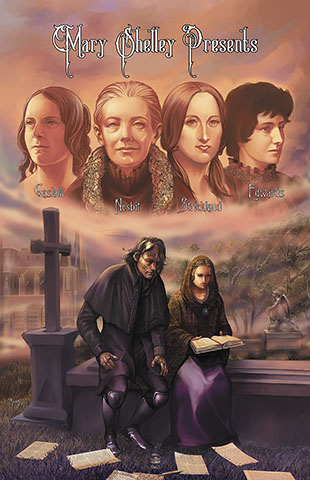
Graphic Novel Review: Mary Shelley Presents: Tales of the Supernatural Vol. 1 by Nancy Holder, art by Amelia Woo

cover for Mary Shelley Presents Vol. 1

Mary Shelley Presents: Tales of the Supernatural Vol. 1 by Nancy Holder, art by Amelia Woo (available only through Kymera Press)

Kymera Press, 2020

ISBN: 978-0-9965558-0-7

Available: Hardcover, trade paperback


Mary Shelley Presents: Tales of the Supernatural #1 is the first in a series from Kymera Press adapting stories by Victorian-era women writers of supernatural fiction. With a foreword by Lisa Morton, who just published her own anthology of Victorian women’s supernatural fiction, followed by Isabelle Banks’ poem “Haunted”, this first volume adapts “The Old Nurse’s Tale” by Elizabeth Gaskell, “Man-Size in Marble” by Edith Nesbit, “The Case of Sir Alister Moeran” by Margaret Strickland, and “Monsieur Maurice” by Amelia B. Edwards.  Each story is preceded by a short introductory paragraph from the publisher and the author, Nancy Holder, and then introduced by a spectral Mary Shelley, accompanied by her Creature. These authors have written some wonderful, chilling stories , but they do get wordy for an impatient, modern audience. Holder’s adaptations slim the stories down while preserving the quality of the storytelling, and Amelia Woo’s gorgeous color illustrations are a perfect accompaniment. The brilliant ghosts, period clothes, and detail in darkened woods and cemeteries pull the reader right in. Each adaptation is followed by the full text of the story. As someone with poor eyesight I could have wished the text was a little larger, but some of the original stories are very long– it took skill and collaborative effort to be able to successfully adapt them.

This is a great way to introduce readers to some excellent women writers who, until very recently, had not received recognition for their supernatural fiction, as well as a treat for those of us already familiar with these authors, who would love to see them gain a larger audience.  I’m hoping we won’t have to wait too long for volume 2. Highly recommended for ages 12+.


Editor’s note: In the interests of full disclosure, I backed the Kickstarter for this book.


Book Review: The Chill by Scott Carson

The Chill by Scott Carson

Atria/Emily Bestler Books, 2020

ISBN-13: 978-1982104597

Available: Hardcover, Kindle edition, audiobook, audio CD


When authors decide to try another genre, it can be a fun ride. The newest name to jump into the darkest end of the pool and go for broke with a horror novel is Scott Carson, better known as New York Times bestselling thriller writer Michael Kortya. Kortya wrote a few books with supernatural elements before going to pure thrillers, but as Scott Carson, he goes all out with a straight horror novel that vacillates between slow burn atmospheric dread and balls-out fights; a mix, perhaps, of Peter Struab and Michael Marshall Smith.

Far upstate in New York State, an old town exists– underwater. The residents who lived there lie drowned beneath the dam that was built to supply New York City with water through a series of tunnels. Those who built the reservoir at Galesburg over eighty years ago had the people leave, bought them out of their homes, and resettled them in Torrance (a Stephen King nod?).

Or so people were told.

Those who didn’t leave still dwell beneath the surface, and their time has come to reclaim their town, along with exacting a bit of revenge on the descendants of those who profited on their deaths.

Back in Torrance, Chief Steve Ellsworth keeps a lid on everything– all except for his son, Aaron, who has returned from a failed stint in the Coast Guard as an ace swimmer and diver. Now plagued by an addiction to drugs and alcohol, he meanders through the town evading rehab and responsibility. All of that changes one fateful evening when he decides to swim in the Chillewaukee reservoir, known to locals as the Chill, to battle the current and prove himself one more time.

An odd photographer, Mick Fleming, a man with a long lineage in the area, emerges from nowhere to discuss the history of the town, the dam, and nothing much at all. Afterwards, Aaron accidentally kills the dam inspector with a bottle toss, only to see Fleming walk out of the woods as if nothing had ever happened. Chief Ellsworth, environmental officer Gillian Mathers, and others witness the event, are convinced Aaron’s lost to substance abuse, and take him home. This act sets the story into motion, as Fleming learns of his role in the town’s revenge, while Gillian’s father, working in the tunnels beneath the Big Apple, begins to see the ghosts of those who perished during the construction of the century-old system.

The histories of the main players unfold with an artful touch as the dread and suspense build towards a conclusion that might be inevitable. Like the best horror writers, Carson knows the characters are the key to a solid story. He builds each of them, every one flawed and fragile. Watching them both crumble and strengthen is a treat. This is what makes The Chill an ultimate success. Its unique premise, coupled with one of the most talented writers publishing today, results in an entertaining book that will likely keep readers of both genres happy. Recommended.


Reviewed by David Simms


Book Review: The Poe Estate (The Grimm Legacy, Book 3) by Polly Shulman

The Poe Estate (The Grimm Legacy, Book 3) by Polly Shulman

Nancy Paulsen Books, 2015

ISBN-13: 978-0399166143

Available: Hardcover, Kindle edition, audiobook, audio CD


This, sadly, is the last book in a trilogy where the real star is not any particular character, but the New-York Circulating Material Repository, a combination library/museum/pocket dimension of fictional objects. The first book, The Grimm Legacy, introduced high school students Elizabeth Rew and Andre Merritt, who were hired to work as pages in the Repository, as they discovered magical objects from fairytales and fantasy. The second book, The Wells Bequest, introduces science geek Leo Novikov and explores fictional objects found in science fiction tales. This third book, The Poe Estate, ventures into the world of Gothic and early horror fiction. It takes place years later, after Elizabeth has become a librarian. She and Andre travel New England looking for haunted objects and houses to store in the repository’s Poe Annex (a detail I loved was that in order to reach the Poe Annex, visitors must first travel through the Lovecraft Corpus, which is just as creepy and atmospherically terrifying as you would expect). However, unlike the first two books, we get a first-person narrator, sixth grader Sukie, whose protective older sister Kitty died from an inherited blood disease from her mother’s side of the family, the Thornes.  Kitty haunts Sukie, still compelled to protect her even after death. Sukie and her parents, suffering financially, move into Thorne Mansion, which is in a sad state of disrepair, with their mother’s very elderly cousin, Hepzibah Thorne, and Sukie soon discovers another ghost haunting the house.  After meeting Elizabeth and Andre at a flea market, Sukie discovers that the house, and members of her family from generations past, appeared in an unfinished Gothic novel. Sukie, Andre, and Elizabeth go on a treasure hunt, passing through the Lovecraft Corpus, visiting the Spectral Library (a fictional library with a ghostly librarian, containing fictional books that exists inside a story: examples of fictional books include the Necronomicon and The King in Yellow, both of which are better handled by a ghost than a human being), and traveling through the Poe Annex, which contains not just haunted houses, but haunted ships, haunted trains, and haunted islands. There are enough Easter eggs in this book to give any fan of Gothic and early horror fiction plenty to delight in, and the metanarrative is kind of fascinating, although it’s also somewhat confusing.

I personally am absolutely delighted to see the names of some of these lesser-known stories (such as “Afterward” by Edith Wharton and “The Wind in the Rose-Bush” by Mary E. Wilkins Freeman) and authors appear in a middle grade novel, and I love the Repository and its collections. However, Sukie’s story as a girl dealing with grief over the death of her sister, financial difficulties at home, and bullying at school, whose elderly cousin is being pursued by unscrupulous developers, gets shafted by the author’s need to incorporate the Repository into the narrative. Jonathan Rigby, the villain from previous books, doesn’t get much space in the story, and the conflicts and relationships don’t get the attention they deserve. Sukie’s story is definitely a middle-grade story, but its intersection with the Repository storyline mostly derails it in favor of dropping names that might not be familiar even to many adults. Shulman could get away with this in The Grimm Legacy, because most kids have a basic familiarity with fairytales, but I don’t think it works here.

If you are an adult who loves the idea of  fantastic libraries or getting to step into favorite stories (visiting the House of Usher, flying on a broom from Young Goodman Brown, tracking down Captain Kidd’s treasure) then this is a really fun book.  Unfortunately, I think a lot of it will go over the target audience’s head. Polly Shulman does provide a list of authors and titles mentioned in the text, and she got me interested enough in Hawthorne to look some of his stories up (The Scarlet Letter successfully turned me off to Hawthorne in high school), but I have trouble seeing kids in elementary or early middle school  actively seeking these stories out on their own. This isn’t great writing, but it’s a lovely tribute with an enjoyable concept,  one of those books that is best shared between an adult who loves the genre and the kids in their lives.