Home » Posts tagged "ghost stories" (Page 10)

Musings: Writing From The Heart: Strange Star by Emma Carroll and Out of the Wild Blue by Blue Balliett

Strange Star by Emma Carroll

Delacorte Books for Young Readers, 2018

ISBN-13: 978-0399556050

Available: Hardcover, Kindle edition


In a recent interview, R.L. Stine expressed his frustration with the writing advice “write from your heart.” To paraphrase, he said “I don’t write from the heart. I write to entertain.”

You may argue that Stine writes formula fiction, which can be predictable, and that it’s shallow to write only to entertain. Only you can make that decision, but know that just because you are writing out of love, that doesn’t mean your writing will be loved, or even understood, by the audience you are trying to reach. I’m writing about children’s books here because that’s what I love and where I’ve recently seen examples of this, but if you’re writing for any audience, this still applies. In general, people who read to escape are looking for a good story, one that flows. They don’t want to have to work for their chills and thrills. I think that’s particularly true for children and teens.

I’ve come across two books this month that illustrate this perfectly. The first one, which I recently reviewed here, Out of the Wild Blue, by the outstanding children’s author Blue Balliett, was a tribute to Nantucket and its ghosts. It is clever and literary, and the worst book she’s ever written. I read it because I was asked to by another school media specialist who couldn’t get through the first 20 pages. Both of us are baffled at the amazing reviews this book has gotten from other librarians and reviewers. Heavy on atmosphere, this book shorted us on character development and plot. It was WORK for me to get through it, and what kid wants to have to work for the creepiness and chills you expect in a ghost story? I mean, the story is practically a love letter, but it’s not successful as an accessible ghost story for children. Or, for that matter, for at least two other adults with expertise in children’s literature.

The second, Strange Star, by Emma Carroll, has a lot of originality, although it’s not necessarily successful at getting the reader to fully suspend disbelief, and some of the pieces don’t connect as smoothly as they could. Strange Star centers on the events of the “haunted summer” during which Mary Shelley first conceived of Frankenstein. The first point of view character, is Felix, a free black servant boy working for Lord Byron at the Villa Diodati, whose goal is to convince Byron to take him back to England as a footman. His story is told in third person. We get Felix’s impressions of Byron, the Shelleys, and their friends, and some pretty detailed information on them is communicated through him. Felix isn’t only used as a way to communicate information, though. He is a character with agency and his own motivations. The second point of view character, Lizzie, an English village girl who was struck by lightning, blinded, and kidnapped by a scientist obsessed with using electricity to resurrect the dead, speaks in her own voice. Her experience of the same group of people that Felix admires is a terrifying one.

The author named many of the fictional characters in the book after characters in Frankenstein as well, even naming the scientist Francesca Stine. She managed to include historical figures like William Godwin, Mary’s father (a relatively minor part of her life after she ran away with Shelley) as a character, whose motivations and actions help move the story toward its conclusion. The messages of and ideas behind the creation of Frankenstein come through clearly in the book—clearly Carroll did her research and used it creatively.

As someone who’s read Frankenstein and also read a lot about Mary Shelley, I found this to be really well done and clever. It is vivid, not just in its descriptions and setting (the title is Strange Star for a reason), but in its portrayal of terrible emotions, particularly grief. Carroll also did a nice job of seamlessly integrating diversity into her characters. But I am not the audience. This is a book written for middle-schoolers, most of whom will not yet have read Frankenstein or heard of Mary Shelley. They won’t even yet have encountered the work of Percy Shelley or Lord Byron. They will miss most of the references and won’t be able to connect the dots when things are implied rather than stated outright (okay, maybe you don’t want them to figure out that Claire Clairmont has a thing going on with Byron). You would have to love Frankenstein and be fascinated with the life of Mary Shelley to write this book, but so much of it will be above the heads of the readers it is targeted for!

I’m sure there are more readers for this than for Balliett’s book, because Carroll handles plot and character development much more effectively—parts of the book are disturbing and even terrifying—but while Strange Star is definitely one to remember, and certainly one I’d recommend to fans of Mary Shelley, it’s more the book that Carroll wanted to write than the one her target audience will appreciate.

As an adult choosing or reviewing a children’s book for a child or teen, it can be easy to forget that we can’t read these books as if they’re written for us when making recommendations. And as an adult choosing to write a book for a child or teen, or really anyone looking to read for pleasure, it’s important to recognize that, if you want to reach readers, writing from your heart is not enough.


Book Review: Out of the Wild Night by Blue Balliett

Out of the Wild Night by Blue Balliett

Scholastic, 2018

ISBN-13: 978-0545867566

Available: Hardcover, paperback, Kindle edition, audiobook


Blue Balliett is a gifted writer with a lyrical voice and quirky tone to her books. Typically she writes what I would describe as puzzle-box mysteries– they have many complex and seemingly unrelated pieces that have to be pulled into place at the right time by their child protagonists to solve a crime that involves a literary or artistic work of some kind. Since her first book, Chasing Vermeer,  was published, a number of other children’s books that require the characters to solve puzzles and codes have come out, but hers remained an outstanding and unique voice, although her narratives have gotten more difficult to navigate, and some books have been better than others. I picked this one up when a colleague told me she was unable to get more than 20 pages in. Surely she couldn’t be speaking of a book by Blue Balliett?

In Out of the Wild Night,  Balliett is trying something completely new– a ghost story, told by a ghost, that takes place on Nantucket, where a greedy real estate investor is buying up historic houses and gutting them to replace the original interiors with modern, updated ones, much to the consternation of some local children and, apparently, some very unhappy ghosts. Balliet’s stories often involve object conservation or historic preservation, and in this case, the absent mother of Phoebe, one of the children, is away studying historic preservation while the houses on Nantucket are being subjected to “renovation.”

My original thought was that Balliett wanted to write about Nantucket more than she wanted to write a good ghost story for children, and a well-hidden author’s note at the back bears that out. Balliett lived in Nantucket more than once, as a teenager and young adult, and it is clear that she deeply loves it and wants to share it with her readers… and for her, living in Nantucket is inextricably intertwined with ghosts.  But her choice of a a 100-year-old ghost woman unable to impact her world or even feel much as a narrator, instead of a child protagonist led to a faded story and atmosphere, and the characters seem like they are afterthoughts. It’s unlike Balliett to leave ends dangling, but while I struggled to get through a majority of the book, in which it seemed that nothing happened, after several rereads of the end chapters I’m still unsure of what actually happened to resolve events as they did. You’d have to be a very careful reader to arrive at her big reveal without being completely confused.

Despite her love of Nantucket and its ghosts, and as lyrical as her writing can be, Balliett fails to evoke the sense of place she’s working to create in her fiction that I’ve felt in books that do bring similar locations to life, such as Rass Island in Jacob Have I Loved, where the environment was intimately tied to the protagonist’s emotional intensity. In her follow-up note, Balliett’s evocation of Nantucket is much stronger than it is in the novel, and I’m left thinking that she wrote the wrong book, and would have done better to create a connected collection of ghost stories of and nonfiction sketches about Nantucket.

As much as I love Balliett’s work, especially Chasing Vermeer, she failed her readers in this book. It does not completely develop either the small world of Nantucket or the Gothic feel of a ghost story, but the pieces aren’t there to put a mystery together; the pacing is slow, the characters aren’t given the space they need to develop, the narrator is ineffective at communicating, and the plot does not hang together. As it is, the primary thing it accomplishes is to briefly bring attention to Nantucket, the importance of restoring the interiors of historic houses, and of building a sense of community. Balliett is clever and creative in her writing, but it’s frustrating to get to the payoff, and more work that the children in the target age range for this book are probably willing to do.

I hope to see another great book from Balliett soon. Sad to say, this one isn’t worth the time and work it takes to read it. Appropriate for ages 9-12, and middle school library collections.

Contains: violence, attempted murder


Interview: Ivy Noelle Weir and Christina “Steenz” Stewart, Creators of Archival Quality

It wasn’t too long ago that we reviewed the graphic novel Archival Quality by Ivy Noelle Weir and Christina “Steenz” Stewart. Monster Librarian reached out to the creators, both professionally qualified librarians, through reviewer Lizzy Walker. Check out their interview, read our review, and then get your library card and check out Archival Quality!


Interview with Christina “Steenz” Stewart and Ivy Noelle Weir 


Christina

Christina “Steenz” Stewart


LW: Tell Monster Librarian readers about yourselves.

CS: My name is Steenz! It’s short for Christina. I work at Lion Forge as the social media and community manager. I used to be a manager of a comic shop and a comics focused librarian. I live with my fiancé Keya and my cat Marko. We are currently going through Arnold Schwarznegger’s entire filmography.


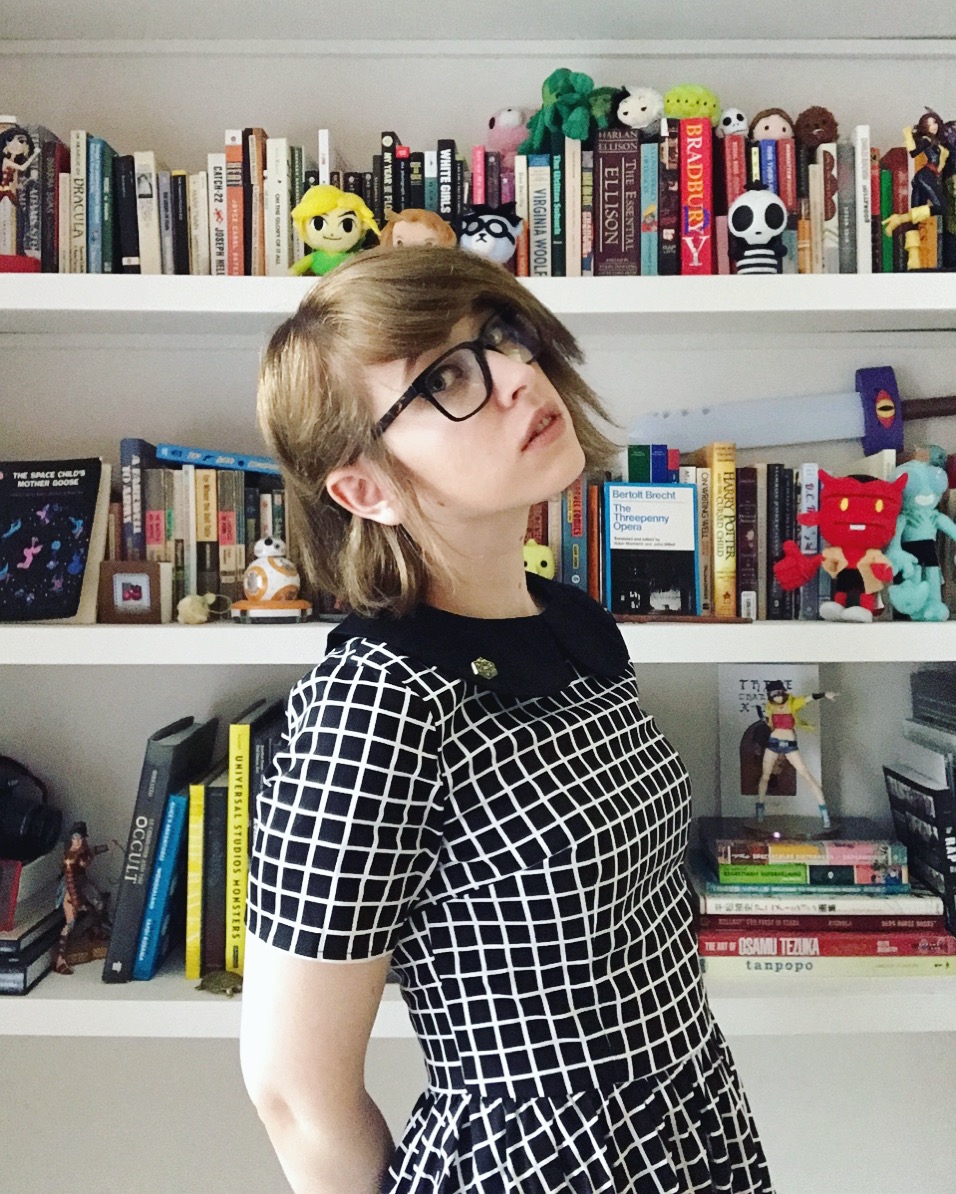
Ivy Noelle Weir

Ivy Noelle Weir


IW: I’m Ivy Noelle Weir, I’m a writer and an MLS-holding former librarian who now works in book publishing.

LW: What attracted you to working on this book?

CS: We became friends through The Valkyries. As I moved on to working in a library after comics retail, I reached out to Ivy to talk about the switch. And then we just started talking every day, every hour, from morning till night and became besties. It was soon after best friend status Ivy asked if I wanted to illustrate a webcomic with her and of course since I’d been itching to do a longform story for so long, I said yes! Also, the story is really good, so I was 100% on board after reading her summary.

IW: As Steenz said, we met in The Valkyries, and I just immediately loved her art from the moment I saw it. There’s a liveliness to Steenz’s art, her expressions are so lifelike and fun. I knew I wanted to work on something with her.

LW: What inspired you to create Archival Quality?

IW: It’s sort of a long story. I did my undergraduate studies in photography, and I became really fascinated by 19th century medical photography, and the ethics surrounding it. I took an internship in a historical medical archive, where I was working closely with images all day that were, to put it mildly, somewhat disturbing, but also deeply sad, isolating, lonely. While I was working there, I fell deeper and deeper into considering the ethics of archiving, what we preserve, and if it consents to being preserved. So, I started writing a ghost story about the ghost of an object in an archive, who doesn’t consent to being archived. Eventually, this turned from a prose novel to a comic script when I met Steenz, and now here we are.

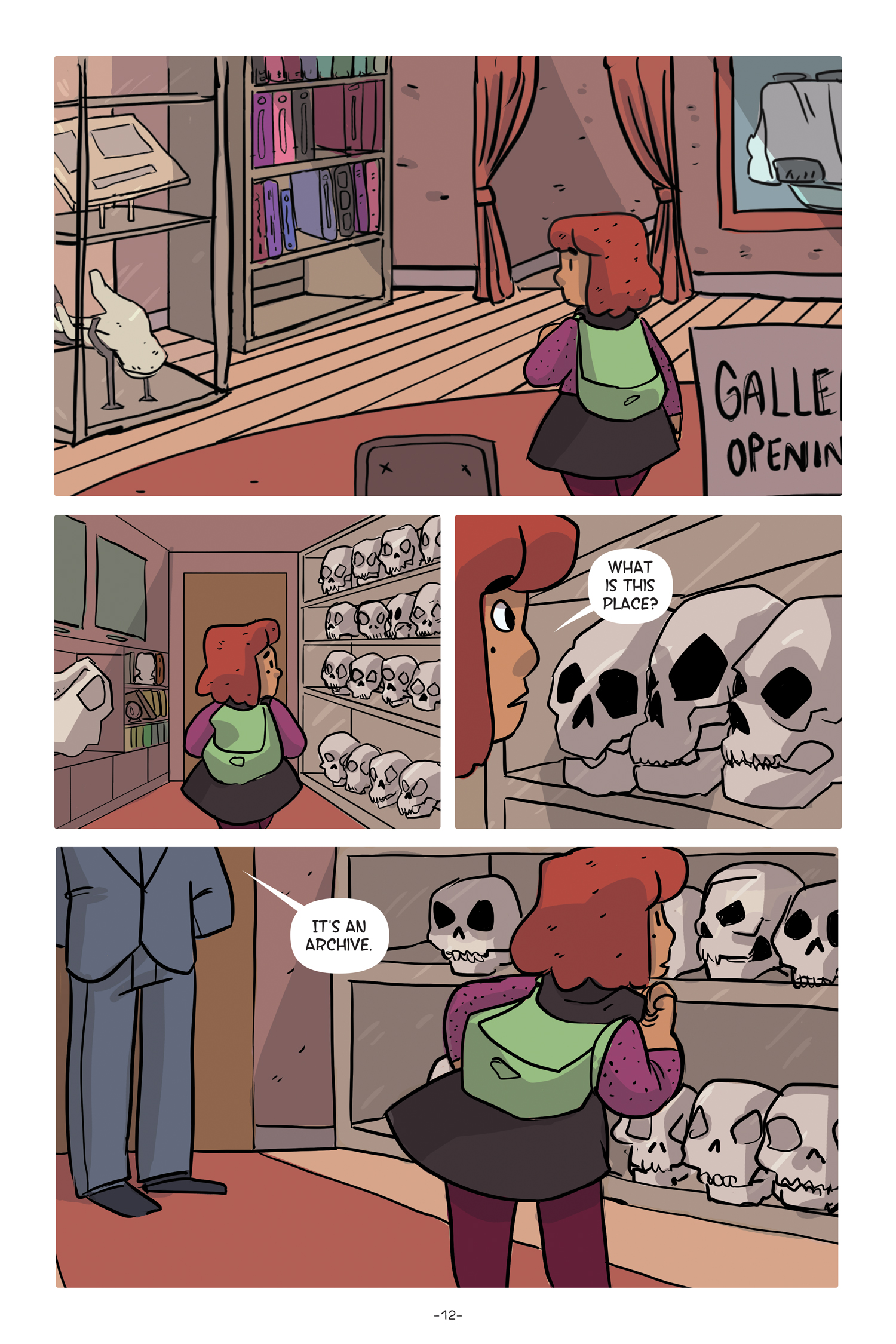
Image from Archival QualityLW: Why did you choose to frame Archival Quality as a ghost story? What drew (ha) you to the horror genre? Are you a horror fan? Why or why not? Do you have recommendations for similar material?

CS: I’m ALL ABOUT horror. I love being scared. There’s something thrilling about watching a film and feeling uneasy afterwards. It’s kind of like a high. I recommend the Poughkeepsie Tapes if you don’t want to sleep for like two nights and Housebound if you’re looking for humorous horror.

IW: I’m a big ol’ horror nerd, and I always have been. I particularly love ghosts and haunted houses – I think they represent so much more than jump scares, they can be this pensive consideration of memory and trauma. The biggest influences on this story were Guillermo Del Toro’s The Devil’s Backbone, Mark Z. Danielewski’s House of Leaves, and Shirley Jackson’s The Haunting of Hill House. I think Jackson’s book in particular blends the concepts of the highly personal with horror in a really fantastic way.

LW: You tackle the subject of mental illness and care very delicately, while at the same time head on. How did you manage to craft such a powerful narrative and equally powerful artwork for this story?

CS: I think when it comes to the art, I read the story… and knowing Ivy as a person, I felt like I had a good idea of what she was looking for in terms of style. We were on the same page when it came to aesthetics for this story. A shared Pinterest helped me a lot. Also knowing that Ivy trusted me entirely with the design of the book and characters let me stretch my world building muscles.

IW: For the story, it was very important to me to show a realistic portrayal of mental illness as it exists for one person. I think when you try to generalize, and make a narrative that fits everyone, or has a “happy” ending where someone is cured or “fixed”, you come up with something that I don’t feel is as genuine or effecting. Depression doesn’t always mean being beautifully sad. Sometimes it means being a jerk to the people around you because you feel out of your own control. I know some people won’t relate to Cel – and I think that’s okay. Depression looks different on everyone, and everyone’s path to helping themselves is doing to be different, too. It was important to me to show someone who struggles with the concept of getting help, because I think a lot of people who struggle with their mental health can relate to that feeling.

LW: Are there any plans or desire to further develop Celine’s story?

CS: I think Celine’s story is done. Celeste on the other hand could have many more adventures and continued growth. But I think we both want to take a break from the world of AQ for a little bit before getting into that.

IW: No, I think she’s got what she needed.

LW: Steenz, your artwork is so unique. I particularly love Holly’s character design! I also follow you on Facebook and adore your kung fu poses. How did you achieve your art style? What tools do you use for your work?  

CS: Thank you! I think when you’re learning to draw you subconsciously create your own style by fusing your interests with what your muscles naturally want you to do. I love Chris Sanders, Rebecca Sugar, and similar works. So, you can see the inspiration, but my style peeks through. I use a WACOM Cintiq, Manga Studio, and Photoshop. I’m hoping to get an IPad soon because all of my other comics friends has one and I’M HORRIBLY JEALOUS. Also, being able to work away from the desk is an amazing idea.

LW: Why should new graphic novel readers seek this out?

CS: Ivy and I both love reading works that aren’t just graphic novels. So, I think our work shows that. It has elements of cartoons, manga, and YA novels. So, if you like those things, there’s no way you won’t like Archival Quality.

IW: I think if you’re interested in haunted house tales, we’ve done something unique here in regard to the genre. And like Steenz said, we both brought techniques from a lot of the other media we consume to this book.

LW: Why should libraries be interested in Archival Quality?

CS: Well, we used to be librarians. And once a librarian, always a librarian. Support the homies, yanno?

IW: I think books that discuss the ethics of librarianship and archives in a conversational way are few and far between, and I hope Archival Quality offers libraries a way to engage with the topic while also getting spooked.

LW: What are some of your favorite books/graphic novels?

CS: Novels: The Lunar Chronicles, Six of Crows; Graphic Novels: Extremity, Daytripper, This One Summer, Batman: Detective Comics, Ms. Marvel, etc. I could go on for a really long time, but those came to my head first. Webcomics: On A Sunbeam, Agents of The Realm, Star Trip, Witchy


IW: Well, my favorite book is the previously mentioned The Haunting of Hill House. I just finished Night Film by Marissa Pessl and really enjoyed it. As for comics, I read pretty widely: I’m a big fan of Hellboy, Saga, Wicked + Divine…I also read a lot of manga – I’m loving The Girl from the Other Side right now.

LW: What other work have you done, separately or together?

CS: We’ve done work for anthologies together. Separately I’ve done work for the MINE! Anthology for Planned Parenthood and the ELEMENTS: Fire Anthology.

IW: We had a short story come out this month in Action Lab’s Princeless Charity Anthology!

LW: What else would you like librarians and readers to know about you?

CS: I tell everyone this, but GET A LIBRARY CARD. Also, I’ve spent many, many, many hours in libraries and I can guarantee you 100% that this is a book that you will want to curl up in a corner of your local library and read from beginning to end.

IW: I second Steenz’s urging for readers to get a library card. Libraries serve so many roles in their communities; your support is integral!

LW: What’s next for the amazing Ivy/Steenz team? 

CS: We’re working on a pitch for another book! Can’t say much other than that. So, GET READY.

IW: We’re working on something new! Which I should really get back to writing.