Home » Posts tagged "fungal horror"

Book Review: Shiny Happy People by Clay McLeod Chapman


Shiny Happy People by Clay McLeod Chapman

Delacorte Press, 2025

ISBN-13 ‏ : ‎ 978-0593904084

Available: Hardcover, ebook edition, audiobook

Buy:  Bookshop.org


I find Clay McLeod Chapman’s work uniquely disturbing. While Shiny Happy People, his foray into YA horror, isn’t as gruesome as some of his previous projects it is a natural fit with his other work, especially Wake Up and Open Your Eyes. 


Kyra was abandoned by her addict mother at a young age and is now the adopted daughter of a loving family. Her father works long hours at a large pharmaceutical company, BoTanic, which employs most of the town. She has terrible anxiety and panic attacks, and a supportive “black sheep” best friend, Halley.


Kyra’s need for control and family history of addiction mean she’s completely straight-edge even in the face of peer pressure, so when a new party drug starts making the rounds at school, she’s one of the few who hasn’t taken it and can observe the effects it is having on the people around her. Kids who have taken the drug go into violent convulsions, followed by becoming artificially happy and calm, causing an uncanny valley effect that Kyra feels but can’t explain to the adults around her, who are also acting very strange. With the people around her all gaslighting her, Kyra starts doubting her grip on reality. The only person who seems to be on her wavelength is new boy Logan, who is clearly hiding something.


Flashbacks to Kyra’s abandonment in a dark room infested with bugs, mold and fungus are truly claustrophobic and creepy, On a personal level, as someone who lives with epilepsy, the descriptions of violent convulsions created a visceral response. Kyra’s description of her anxiety as “ivy threaded through my ribcage” is vivid, and when it gets entangled with already-creepy fungal horror, becomes terrifying, with its network spreading wider and wider. This horror is not limited to one school or even one town.


There is so much going on in this book: it comments on addiction, Big Pharma, hive mentality, peer pressure, corruption, mental health, and more, but messaging doesn’t take over the story. Chapman follows Kyra’s narrative thread all the way through at a fast pace. It’s an uncomfortable, disorienting ride, and one that’s well worth taking.


Highly recommended.


Reviewed by Kirsten Kowalewski
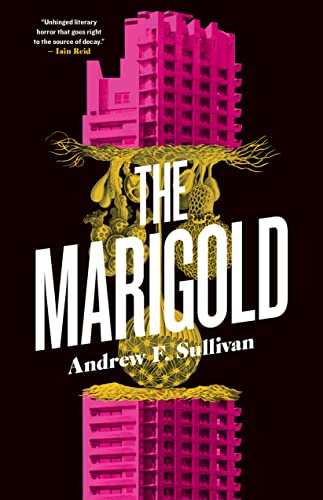
Book Review: The Marigold by Andrew F. Sullivan


The Marigold by Andrew F. Sullivan

ECW Press, 2023

ISBN: 9781770416642

Available: Paperback, Kindle edition 

( Bookshop.org  Amazon.com )


The Marigold is a book readers will probably either love or hate: there won’t be a lot of in-between.  It has a wildly inventive plotline revolving around city decay and revival, but its more literary style of prose may split readers: some will see it as genius, others as overly pretentious writing.  


As noted, the plot is a true original, a nice horror-spiked take on urban blight.  The book asks: what if there is a physical cause?  That’s where the antagonist of the book, a fungus (or is it?) called the Wet, slides in, invading certain buildings in Toronto.  Where the book really shines is playing with the possibilities throughout the book, never giving away too much.  Is the Wet just an annoying mold? Can it infect people?  Could there be intelligence directing it, or is it a sentient being in its own right?  Scary possibilities!  The author does a fantastic job leaving the avenues open, and it all becomes clear at the right time.  He also avoids the usual big reveal at the end, and the story is much better for it.  Tied in to this plot thread is another, the idea of actual sacrifices needing to be made to keep buildings standing upright.  The two threads together make for a very creative knot in terms of story.  Regardless of whether you like the book, one has to admire how well laid out the scenario is.


The book itself moves at somewhat of a “slow burn” pace, gradually picking up some speed, but it’s not a fast page-turner: it works best read in chunks.  The characters push the story where it needs to go. They include a mix of health investigators, unscrupulous land developers, some nosy ordinary citizens, and a conspiracy theorist or two.  All the pieces fit where they should in terms of character development, and there’s enough backstory for the characters to appear believable and generate emotion.


It’s the writing that is a blessing or a curse, depending on how you look at it.  This isn’t straight-ahead Stephen King style writing, it’s more in the vein of T.E. Grau.  The problem is, it doesn’t always work.  The author is capable of reeling off beautifully written passages that would do a literature professor proud, and does it often. However, there are plenty of times where it winds up bogging down the story, instead of driving it.  The main examples are the chapters dealing with how the Wet invades different apartments in the building called the Marigold, and what happens to the tenants.  These chapters could have been trimmed down or slashed altogether. They muddle the pacing, and don’t add to the story.  I started skimming those chapters, since I already knew how the chapters were going to end.  Some of the character dialogue scenes suffered the same problem. They needed less fluff and more stuff.   When it’s good, it’s very good, but the book lacks consistency.  


Bottom line time: The Marigold has a lot of good qualities, but also some glaring deficiencies to overcome.  


Recommended for readers who like what they read above.  It’s not for all, but definitely for some.


Reviewed by Murray Samuelson

