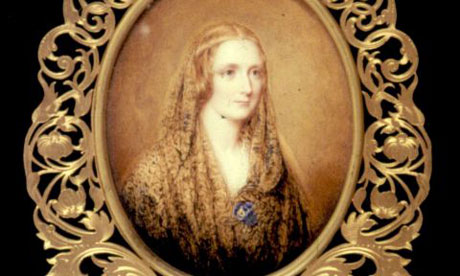
Any time the topic of women in horror fiction comes up, someone almost immediately mentions Mary Wollstonecraft Shelley. It’s a little frustrating to me because usually she’s the only one, or one of a very select few, whose names are repeated over and over, even though there are a wide variety of women writing horror. But I can certainly understand it. She wrote a novel that has resonated with countless individuals on many levels, reimagined in a variety of media, with varying interpretations. Even people who don’t know who Mary Shelley is and have never read the book are familiar, in some way, with the Frankenstein story. It is that ingrained into our culture. It is an incredible accomplishment that a teenage girl not only had a terrifying vision– we all have nightmares at some point– but that she penned her story with such passion and horror that, if you can get past the clunky beginning, it stirs the reader’s emotions and twists at the heart. In her own words:
When I placed my head on my pillow, I did not sleep, nor could I be said to think. My imagination, unbidden, possessed and guided me, gifting the successive images that arose in my mind with a vividness far beyond the usual bound of reverie. I saw – with shut eyes, but acute mental vision – I saw the pale student of unhallowed arts kneeling beside the thing he had put together; I saw the hideous phantasm of a man stretched out; and then, on the working of some powerful engine, show signs of life, and stir with an uneasy, half-vital motion.
Frightful must it be; for supremely frightful would be the effect of any human endeavour to mock the stupendous mechanism of the creator of the world. His success would terrify the artist; he would rush away from his odious handiwork, horror-stricken. He would hope that, left to itself, the slight spark of life which he had communicated would fade – that this thing, which had received such imperfect animation, would subside into dead matter, and he might sleep in the belief that the silence of the grave would quench for ever the transient existence of the hideous corpse which he had looked upon as the cradle of life. He sleeps, but he is awakened; he opens his eyes, behold the horrid thing stands at his bedside, opening his curtains, and looking on him with yellow, watery, but speculative eyes! I opened mine in terror.
The idea so possessed my mind that a thrill of terror ran through me…
I returned to my ghost story – my tiresome unlucky ghost story! O! if I could only contrive one which would frighten my reader as I myself had been frightened that night! Swift as light and as cheering was the idea that broke in upon me. “I have found it! What terrified me will terrify others; and I need only describe the spectre which had haunted my midnight pillow.”
In The Monsters: Mary Shelley and the Curse of Frankenstein, Thomas and Dorothy Hoobler describe Mary’s life in great detail. At eighteen, Mary Wollstonecraft Godwin, not yet married to Shelley, was intimately familiar with the creation and destruction of life. Her mother, Mary Wollstonecraft died eleven days after she was born, an event which shaped the rest of her life.When her father remarried, she was displaced by a stepbrother. At sixteen, she had already run off with Percy Shelley, who was already married (although estranged from his pregnant wife). Before the summer of 1816, she had borne two children, the first of whom died before she had even been named. By the age of eighteen, Mary was very familiar with how easily life can slip away. Percy Shelley, unstable but brilliant, was fascinated with the supernatural and Gothic and also with science, interests that he did not seem to find at odds. Their companions during the “Haunted Summer” of 1816, Lord Byron and John Polidori, were similarly fascinated with both: Polidori, a medical doctor, also began the story that became the classic horror novel The Vampyre that summer. The idea that science, when bent to the manipulation of creating and animating (or, particularly, re-animating) life, could be as destructive and frightening as any supernatural force, was her nightmare, and she made it ours.
I, Frankenstein, yet another interpretation of the Frankenstein story, comes out in movie theaters this Friday. The reviews I’ve seen haven’t been great. Honestly, some of the other versions of the Frankenstein story that have appeared over the years have moved far away from the waking vision Mary Shelley had on a dark and stormy night. Whatever her other tragedies, and there were many in her life, her creation, and her Creature, has changed and grown, and whatever else it has become, there is no doubt that with her novel, she brought them to life. Would she look upon the many incarnations today the way that Victor Frankenstein did when he first saw his creation come to life? Would she be amazed by the tremendous impact a little novel she had to publish anonymously has had on the world? What would Mary Shelley think of the way so many people have co-opted her “midnight spectre?”
 When writing about women in horror, it’s almost impossible not to mention Mary Shelley.





Follow Us!