Home » Posts tagged "Frankenstein" (Page 5)

Book Review: Obsidio (The Illuminae Files_03) by Amie Kaufman and Jay Kristoff, illustrations by Marie Lu

Obsidio (The Illuminae Files_03) by Amie Kaufman and Jay Kristoff, illustrations by Marie Lu

Knopf Books for Young Readers, 2018

ISBN-13: 978-0553499193

Available: Hardcover, paperback, Kindle edition, audiobook, audio CD


Obsidio is the final volume of The Illuminae Files, preceded by Illuminae and Gemina. Illuminae started with the testimony of the Illuminae Group about the invasion of an illegal mining colony on an out of the way planet, Kerenza IV, owned by the mega-corporation Wallace Ulyanov Consortium (WUC), by a second mega-corporation, BeiTech Industries. An SOS call from Kerenza IV brought the only nearby warship of the United Terran Authority, the Alexander, to the defense of the colony. After crippling BeiTech’s jump platform and damaging its ships, and filled with refugees, along with two other ships belonging to the WUC, the Copernicus and the Hypatia, thousands of refugees escaped, chased by the crippled BeiTech ship Lincoln. The Alexander’s complex AI, AIDAN, which would have been able to speed things along, was damaged.

A bioweapon that BeiTech dropped on Kerenza IV during the attack infected hundreds of refugees, AIDAN, in an attempt to save the fleet, destroyed the Copernicus and took over the Alexander. Teenage hacker Kady Grant and her ex-boyfriend Ezra, now a pilot, take on AIDAN, and with its help destroy the Lincoln. The Alexander, now flooded with the infected, is destroyed in the successful attack on the Lincoln. Despite AIDAN’s participation in large-scale mass murder, Kady saves a copy of his programming onto her tablet before she escapes back to the HypatiaWithout any kind of jump platform, the remaining survivors of Kerenza IV must travel in real-time towards the nearest wormhole that opens to a jump station.

In Gemina, we learn that the BeiTech invasion forces at Kerenza IV has been unable to communicate with headquarters, and that a BeiTech spy embedded in communications at jump station Heimdall has been intercepting all messages from the Kerenza IV refugees. As a result, no one knows there has even been an invasion. An executive from BeiTech, learning from the spy that after many months of travel, the Hypatia is nearing the wormhole, sends a “cleanup team” to prevent the ship from getting through or any news of the attack from getting out. Heimdall’s commander’s daughter, Hanna Donnelly, and her drug dealer, Nik Malikov, are saved from being trapped by just missing the violent arrival of the assassins. Thus begins a deadly game of cat-and-mouse, with Hanna and Nik attempting to eliminate the various members of the kill team, psychotropic monsters, alternate realities, and, finally, contact with the Hypatia. Unable to save the station, Hanna and Nik collect as many station residents as they can onto the ship Mao, and flee through the wormhole, which collapses behind them.

In Obsidio, the refugees realize that there is no way for them to get back to a more central system, and the captain of the Hypatia decides their only option is to return to Kerenza IV. With the Hypatia falling to pieces, the decision is made to transfer everyone to the Mao and scuttle the ship. Kady argues in favor of leaving a beacon, with information about the attack, but the captain shuts her down. Determined that the destruction of Kerenza IV and Heimdall Station be documented, Kady resurrects AIDAN on the Mao, with the hope that, with help from Ezra, Hanna, Nik, and Nik’s hacker cousin Ella, it will compile the information. In the meantime, the adults from Heimdall have noticed that teenagers seem to be running things, and object strenuously, on the grounds that they are more qualified and have better judgement than teenagers do. AIDAN notes that there are more people on the Mao than life support is capable of supporting for the time that it will take to travel back to Kerenza IV.

Then readers get the surprise of discovering that there actually were survivors of the invasion of Kerenza IV. Not only did a significant number of the BeiTech forces end up trapped when their mobile jump platform (which could transport them to another system) was damaged, but there are still a number of miserable colonists, one of whom is Kady’s cousin Asha. When the resistance causes the deaths of the majority of techs on the planet, Asha gets a surprise– one of the replacement techs, who has been working on the jump platform, is her ex-boyfriend, Rhys, who just might be able to get a message out through BeiTech’s communications software. BeiTech is getting close to fixing its mobile jump platform, and won’t leave evidence behind, so the remaining colonists are quickly running out of time.

Horrific things happen in Obsidio. There were times I stopped breathing, or was nearly in tears. Kaufman and Kristoff do not pull their punches in describing the brutality and senselessness of war– and in this case, a war that doesn’t even attempt to disguise itself as anything else than an unapologetic attack on an economic competitor out of greed. Yet there are very few completely unsympathetic characters. What makes someone sign on to participate in a situation like this? How can someone willing to sacrifice his life for a cat command the death of innocent civilians? What makes someone whose job has been protecting others from harm lead a mutiny that ends in blood and death? Knowing that AIDAN has acted ruthlessly in the past, why does Kady keep bringing him back?

One thing that does really bother me is the way that the authors tried to humanize AIDAN. It is clear that by the end of the third book AIDAN is in love with Kady. But AIDAN, as Ella points out, is not a person, but an “it”. AIDAN’s meta-awareness is also frustrating. It somehow has realized that it is in a story and decided that “every story needs its monster”, so it will be the monster. AIDAN is the “Frankenstein” of the series, I get that, but that doesn’t need to be said over and over.

The book hangs on a million coincidences, but it does all hang together in the end.  Obsidio is creative in every way, from its design and the illustrations by Marie Lu (the book is a work of art), to the storytelling through the format of a collection of emails, instant messages, maps, and other documents. It does need to be read following the first two books in order to make sense, but, as long as all three of them are, it is absolutely worth it. I recommend reading this as a hardcover, so you can appreciate the illustrations and full-page designs, but I have also heard that it is outstanding as an audiobook. Highly recommended.
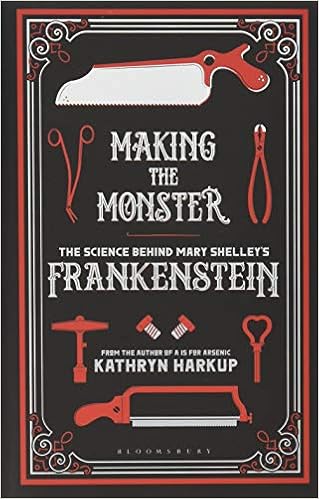
 

Book Review: Making the Monster: The Science Behind Mary Shelley’s Frankenstein by Kathryn Harkup

Making the Monster: The Science Behind Mary Shelley’s Frankenstein by Kathryn Harkup

Bloomsbury Sigma, 2018

ISBN-13: 978-1472933737

Available: Hardcover, paperback, Kindle edition, audiobook, MP3 CD


The primary takeaway I got from Making the Monster: The Science Behind Mary Shelley’s Frankenstein is that Frankenstein really truly is science fiction. There are things implied in the book that science today still isn’t able to accomplish! I think in today’s world we don’t really have the ability to imagine the time that Mary Shelley was writing, when the way people saw the world was in flux, with alchemy only very reluctantly ceding its way to the barely understood beginnings of chemistry, biology, and physical science, and the materials for experimentation not easily available. The potential of science to change what makes us human, as exciting and mysterious as it was, also activated anxieties and fears that, while they have changed in specifics, still affect us today. The mystery of what science could accomplish, though, was so profound at that time that Shelley’s novel of an ambitious, obsessive scientist has so little actual science in it, and so little of the text actually devoted to creating the monster itself.

Harkup breaks her topic down by first summing up the life of Mary Shelley to the point at which she wrote Frankenstein, and then, about 80 pages in, addressing the specific aspects of science and experimentation described in the text. She does a good job of recreating the gruesome aspects of science at that time, and the enthusiasm scientists had that sent them past the point of what we would consider ethically acceptable. She covers some fascinating people and ideas, such as anatomist John Hunter (evidently the model for both Dr. Doolittle and Dr Jekyll); foundational chemist Antoine Lavoisier; serial killers William Burke and William Hare, who sold the bodies of their victims to anatomy schools; and Luigi Galvani and Alessandro Volta, the major players in the debate on the role of electricity in animal and human bodies, among others. Bodysnatching, graverobbing, transplants, preserving body parts in jars, the creation of batteries, chimeras, body decomposition, electroshock therapy, acromegaly, transfusions, feral men, Lamarck’s theory of genetics, all are covered in the pages as the flotsam surrounding educated (and not as educated) people at the time, often simultaneously as entertainment and education.

Making the Monster is interesting, even compelling at times, but there were some stretches that took me a long time to get through. I got impatient when Harkup moved too far into the past or too close to the current day, and much of what she said about where Shelley got her ideas was farfetched supposition. That is, not that Mary couldn’t have encountered these ideas and people, but that she might have encountered (for example) John Hunter’s ideas because of a one-time encounter between Hunter and her father. Despite it running only 274 pages, I ended up picking it up and putting it down several times.

As it’s the 200th anniversary of the novel, this is a good addition to a Frankensteinia collection, and some of the stories about the science of the times make for interesting reading if you are interested in the history of science in the 1800s. Making the Monster is a mostly enjoyable read, but outside of the specific applications of science that tie into the novel, it treads some pretty familiar ground, so it’s not an essential item for most collections.  Recommended for large public library collections and Frankenstein lovers.


Musings: Writing From The Heart: Strange Star by Emma Carroll and Out of the Wild Blue by Blue Balliett

Strange Star by Emma Carroll

Delacorte Books for Young Readers, 2018

ISBN-13: 978-0399556050

Available: Hardcover, Kindle edition


In a recent interview, R.L. Stine expressed his frustration with the writing advice “write from your heart.” To paraphrase, he said “I don’t write from the heart. I write to entertain.”

You may argue that Stine writes formula fiction, which can be predictable, and that it’s shallow to write only to entertain. Only you can make that decision, but know that just because you are writing out of love, that doesn’t mean your writing will be loved, or even understood, by the audience you are trying to reach. I’m writing about children’s books here because that’s what I love and where I’ve recently seen examples of this, but if you’re writing for any audience, this still applies. In general, people who read to escape are looking for a good story, one that flows. They don’t want to have to work for their chills and thrills. I think that’s particularly true for children and teens.

I’ve come across two books this month that illustrate this perfectly. The first one, which I recently reviewed here, Out of the Wild Blue, by the outstanding children’s author Blue Balliett, was a tribute to Nantucket and its ghosts. It is clever and literary, and the worst book she’s ever written. I read it because I was asked to by another school media specialist who couldn’t get through the first 20 pages. Both of us are baffled at the amazing reviews this book has gotten from other librarians and reviewers. Heavy on atmosphere, this book shorted us on character development and plot. It was WORK for me to get through it, and what kid wants to have to work for the creepiness and chills you expect in a ghost story? I mean, the story is practically a love letter, but it’s not successful as an accessible ghost story for children. Or, for that matter, for at least two other adults with expertise in children’s literature.

The second, Strange Star, by Emma Carroll, has a lot of originality, although it’s not necessarily successful at getting the reader to fully suspend disbelief, and some of the pieces don’t connect as smoothly as they could. Strange Star centers on the events of the “haunted summer” during which Mary Shelley first conceived of Frankenstein. The first point of view character, is Felix, a free black servant boy working for Lord Byron at the Villa Diodati, whose goal is to convince Byron to take him back to England as a footman. His story is told in third person. We get Felix’s impressions of Byron, the Shelleys, and their friends, and some pretty detailed information on them is communicated through him. Felix isn’t only used as a way to communicate information, though. He is a character with agency and his own motivations. The second point of view character, Lizzie, an English village girl who was struck by lightning, blinded, and kidnapped by a scientist obsessed with using electricity to resurrect the dead, speaks in her own voice. Her experience of the same group of people that Felix admires is a terrifying one.

The author named many of the fictional characters in the book after characters in Frankenstein as well, even naming the scientist Francesca Stine. She managed to include historical figures like William Godwin, Mary’s father (a relatively minor part of her life after she ran away with Shelley) as a character, whose motivations and actions help move the story toward its conclusion. The messages of and ideas behind the creation of Frankenstein come through clearly in the book—clearly Carroll did her research and used it creatively.

As someone who’s read Frankenstein and also read a lot about Mary Shelley, I found this to be really well done and clever. It is vivid, not just in its descriptions and setting (the title is Strange Star for a reason), but in its portrayal of terrible emotions, particularly grief. Carroll also did a nice job of seamlessly integrating diversity into her characters. But I am not the audience. This is a book written for middle-schoolers, most of whom will not yet have read Frankenstein or heard of Mary Shelley. They won’t even yet have encountered the work of Percy Shelley or Lord Byron. They will miss most of the references and won’t be able to connect the dots when things are implied rather than stated outright (okay, maybe you don’t want them to figure out that Claire Clairmont has a thing going on with Byron). You would have to love Frankenstein and be fascinated with the life of Mary Shelley to write this book, but so much of it will be above the heads of the readers it is targeted for!

I’m sure there are more readers for this than for Balliett’s book, because Carroll handles plot and character development much more effectively—parts of the book are disturbing and even terrifying—but while Strange Star is definitely one to remember, and certainly one I’d recommend to fans of Mary Shelley, it’s more the book that Carroll wanted to write than the one her target audience will appreciate.

As an adult choosing or reviewing a children’s book for a child or teen, it can be easy to forget that we can’t read these books as if they’re written for us when making recommendations. And as an adult choosing to write a book for a child or teen, or really anyone looking to read for pleasure, it’s important to recognize that, if you want to reach readers, writing from your heart is not enough.