Home » Posts tagged "Frankenstein" (Page 3)

Book Review: Miscreations: Gods, Monstrosities, and Other Horrors edited by Doug Murano and Michael Bailey

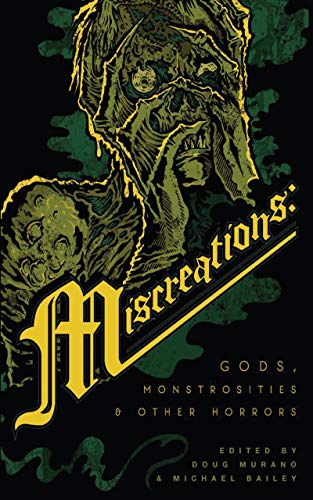
cover art for Miscreations edited by Doug Murano and Michael Bailey

Bookshop.org |  Amazon.com )

Miscreations: Gods, Monstrosities, and Other Horrors edited by Doug Murano and Michael Bailey

Written Backwards, 2020

ISBN-13 : 978-1732724464

Available: Hardcover, paperback, Kindle edition


In the foreword to Miscreations, Alma Katsu writes that “we’re told from childhood that monsters exist… we don’t need anyone to tell us they’re real”. Collected within the pages are 23 tales of monsters of all kinds, from the traditional to the unconventional, from the literary to the personal.  Interspersed is artwork from HagCult, who also did the cover art for the book.

Josh Malerman gives us a werewolf tale in “One Last Transformation” with an engaging, murderous narrator addicted to the change, and a number of writers approach the Frankenstein story in different ways. My favorites of these tales were Stephanie M. Wytovich’s poem “A Benediction of Corpses”  in which the Creature addresses his creator directly, and “Frankenstein’s Daughter”, by Theodora Goss, with its surprising and satisfying ending. Christina Sng takes an unconventional approach to an evil Russian water spirit in “Vodoyanoy”.

More personal monsters also appeared.  Michael Wehunt’s “A Heart Arrhythmia Creeping Into A Dark Room” was an effective and creepy tale about the anxiety and dread that accompany someone living in the shadow of a potential heart attack. The story was flawed by the author’s insertion of a fictionalized monster and victim in a story that was far too realistic. Victor Lavalle’s “Spectral Evidence” touched on the way grief lives on, and Scott Edelman’s “Only Bruises Are Permanent” tells the story of a woman who has the bruises left from an incident of domestic violence tattooed on her body.

Monstrous mothers also appear, in Joanna Parypinski’s brutal “Matryoshka”, in which a family tradition of giving each mother and daughter a matryoshka doll goes dramatically wrong, and Mercedes M. Yardley’s ironic “The Making of Asylum Ophelia”, in which a mother raises her daughter to resemble Hamlet’s Ophelia with plans to also replicate her fate.

Other strong stories I especially enjoyed include Nadia Bulkin’s “Operations Other Than War”, Usman T. Malik’s “Resurrection Points”,  Lisa Morton’s “Imperfect Clay”, and the disturbing “My Knowing Glance” by Lucy A. Snyder, which went in a much different direction than I expected it to.

Miscreations is overall a strong collection. The authors have come up with imaginative creatures using a variety of creative approaches, and readers will find sitting down with it well worth their time. Highly recommended.

Contains: murder, torture, violence, gore, body horror


Reviewed by Kirsten Kowalewski


Editor’s note: Miscreations: Gods, Monsters, and Other Horrors is a nominee on the final ballot for the 2020 Bram Stoker Award for Superior Achievement in an Anthology. 
Book Review: It Came From: …The Stories and Novels Behind Classic Horror, Fantasy, and Science Fiction Films by Jim Nemeth and Bob Madison

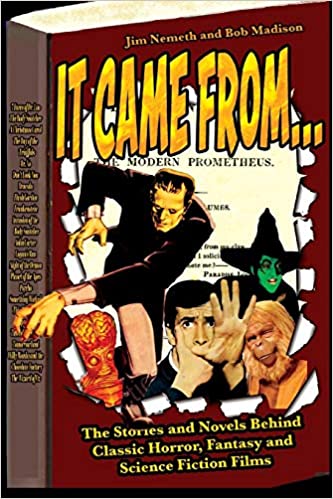
cover art from It Came From... by Jim Nemeth and Bob Madison

(  Bookshop.org )

It Came From:  …The Stories and Novels Behind Classic Horror, Fantasy and Science Fiction Films by Jim Nemeth and Bob Madison

Midnight Marquee Press, Inc., 2020

ISBN-13: 9781644300916

Available: Paperback

In this book, critics Jim Nemeth and Bob Madison explore genre films and the written works that inspired their creation,  Each is presented in its own section, chronologically, and the written works that inspired them. While this book primaritly covered fantasy and science fiction films, this review will concentrate on the aspects of  the horror genre presented. The authors include information on the production of the films, as well as the differences between the texts and the movies. At times they also posit the view that the film may be better than the books, a controversial opinion among some audiences.

The author of the horror section introduction argues that horror is the most difficult genre to adapt because movies “that merely provides a book’s ‘Boo!’ moments are but empty shells, lacking the underlying background and context that frequently makes the literary piece the more satisfying experience” (p. 12). He then moves to his example of The Shining. While I do not necessarily agree completely with the author, he does make some interesting points. Films included in the horror section include The Body Snatcher, Invasion of the Body Snatchers, Night of the Demon, Psycho, The Day of the Triffids, and Don’t Look Now.

Two titles receive special treatment in that they each have a significant chapter devoted to them: Dracula and Frankenstein. The authors look at “several of the best, worst, and most popular of their cinematic incarnations” (p. 11). Dracula films covered range from Nosferatu (1922) to Bram Stoker’s Dracula  (1992), while the Frankenstein films range from the first film version of Frankenstein (1910) to Victor Frankenstein (2015).

My primary criticism of the book is focused more on the overall contents rather than specific chapters. The authors interject their own opinions into the chapters in a way that can be a bit heavy handed. For instance, when it comes to science fiction, one of the authors makes it abundantly clear that he does not like the gritty, darker, current sci-fi storylines. Additionally, while it seems that each chapter is written by an individual author, it is difficult to tell who wrote which one.

This could be a good resource for anyone interested in exploring the literature upon which genre films are based, as long as readers are aware that the authors’  strongly expressed opinions are interspersed throughout.

Recommended with reservations.


Reviewed by Lizzy Walker

Graphic Novel Review: Frankenstein: Junji Ito Story Collection by Junji Ito

Frankenstein: Junji Ito Story Collection by Junji Ito

Viz Media, 2018

ISBN-13: 9781974703760

Available: Hardcover, Kindle, comiXology

Junji Ito, the master of horror manga, adapts Mary Shelley’s classic, Frankenstein in this graphic collection. Victor Frankenstein is obsessed with creating life from death. He stops at nothing to create his giant, only to be repulsed by his design. Abandoned and angry, the creature takes his revenge on those Victor loves.

I read a few reviews that were critical of Ito’s adaptation, indicating that they felt that adapting Shelley’s novel restricted his horrific artwork and storytelling. I would have to disagree, particularly regarding the art. While it is true Ito is skilled at the grotesque, his ability to draw beautiful characters seems to go unnoticed. For instance, is titular character in Tomie is gorgeous, which I think makes the horrific scenes in the manga so effective. The same can be said of his art for Frankenstein. The Creature, and moreover the companion Victor creates for him, are horrific. The character designs are signature Ito. Ito takes some liberties with the story, but not enough that it takes away too much from Shelley’s original novel. Purists may be disappointed, however.

Included in this collection are six short stories that center on a high school student named Oshikiri who lives alone in a strange mansion while his parents are away. In “Neck Specter”, he murders his best friend Kojima over petty jealousies and buries him on his family’s land, only to discover that when he unearths him that his neck has grown longer. Soon he is seeing everyone around him growing long, winding necks and accusing him of his crime. “Bog of Living Spirits” tells the tale of a small body of water near Oshikiri’s high school where it is rumored the ghost of a jealous girl drowns handsome boys that wander into the area. In this story, Kojima is alive and followed relentlessly by the high school girls who adore him. When he volunteers to help the other students tidy up the land around the bog, the girls are distraught and beg him not to go. Were they right, especially when they witness him falling in and not resurfacing? Oshikiri becomes friends with a seemingly lonely girl in “Pen Pals”. The young girl begins receiving insults and death threats in letters after she tells them of her new friendship. Oshikiri finds out the disturbing truth when he visits her at home. In “Intruders”, Oshikiri befriends some classmates who are interested in alternate dimensions, and who want to explore his mansion after he describes the strange footsteps he hears. There, they discover their own graves, complete with rotting corpses.

“Hell of the Doll Funeral” is the shortest story in the book, but one of the most gruesome. Children are starting to turn into dolls, and parents burn them before the affliction completes its cycle. One mother refuses to do so, and the result is terrifying.

The last two stories in the book gives the reader an uncommonly light-hearted look into the Ito family, specifically the family dog. The Matlese named Non-Non was clearly the ruler of the family.

While this volume is a departure from works such as the aforementioned Tomie, Uzumaki, and Gyo, it is still very enjoyable. Ito’s art style is unique and highly detailed. I would recommend this title for those who like graphic adaptation of classic horror, body horror, horror manga, and interesting stories.

Contains: blood, body horror, gore, nudity

Highly recommended

Reviewed by Lizzy Walker