Home » Posts tagged "folk horror" (Page 2)

Book Review: The Serpent’s Shadow by Daniel Braum

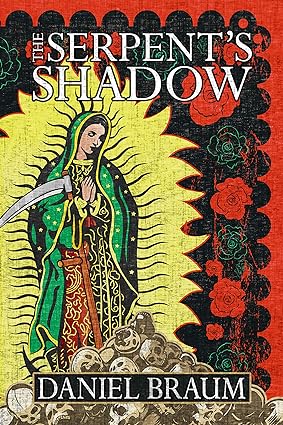
Cover art for The Serpent's Shadow by Daniel Braum


The Serpent’s Shadow by Daniel Braum

Cemetery Dance, 2023

ISBN-13 ‏ : ‎ 978-1587679322

Available: Paperback

Buy: Bookshop.org


Daniel Braum’s writing is always intriguing. His NIght Marchers and Other Strange Tales was an outstanding collection of dark fiction. The Cemetery Dance release of his first novel departs from quiet horror to regale readers with a chilling story that is well worth the read.


David and his family land in Cancun, circa 1986. He and his sister are looking for adventure, hoping to escape their parents. They find it in a nightclub where he meets Anne Marie, a beautiful young woman to steal the eighteen-year-old’s heart. Yet she isn’t seeking to kill him, only to befriend him. Her innocence and ties to the city only ensnare his attention even more.


The true adventure begins as they explore a Mayan temple. The cab driver informs them that not everything is ancient history. The teens discover the pyramid holds a group of natives, many of the modern sort, who ache to bring Cancun back to the olden days when magic ruled the land.


What ensues is a blistering dark fantasy story that brings the horror. Braum knows how to deliver solid horror: how to build the tension, slowly tightening the noose on the readers. The setting is rendered beautifully, both the tourist trap of the city with its saccharine glitz, and the rich culture of the Mayans and Mexicans, struggling to reclaim a culture lost

.

David and Anne Marie are fascinating in the depth of their characterization, as both stretch out in intriguing manners. The plot twists and turns, via the dive into the cultural dichotomy of past and current, as even the slightest characters contribute to the story. The less said, the better about this short novel, as the surprises creep off the page.


Braum paints a bizarre tale that leaves readers aching to read more of the writer’s work. Recommended.


Reviewed by David Simms
 

Book Review: The Forest Demands Its Due by Kosoko Jackson

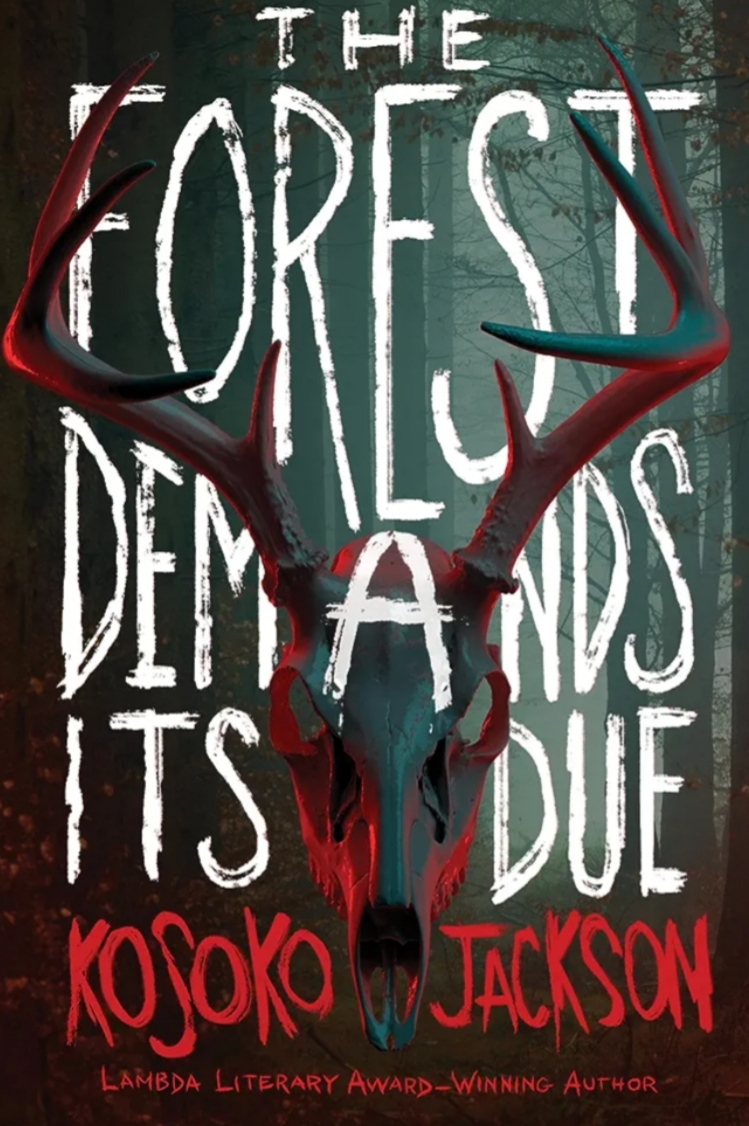
The Forest Demands Its Due by Kosoko Jackson

Quill Tree Books, 2023

ISBN-13: ‎978-0063260795

Available: Hardcover, Kindle edition, audiobook, audio CD

Buy:  Bookshop.org  |  Amazon.com


I have enjoyed Kosoko Jackson’s previous YA books, the dystopian Survive the Dome and the time travel novel Yesterday is History, both with Black queer boys as protagonists. The Forest Demands Its Due once again changes genre, to a combination of dark academia and folk horror.


Douglas Jones was arrested for arson and manslaughter when a lawyer offered her services pro bono if he would agree to attend an elite boarding school in an isolated area of Vermont. The school is bordered by a forest that students are warned away from as there have been many who disappeared into them never to be seen again.


As the only Black queer boy attending Regent School, Douglas is a target for bullies. He also hears loud, disturbing voices he can’t  turn off that he is certain come from the forest. Just the first few pages and Jackson had me deep in his story.


Early in the book a bully drags Douglas into the forest and is killed. Everett Everley, a member of the Everley family charged with protecting students, bargains with the Emissary, a vengeful creature of the god of the forest, to save himself and Douglas. Douglas learns that whenever there is a suspicious death the headmaster “erases” the existence of the person from everyone’s memories, so no one is aware of how many students and teachers have been lost to the forest.


There is a curse on the forest, nearby town of Winslow, and the five founding families of the town preventing them from leaving because they participated in the burning of Henry, the forest god’s lover, generations ago. His grief and anger have caused the death and anguish of many students and locals.  Everett and the headmaster are both descendants of the founding families. Everett helps Douglas investigate the history of Winslow, the school, and the forest, and after some awkward misunderstandings they start to develop a romantic relationship. The headmaster convinces Douglas to enter the forest  in hopes that he can find the gate to the forest god’s retreat and break the curse. Everett goes with Douglas to protect him. The forest is nightmarish, twisty and changeable and they easily get lost, then attacked by Emissaries and their grotesque servants, called Perversions. When they find the gate, Douglas goes through to try to convince the god to let go of his grief and anger and release the forest and town from their curse. As the god dies, he transfers his powers to Douglas, tying him to the forest and freeing Everett.


This was a very emotional story with a lot of darkness and trauma. The two boys have had very heavy responsibilities set on their shoulders and see and experience things no one should have to. They witness the aftermath of a suicide and there is a fair amount of gore and body horror (the Perversions are a grotesque combination of human and animal parts) Jackson’s writing is descriptive and atmospheric, although it’s a little slow in places, and he has created an immersive experience of the dark fantastic.


Jackson frequently addresses the injustice and inequality of institutions such as the legal system and education, and that is evident here. I love that he puts power for change in the hands of someone marginalized, who has only ever felt powerless. Recommended.


Reviewed by Kirsten Kowalewski

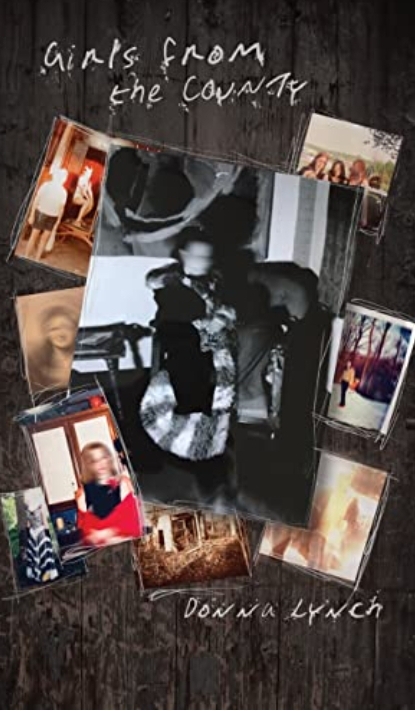
Book Review: Girls from the County by Donna Lynch


Girls from the County by Donna Lynch

Raw Dog Screaming Press, 2022

ISBN: 978-1947879478

Available: Paperback, Kindle edition

Buy:   Bookshop.org  |  Amazon.com


The city and the country are not the only dangerous places for a woman, according to Donna Lynch’s Girls from the County. In these poems, girls create a permanent connection to their landscape through the memories of places that “want to kill you” and the tragic deaths that result from ignoring ghostly warnings.


Lynch depicts the county as a haunted setting where people continue to tell the stories of horrible events involving nameless women whose lives have been destroyed there or, conversely, whose names became famous only because of the grisly details of their death. These are old stories, but also current ones, which show that some things do stay the same and that the only thing between you and disaster might be, as Lynch tells us, the words of your wise grandmother who knows how to survive. 


The county girl, as Lynch points out, soon realizes that what passes as tradition, ritual or symbol is darker than it seems and even darker when you trace it to its roots. Men play a big role in this hidden evil – of violence by the river,  “animal screams” mixing with unidentified screams in the woods, and things known by county girls that can’t be proven in order to save them or get them the justice they deserve. Even ordinary parties are characterized as events where county girls are likely to be “devoured” by men.


There is an occult connection between these horrors and old parts of a county – old burial grounds, old home sites now vacant, old houses where someone might think there was “something” scary in the window, old quarries and old cars that might be hiding dead bodies, and even gatherings of women trying to use the dark arts to protect themselves or to take revenge, not knowing whether they are really unleashing even more destruction.    


Lynch’s short, free verse poems that often read like prose narratives describe the county as a place where girls are held “in captivity” and want to escape, where the “beauty queen” finds out how her good looks are also a curse, and where people talk to you one day and disappear or abandon you the next. There are threats that make these girls stay silent about what they know, that warn them to avoid being “dramatic” by not making accusations without “evidence,” that cause them to be concerned about their safety if they are “pretty” or “sad” because being perceived in those ways opens them up to being targeted by a predator.


With menacing poem titles like “The Thing about Girls with Hammers” and “When the Cloud Comes for You,” a reference to a Dorothy in Oz who does not want to go home, Girls from the County depicts the county as a place where there is a barely contained fear, a lurking anxiety, a sense that every person, location, and situation is a potential threat to girls. In “Thirty-two Years (Eighteen Years Reprise)” the speaker worries, “What if / what we really saw / were all the things / we could not escape” and realizes that, ultimately, the “hurt” “waited for us in the trees,” and so, these girls have no choice but to run while the past always follows closely behind.


Reviewed by Nova Hadley