Home » Posts tagged "filmmaking"

Musings: Doing What You Love with Someone You Love, by Kirsten and Miles Kowalewski


This entry was written at the request of my son Miles, previously referred to here as the Monster Kid for privacy reasons (Miles is just a few months older than Monster Librarian, and inspired our Monster Movie Month project in July 2012. A  little kid doesn’t need his name out there on the Internet) There are some really cool blog posts in the July 2012 archives for this blog) At 20, he is no longer a kid and while he’s home from college he wanted to share how important it is to him that the two of us share the experience of watching and talking about horror movies together. We’ve each written a little about it here, first from my point of view and then from his. Mine is a bit wordy, but make sure to read what he has to say. It’s so cool to see what he thinks about the time we spend together sharing this interest! If you’ve ever wondered how horror-loving kids turn out, mine is kind, curious, loving, generous, and enthusiastic about his interests.


Kirsten: 

I am more of a horror reader than a horror movie watcher. Being married to a horror movie lover made movie nights challenging, to say the least. But my son has not just followed in Dylan’s fandom footsteps but has even gone further, majoring in media production and screenwriting, and working on short films for Radiance, Ball State University’s immersive learning experience in filmmaking. Since Miles was a kid, he has had an interest in monsters and scary movies– in fact, one year, Dylan helped him shoot a short monster movie during his birthday party. As a teenager Miles read about and took classes in screenwriting for horror movies, learned to write film criticism, connected with people online, and even to conventions.


I have learned that if you want your kids to spend time with you, it makes a difference if you take time to share their interests, so I watch and talk about horror movies with Miles. I love getting to share the experience with him, and because it’s interesting to him, he makes it interesting, and even exciting, to get into it with him. I probably text him now with more horror movie related content than I do cat videos (college students apparently need a steady diet of cat videos). I owe many thanks to James A. Janisse of the Kill Count, who has made it possible for me to talk about movies intelligently with him even when I haven’t watched them through.


Almost all of the movies I’ve seen in theaters in the past year have been with Miles, and this actually was a great year for watching horror movies in a theater. I’m probably not representative of the general moviegoing population, but in addition to Sinners, four of the five movies I saw in theaters were horror movies, and worth the ticket price (28 Years Later, Weapons, The Long Walk, and Frankenstein). I really think that they are a lifeline for movie theaters. I saw the first three with my son, and watching a movie on the big screen in a movie theater is a great experience to share with someone who really is interested in being there and enjoying it.  I love Guillermo del Toro and everything Frankenstein, and although Miles was at school, I could go back and forth with him about cinematography, directorial choices, special effects, storytelling, and all the other things I’ve learned from him about filmmaking, especially horror, even though we weren’t able to see it together.  I saw del Toro’s Frankenstein with my mom, who loves the book but doesn’t like violence or horror, and there is a world of difference in the discourse when you are sharing the experience with someone who isn’t open to it.


Since Miles is in college now, we mainly watch movies when he’s home on break, and this year we’ve watched It Follows (a favorite of his), Pearl, Get Out, Psycho, Cure, and Black Christmas together.  We also watched Night of the Living Dead and Dawn of the Dead again, because we learned that the Monroeville Mall, where parts of Dawn of the Dead were filmed, will be demolished later this year. We actually intended to visit this weekend while he is on spring break, but then I discovered there’s actually going to be a final farewell there in June, with original cast members in attendance, so I think we’re going to wait for that!  I watched them casually in the past, but now horror movies mean more, because they’re something Miles and I share.


Miles: To me, this whole experience has been getting to do something that I love with a person that is into and enjoys the same genre as I do. We both have different specialties in regards to the horror genres, across multiple mediums. I enjoy movies more then I do books and for Mom, it is vice versa.


I specifically enjoy watching horror movies with my Mom because I have always been fascinated with movies as medium and horror as a genre ever since I was incredibly young. Plus I also think that it may help that it is something we do together, to varying degrees of enjoyment.


I find that with these movies we watch, it helps us bond and grow closer together. I don’t think Mom would have willingly watched any of the movies that we did with anyone else (maybe except for Daddy, but he was into some pretty intense stuff). And given how unique and special my mom can be with these kinds of things, it is always a treat to do.


In summary, you can dice it many different ways. It could be family bonding, the continuation of legacy, film analysis, criticism and appreciation, or maybe just laughing and screaming at whatever is on our screen for the night (most likely all of the above). But at the end of the day, it is something that I always have found brings me a sense of warmth and comfort in a world that always seems to be getting darker and colder.
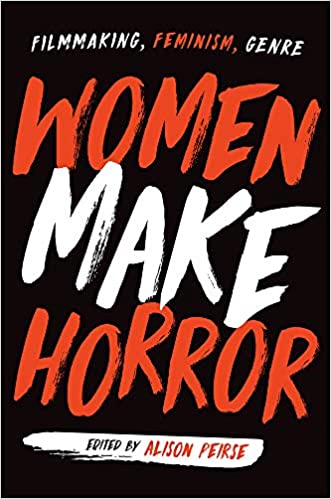


Book Review: Women Make Horror: Filmmaking, Feminism, Genre edited by Alison Peirse

cover art for Women Make Horror edited by Alison Peirse

Women Make Horror: Filmmaking, Feminism, Genre edited by Alison Peirse

Rutgers University Press, 2020

ISBN-13: 9781978805118

Available: Paperback, Kindle edition Bookshop.org | Amazon.com )


Women working in the horror industry today are severely underrepresented. Although they have been making horror for centuries, many women have been cut out of that history and/or had their authorship and creative influence denied. What is more, women also enjoy consuming horror. Women Make Horror explores women’s creation and enjoyment of the genre through analysis of experimental cinema and filmmaking. The book includes seventeen essays, global in scope, discussing creatives, films, and festivals. While I think every one of these chapters deserve attention, I will highlight some that stand out.

“Women Make (Write, Produce, Direct, Shoot, Edit, and Analyze) Horror” by Alison Peirse provides a solid introduction to the text. Peirse discusses how she garnered and selected the texts for this volume. She asked three questions of the writers: why do women make horror; what kinds of stories do women tell in horror; and what makes a horror film a feminist film (p. 8-9). Every contributor has a unique perspective as to how they answered these questions.

“The Secret Beyond the Door” by Martha Shearer discusses Daria Nicolodi’s authorship and, subsequently, creative content of the original Suspiria. In “Why Office Killer Matters”, Dahlia Schweitzer provides valuable information on this film and argues that it is a film that not only restructures the representation of gender representation, but how horror films are expected to conform to specific tropes (p. 89). Donna McRae, in her chapter titled “The Stranger with My Face International Film Festival and the Australian Female Gothic”, discusses the development of this essential film festival, as well as “considers the influence of a female-centric genre filmmaking in Australia today” (p. 146) and how it has been a force for good in creative circles. Erin Harrington’s “Slicing Up the Boys’ Club” provides an excellent analysis of the existing state of anthology and omnibus films and their lack of diversity, as well as a discussion regarding the women-led anthology, XX. Harrington poses some good questions regarding representation for readers as well. “The Transnational Gaze in A Girl Walks Home Alone at Night” by Lindsey Decker presents an analysis through the lens of Hamid Naficy’s Islamicate gaze theory rather than the typical male gaze theory used so often in feminist film analysis.

In “Gender, Genre, and Authorship in Ginger Snaps“, Katarzyna Paskiewicz analyzes the film Ginger Snaps, which makes connections between a werewolf legend and a girl’s coming-of-age story. Paskiewicz describes her study as having two purposes. She seeks to answer how the film might be productively read through a lens that recognizes filmmaking as a collective art form” (p. 106), as well as wanting to “register the significance of women’s film authorship within the horror genre histories in which they have been traditionally overlooked” (p. 106). Early in the chapter, the author argues that directors are not the only creative voice in a film project. Editors, screenwriters, set designers, and more have influence over various aspects of a film (this is precisely why my colleague and I created Women in Film: A Film Index, to recognize other creatives in horror. That the sentiment is recognized in this seminal text is encouraging).

Other chapters cover directors such as Gigi Saul Guerrero, Lucile Hadžihalilović, and Alice Lowe. There are also chapters that focus on the New French Extremity, Korean horror cinema, fans as filmmakers, international films and events, and much more. The end of each chapter includes notes, and there is an extensive index at the end of the book.

Women Make Horror is a much-needed collection of feminist horror film criticism. Some of these essays, such as Molly Kim’s delve into Korean women-made cinema, are the first of their kind. and others showcase someone’s overlooked or misappropriated contributions, such as Alicia Gomez’s chapter on Stephanie Rothman’s The Velvet Vampire, a film originally credited to Roger Corman. Women Make Horror would be an excellent resource for horror scholars or even an addition to a film studies course on the genre. The general reader could enjoy it, but there are many chapters that read more like an academic work.  Highly recommended.


Reviewed by Lizzy Walker


Editor’s note: Women Make Horror: Filmmaking, Feminism, Genre is a nominee on the final ballot for this year’s Bram Stoker Award. 

Interview: Eric Shapiro on Adapting Greg Gifune’s “Hoax” Into Film

It’s always cool to see how different media interact across platforms. Here, ML reviewer Colleen Wanglund interviews filmmaker Eric Shapiro about transforming Greg F. Gifune’s short story “Hoax”, which appears in his short story collection Down to Sleep into a short film. As a filmmaker, Shapiro’s first feature was Rule of Three, which won awards for Best Acting Performance at Shriekfest and Best Actor at Fantasia International Film Festival in 2010.  His second feature, Living Things, was released by Cinema Libre Studio in 2014. Shapiro’s current project is a 15-minute short film adaptation of Greg F. Gifune’s “Hoax”, starring Rodney Eastman, with DarkFuse as executive producer, and releasing the film via digital distribution.


In addition to making films, Shapiro is also an author, screenwriter, and ghostwriter. He has had numerous stories published in anthologies, and his books include Love & Zombies, The Devoted, Stories for the End of the World, and Short of a Picnic. Shapiro’s 2005 novella It’s Only Temporary was included on the Preliminary Nominee Ballot for the Bram Stoker Award in Long Fiction, and appeared in Nightmare Magazine’s list of the Top 100 Horror Books.

Interview with Eric Shapiro

ML: Tell me a little bit about Greg F. Gifune’s short story “Hoax” and why you wanted to adapt it into a short film.

ES: All I can say about the story is that it’s about a guy in a bar who may or may not be trying to pick up the bartender – and may or may not pose a threat to her. It’s about that and a whole lot more…

Greg and I had been talking for a while about the possibility of me adapting his fiction into film. Since we’re in an environment where indie features are struggling financially, I said I’m of the mindset that it really doesn’t pay to pour yourself, and your cash, into creating 80 or 90 minutes when you can create 15 for a specific audience. Greg’s worked for ages with Shane Staley at DarkFuse, and he got Shane to come aboard and provide us with a digital distribution platform – which I would have been a fool to not jump all over. Great author, great company; I last worked with them on my novella Love & Zombies. They’re organized; they have fans. They’re not caught up in horror scene politics. It’s the first time I’ve done a film where the audience and platform are waiting, which is fun. The alternative is hoping you can find an audience. In this case, it’s hoping what I bring will impress the fans.


ML: What is it about Greg’s work that you enjoy so much?

ES: A lot of things, but mostly the attitudes of the characters. I get the sense from Greg’s writing that he’s lived a lot, and continues to. I pick up on a sensitivity in the prose. These aren’t sunny or prepackaged personalities; they’re difficult and ambiguous, and very human. It’s heavy material, but his poetic prose gives it a lift. He’s a major artist. Plus he has a gift for coming up with creative story lines you wouldn’t have expected. And his work is in a very classic vein. My own prose is more outwardly gonzo and manic; Greg’s more with the people.


ML: What are the differences and/or similarities between writing books/short stories and writing screenplays?

ES: On a technical level, it’s the fact that fiction is a finished thing and a screenplay is a blueprint for something else. However, my fiction is often spare and screenplay-like, and my screenplays are often poetic and prose-like, so I tend to mesh and blend what each medium has to offer. On a professional or political level, I think prose is more personal and screenplays are more social. The editors and publishers I’ve encountered in the fiction world hold your work as sacred in a sense. It’s a more private and intimate medium than films. More introverted. With screenwriting, I’m often working with producers or co-writers who are coming at it from the standpoint of having fun and/or making a hit. Creating an exciting experience for ourselves and the audience. It’s more extroverted and party-like.


ML: Which do you enjoy more, being an author or being a filmmaker?

ES: I’m gonna punt and say screenwriter, but it happens to be the truth. My passions reach their maximum when I’m screenwriting. Producing and directing are incredibly demanding jobs, particularly when funds are limited. You’re up against time. Technology’s erratic. You’re managing a bunch of personalities and expectations. I’m generally pretty quiet when I direct, which comes from caring so much. If I started to outwardly express how much I care about the end result, I’d be screaming and giving grand speeches all day. But that’s no way to behave, so I internalize it and pipe it all into the work, which is exhausting. So directing’s more like a sport for me. Filmmaking’s fun in the writing phase, though – and post-production, which is a lot like writing. More grounded and pleasure-producing.


ML: Where does your creative inspiration come from?

ES: Since I became a dad four years ago, my mind is generally focused on my kids: where they are, are they OK, are they fed, happy, what’s next on the schedule. I don’t float up into the ether as much, so creativity’s become more about ass-plus-seat. I work constantly as a ghostwriter and editor, so I have daily deadlines and assignments. It’s during the act of creation itself when I’m in the ether again. I just have to do it; the muse doesn’t come to me; I go to her. It’s more intense and exciting that way, as the time is precious. I’m on the clock. Which makes it all sound very dry and practical, but the truth is when I clock in I let loose. My metabolism’s fast; I tend to be emotional; so I just jump. I think everyone’s got that ocean inside; it’s just a question of how willing we are to go in.


ML: Besides Gifune, who are some of your favorite authors and genres?

ES: It’s reached the point where there are just so many. One of my favorite aspects of life is changing my perceptual aperture; opening and adjusting for new input and experiences. So I’ll read any genre. I read a book called Assholes: A Theory, by Aaron James recently. That was excellent; it was a complex philosophical examination of what makes someone an asshole, and how to deal with it. I’m reading Between the World and Me by Ta-Nehisi Coates right now; he did an extraordinary job mapping how his racial consciousness, of himself and his culture, has evolved throughout his lifetime. You feel like you’re in there growing with him. My favorite author as of now is Eric Bogosian, who’s more known for plays like “subUrbia” and “Talk Radio”, but happens to be an extraordinary novelist. He has every aspect of fine prose at his fingertips, mixing high and low, speed and patience, eloquence and grit. He’s pretty amazing.


ML: Who are your favorite filmmakers and why?

ES: Oliver Stone’s at the top because of what he’s accomplished in his career, the depth and breadth of his body of work and the amount of topics he’s not only spanned, but actually penetrated and examined. He’s consistently operated within the establishment yet offered a product that they usually would run away from. Whether or not you agree with or accept his points-of-view, it’s amazing to consider how consistently he’s infiltrated the mainstream with radical content. He could have used his talent to make crime films or suspense thrillers, but he’s hunting for bigger game. Kubrick’s up there, too, for the same reasons. Scorsese’s probably the biggest natural talent alive. And from a business standpoint, I like what Coppola’s been up to in the past decade: He self-finances his films and does whatever he wants. He’s taken the studio trip already, so he’s not motivated by conquering the marketplace. He makes his money from wine and puts it into true art. Once you see how the system can muck up your content, that starts to seem like the sanest path to travel…

ML: Thanks so much for your time, Eric.
Hoax will be filming in the next few months, so keep your eye out for it in 2016.