Home » Posts tagged "feminist criticism"

Book Review: That Very Witch: Fear, Feminism, and the American Witch Film by Payton McCarty-Simas

cover art for That Very Witch by Payton McCarty-Simas


That Very Witch: Fear, Feminism, and the American Witch Film by Payton McCarty-Simas

Luna Press Publishing, 2025

ISBN-13: 9781915556608

Available: Paperback, Kindle edition

Buy: Bookshop.org | Amazon.com


Payton McCarty-Simas’ That Very Witch: Fear, Feminism, and the American Witch Movie analyzes the cinematic witch’s evolution and relationship to feminist movements from the 1960s to the 2020s. Using historical, social, and feminist models for basis of analysis, they examine how the witch became viewed as both the feminist representation of empowerment and fear. McCarty-Simas’ analysis of the witch film reveals how the witch has been portrayed over time, reflecting significant changes in American culture and politics.


A brief history of early European witches, and their associated witch hunts, or “crazes,” driven by bigotry, misogyny, and racism, creates the basis for the contents of the book, as these are central to the concept of the witch. The author addresses the concept of the witch as a symbol in feminist circles, what can be learned from various witch cycles through history, whether witches through time can be considered feminist figures, and more, in their analysis of witch films.


In Part 1, “Season of the Witch: The Countercultural Witch Films of the Long Sixties,” the author explores witch films from 1960 through 1973, including the birth and death of the witchsploitation film in the context of the sociopolitical climate of the era. Part 2, “Unpleasant Dreams: Feminism, Satanic Panic and the Witch Films of the 1980s,” takes the reader through the rise and decline of the Satanic Panic. McCarty-Simas expands on how this era’s witch films responded to the earlier witch cycle film, the Panic’s effect on the figure and evolution of the witch and Satan, and antifeminist rhetoric pushed by conservatives that the role of working women, as well as the innovation of home video technology and the VHS, were to blame for Satanic cults lurking around every corner. Particularly interesting in this section is that McCarty-Simas highlights the “Satanic Panic specials,” framing them as horror comedies. For readers who have seen clips or the full version of such shows, you know why the author includes these as horror comedies. Over-the-top “reporting,” alleged experts on Satanic Ritual Abuse who spread disinformation, and decrying explicit material in horror movies while in the same show describing in great detail what happened to alleged victims, are just a few of the reasons the author correctly includes them here.


“Interlude: Notes on the Postfeminist Witch Film (1990-2013)” focuses on the witch film in terms of Third Wave feminism, Riot Grrrls, girl power, the commodification of witches to teenagers, and the bitchification of the witch. The author presents an insightful analysis of
The Craft a
nd its overall failure at intersectionality, and discusses girl and women witches in the Harry Potter franchise. The author includes some television series from this time period as examples of dark fairy tales, highlighting American Horror Story: Coven and its successful portrayal of feminism, race, and intersectionality.


Part 3, “Gender, Genre, Psychedelics, and Abjection in the 2010s ‘Witch’ Horror Cycle,” examines 2010s witch films, tying the “demonic woman” to the cycles in previous chapters. A major visual the author uses as a tool for analysis is the smile of the heroine or final girl at the end of horror films, comparing them to how the meaning of this expression can be interpreted on the face of a witch at the end of her film.


I would be remiss if I did not address a significant issue with the text, that being the “Works Cited” section. There are links that point the reader to academic library databases where an account is needed to access the articles or books, Google Books links, and broken links, rather than using DOIs (digital object identifiers) or stable URLs. Correct citations bolster the text and provide readers with further information. This includes directing readers to the resource itself.


Regardless of the problems with the citations, That Very Witch would be a good resource for readers interested in the history of the American witch film in terms of particular political climates, social movements, and historical context. It provides an extensive film and mediography that has increased my watch list. Recommended.


Reviewed by Lizzy Walker
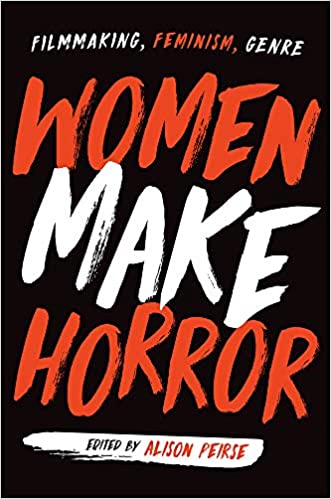
Book Review: Women Make Horror: Filmmaking, Feminism, Genre edited by Alison Peirse

cover art for Women Make Horror edited by Alison Peirse

Women Make Horror: Filmmaking, Feminism, Genre edited by Alison Peirse

Rutgers University Press, 2020

ISBN-13: 9781978805118

Available: Paperback, Kindle edition Bookshop.org | Amazon.com )


Women working in the horror industry today are severely underrepresented. Although they have been making horror for centuries, many women have been cut out of that history and/or had their authorship and creative influence denied. What is more, women also enjoy consuming horror. Women Make Horror explores women’s creation and enjoyment of the genre through analysis of experimental cinema and filmmaking. The book includes seventeen essays, global in scope, discussing creatives, films, and festivals. While I think every one of these chapters deserve attention, I will highlight some that stand out.

“Women Make (Write, Produce, Direct, Shoot, Edit, and Analyze) Horror” by Alison Peirse provides a solid introduction to the text. Peirse discusses how she garnered and selected the texts for this volume. She asked three questions of the writers: why do women make horror; what kinds of stories do women tell in horror; and what makes a horror film a feminist film (p. 8-9). Every contributor has a unique perspective as to how they answered these questions.

“The Secret Beyond the Door” by Martha Shearer discusses Daria Nicolodi’s authorship and, subsequently, creative content of the original Suspiria. In “Why Office Killer Matters”, Dahlia Schweitzer provides valuable information on this film and argues that it is a film that not only restructures the representation of gender representation, but how horror films are expected to conform to specific tropes (p. 89). Donna McRae, in her chapter titled “The Stranger with My Face International Film Festival and the Australian Female Gothic”, discusses the development of this essential film festival, as well as “considers the influence of a female-centric genre filmmaking in Australia today” (p. 146) and how it has been a force for good in creative circles. Erin Harrington’s “Slicing Up the Boys’ Club” provides an excellent analysis of the existing state of anthology and omnibus films and their lack of diversity, as well as a discussion regarding the women-led anthology, XX. Harrington poses some good questions regarding representation for readers as well. “The Transnational Gaze in A Girl Walks Home Alone at Night” by Lindsey Decker presents an analysis through the lens of Hamid Naficy’s Islamicate gaze theory rather than the typical male gaze theory used so often in feminist film analysis.

In “Gender, Genre, and Authorship in Ginger Snaps“, Katarzyna Paskiewicz analyzes the film Ginger Snaps, which makes connections between a werewolf legend and a girl’s coming-of-age story. Paskiewicz describes her study as having two purposes. She seeks to answer how the film might be productively read through a lens that recognizes filmmaking as a collective art form” (p. 106), as well as wanting to “register the significance of women’s film authorship within the horror genre histories in which they have been traditionally overlooked” (p. 106). Early in the chapter, the author argues that directors are not the only creative voice in a film project. Editors, screenwriters, set designers, and more have influence over various aspects of a film (this is precisely why my colleague and I created Women in Film: A Film Index, to recognize other creatives in horror. That the sentiment is recognized in this seminal text is encouraging).

Other chapters cover directors such as Gigi Saul Guerrero, Lucile Hadžihalilović, and Alice Lowe. There are also chapters that focus on the New French Extremity, Korean horror cinema, fans as filmmakers, international films and events, and much more. The end of each chapter includes notes, and there is an extensive index at the end of the book.

Women Make Horror is a much-needed collection of feminist horror film criticism. Some of these essays, such as Molly Kim’s delve into Korean women-made cinema, are the first of their kind. and others showcase someone’s overlooked or misappropriated contributions, such as Alicia Gomez’s chapter on Stephanie Rothman’s The Velvet Vampire, a film originally credited to Roger Corman. Women Make Horror would be an excellent resource for horror scholars or even an addition to a film studies course on the genre. The general reader could enjoy it, but there are many chapters that read more like an academic work.  Highly recommended.


Reviewed by Lizzy Walker

 

Editor’s note: Women Make Horror: Filmmaking, Feminism, Genre is a nominee on the final ballot for this year’s Bram Stoker Award. 

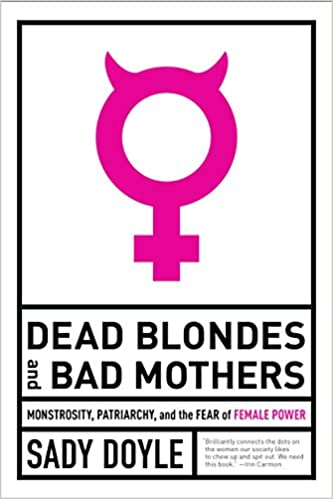
Women in Horror Month: Book Review: Dead Blondes and Bad Mothers: Monstrosity, Patriarchy, and the Fear of Female Power

cover art for Dead Blondes and Bad Mothers: Monstrosity, Patriarchy, and the Fear of Female Power by Sady Doyle

Bookshop.org  |  Amazon.com  )

Dead Blondes and Bad Mothers: Monstrosity, Patriarchy, and the Fear of Female Power by Sady Doyle

Melville House Publishing, 2019

ISBN-13 : 978-1612197920

Available: Paperback, Kindle edition, audiobook

Sady Doyle has written a witty, chatty, insightful, and angry book on female monstrosity. Her premise is that women who claim ownership over their voices and bodies are constructed as monsters because they violate the social and biological norms that threaten men’s control over them- they are a threat to the patriarchy. Doyle identifies three key roles women fill in our patriarchal society and divides the book into sections on “daughters”, “wives”, and “mothers”. She has a lot to say about mothers: that section gets twice the number of pages as the other two sections combined.

Doyle has combed through pop culture, history, literature, fairy tales, myths, horror, true crime, sociology, and personal anecdotes to find examples and support for her theories, and when she does a deep dive into a topic (as she did on a number of girls and women, including Annelise Michel, Bridget Cleary, and Augusta Gein), or a critique of The Conjuring, it is fascinating and memorable. However, Doyle jumps around a lot, and it isn’t always clear how things are related.  Her writing flows well, and she does a nice job making it relevant and tying it to recent events.

If you’re looking for an enjoyable feminist take on monstrous women, you’ve found it.

The book includes an annotated list of works cited, endnotes, and an index.


Recommended.

Reviewed by Kirsten Kowalewski


Sady Doyle’s premise is that female monstrosity is determined by patriarchy, which she describes as a social, cultural, and moral structure that is founded in men’s absolute power and control over at least one woman, generally through instilling fear in them.  Doyle contends that women who claim ownership over their voices and bodies are constructed as monsters because they violate social and biological norms that threaten men’s control over them. She identifies three key roles women fill in our patriarchal society, and devotes a section of her book to “daughters”, one to “wives”, and one to “mothers”. She chooses from a variety of literary, legendary, historical, and pop culture examples and stories to discuss female monsters, both fictional and real, that exist outside society (or are ostracized by society), and the female victims of monsters that the patriarchy requires.