Home » Posts tagged "Eric J. Guignard"

A Graveside Gallery: Tales of Ghosts and Dark Matters by Eric J. Guignard

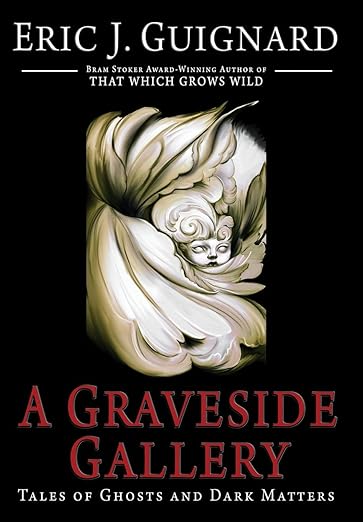
Cover art for A Graveside Gallery by Eric J. Guignard

A Graveside Gallery: Tales of Ghosts and Dark Matters by Eric J. Guignard

Cemetery Dance, 2025

ISBN-13 ‏ : ‎ 978-1949491616

Available: Hardcover, paperback, Kindle edition

Buy: Bookshop.org  | Amazon.com


For those who love short stories of the darker kind, Eric J. Guignard should be a household name. Not only has he written some of the finest, and most varied, stories in the past decade, but he also is at the helm for the popular Horror Library and the Exploring Dark Short Fiction series, working diligently to promote the best of modern horror writers. His skill in creating atmosphere and quirky characters is in the top tier of horror writers working today, but his stories are not bound by genre. A Graveside Gallery epitomizes that scope and demonstrates the breadth of Guignard’s talent.


These stories are a rollercoaster ride of tone, voice, and overall storytelling, many with notes of The Twilight Zone and Night Gallery, not to mention the “you are there” feeling of Joe R. Lansdale.


The highlights for this reviewer, which changed upon a second read-through:


“Penny’s Diner” is a gut punch that sets the stage for the rest of the collection. It is reminiscent of Richard Matheson’s work, and winds up quietly before a sucker punch takes the breath out of the reader. The less known about this tale, the better.


“If I Drive Before I Wake” is much too timely. I’m sure there’s a certain tech mogul who won’t much appreciate this tale of automated vehicles and their dangers, but it’s more than a cautionary tale. It’s chilling in its near-future worldview, with a nerve-wracking conclusion.


“Bummin’ to the Beat of The Road” suggests Black Mirror, and is a mind f*ck in its imagery. Readers’ teeth will never feel the same in this sensory-driven horror.


“Perchance to Dream in Voices of a Fiend: A Fanciful Epilogue to Frankenstein.” Wow. An homage to the great Mary Shelley and her creation. The author finely captures her voice while retaining his own in an epilogue to the famous novel.


The others are well worth the read, although mileage obviously will vary. There’s one story within that will remain unnamed, that lingered through the evening and caused a nightmare. For those of us who live and breathe horror, reading and creating it, that’s a pretty tough task to achieve! 


Read a few, let them digest, and read some more. Each is its own complete universe of story and emotion, and to delve deeper into the individual tales would disturb the potent magic.


Guignard is a powerful force in writing. It’s about time more people know. Highly recommended.


Reviewed by David Simms
 

Women in Horror Month: Of One Blood: The Hidden Self by Pauline Hopkins, edited by Eric J. Guignard and Leslie Klinger, introduction by Nisi Shawl

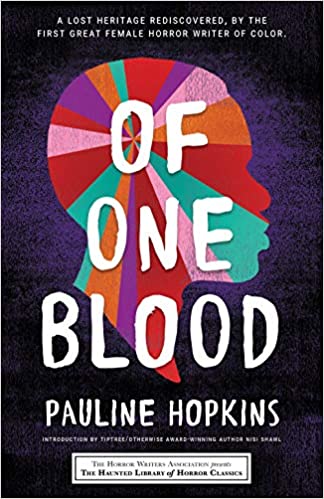
cover art of Of One Blood: The Hidden Self by Pauline Hopkins

Of One Blood: The Hidden Self  (Haunted Library Horror Classics) by Pauline Hopkins, edited by Eric J. Guignard and Leslie S. Klinger, introduction by Nisi Shawl

Poisoned Pen Press, 2021

ISBN-13 : 978-1464215063

Available: Paperback, Kindle edition


This new edition of Of One Blood is part of a series published by Poisoned Pen Press in partnership with the Horror Writers of America.  Author Pauline Hopkins was an African-American writer of the early 20th century,  and Nisi Shawl introduces the book, originally published in chapters as a serial in The Colored American magazine during 1902-1903, as an early speculative fiction novel combining the popular genre of “society novels” with a “lost world” narrative. revolutionary because the “lost world” is an advanced society consisting entirely of Black individuals, and promoting the thesis, novel at the time, that Africa is where the arts and technology have their origins.

Set in Boston in 1891 (my best guess based on the footnotes), Reuel Briggs is an impoverished medical student passing as white who is obsessed with the hidden forces of the supernatural and how to control them enough to reanimate the recently dead (shades of Victor Frankenstein). He is given the opportunity to put his theories into practice when the beautiful African-American singer Dianthe Lusk is killed in a car accident. While he is successful at bringing her back to life, she has lost her memory, and Reuel, his wealthy friend Aubrey, and Aubrey’s fiance Molly, set out to rebuild her into a new person. Molly becomes close friends with Dianthe, and Dianthe and Reuel fall in love and marry. To support her, he appeals to Aubrey for help in finding work. Aubrey, secretly in love with Dianthe, gets Reuel to sign on to a two year expedition to Africa to get him out of the way so he can marry Dianthe himself.

As Reuel journeys through Africa he sees its greatness, vividly described by Hopkins. The white men he is traveling with are surprised and at first dismayed to realize that African civilizations and peoples are the cradle of culture, as they have always believed that Africans were lesser than white people. Through Aubrey’s machinations, Reuel and Dianthe receive letters informing them that the other is dead, but while Reuel’s supernatural and mystical powers grow,  Dianthe feels more and more lost and traumatized, especially as she learns more about her tangled family tree.

There are many books now that deal with the intergenerational trauma, tangled family trees, and family separation caused by slavery, including Octavia Butler’s speculative novel Kindred,  Yaa Gyasi’s Homegoing, and Maisy Card’s These Ghosts Are Family.  In Of One Blood, we see a fantastical, awe-inspiring world, that contrasts the glories of African civilization rising again with the results of  the terrible treatment, taken for granted, of African-Americans. Dianthe in particular goes through unbelievable trauma: she is killed, re-animated, separated from everything she knows, nearly drowned, grieving a friend and a husband, and under tremendous pressure from Aubrey already, when the additional information about her family comes to light. In her case, it only takes one generation to destabilize her and poison her interactions with her environment. Shawl described this novel as science fiction, but to me it seems more to combine the “lost world”  utopian narrative Reuel experiences in Africa with the Gothic horror experienced by Dianthe.

Occasional footnotes are helpful in dating the time period of the book and understanding vocabulary and literary references. A brief but detailed biographical note about the author,  discussion questions, and a wide-ranging list of recommended further reading follow the story.

This is a good choice for readers interested in the beginnings of Afrofuturism and African-American speculative fiction and horror, Gothic horror, lost world and utopian narratives, and early 20th century African-American and women writers. In addition, Of One Blood would be a unique choice for the increasing number of book clubs focusing on anti-racist titles, which, in my experience, generally avoid genre fiction. Highly recommended.

Contains: incest


Reviewed by Kirsten Kowalewski


Book Review: Doorways to the Deadeye by Eric J. Guignard

Doorways to the Deadeye by Eric J. Guignard

JournalStone, 1919

ISBN-13: 978-1947654976

Available: Hardcover, Kindle edition


Novels about riding the rails can be exhilarating journeys in the right hands. Eric J Guignard is fresh off his first Bram Stoker win for best fiction collection, proof he has the skills to terrify his audience. Luke Thacker is a victim of the Great Depression, scraping by to survive on the dangerous rails of America. Along the way, he learns many secrets to staying alive, from a code left by other hobos, often warning them of strangers who would sooner leave them bleeding in a ditch or a friend ready to help out a guy in need through symbols carved into trees. When he discovers one odd symbol, an infinity sign, he learns that reality is a bit broken.

He meets a gangster ready and armed, John Dillinger, who had perished just months ago in a hail of bullets. Luke  has entered the Athanasia, the realm of the deadeye.

The dead don’t exactly haunt but can be dangerous. The spirits that linger are the ones who are remembered. Dillinger hires Thacker to be his driver for a bit, before being rescued by Harriet Tubman who ferries him to safety through the corridors of the deadeye. The stronger the person was in life, the longer they linger in Athanasia, where the living can see them, hear them, and be hurt by them.

Some are them are pretty angry and vicious.

Luke takes to the rails and meets up with the semi-gentle giant Zeke, and the woman who entrances his heart, Daisy. Together, they explore more of the deadeye world, encountering the Wyatt brothers, bank robberies, and the worst memory of the rails, Smith McCain, a brutal rail worker who made his living tossing hobos from moving trains. In death, his viciousness only has amplified. He tracks down riders to send them into the deadeye where most of them don’t have the strength to remain remembered. They simply fade away into nothingness. McCain is a beast straight out of the best thriller and horror movies, a former man who can never be stopped.

Fifty years later, another former hobo, King Shaw,  is keeping the stories of Luke alive as he tells them to a reporter, and hopefully keeping himself alive, too.

This novel is a stunner. Horrifying and suspenseful throughout, what makes it work is the strong writing of Guignard. Having never read any of this author before, it was shocking to see how powerful his lines were, how well-drawn the characters had become.

This guy is more than someone to watch in horror. He’ll be winning plenty more awards.


Reviewed by David Simms

Editor’s note: Doorways to the Deadeye was nominated to the final ballot of the 2019 Bram Stoker Award in the category of Superior Achievement in a Novel.