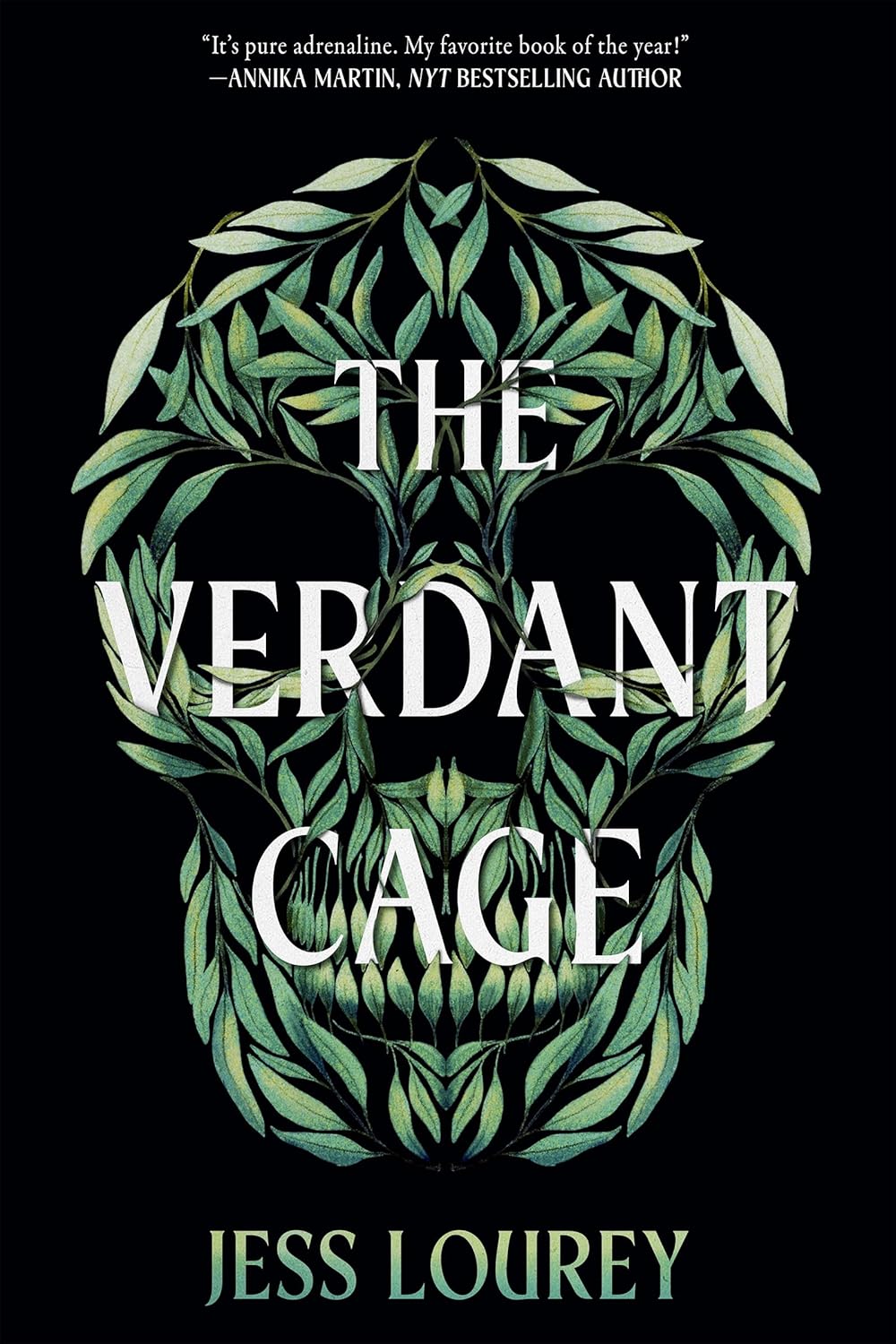
The Verdant Cage, by Jess Lourey
Mayhem Books, April 2026
ISBN: 9781682816455
Available: Hardcover, ebook edition
Buy: Bookshop.org
The Verdant Cage is a decent YA dystopian novel that in terms of basic setup, strongly resembles the old M. Night Shyamalan movie The Village: small utopian, self-sustaining community cut off from the rest of the world behind a wall in an idyllic village, no electricity, they all live in peace and harmony. It’s a good read, although a bit slow and predictable through the first two-thirds. However, the payoff and increased pace in the last third of the book are worth the wait. As far as where it falls in quality in the YA dystopian genre, it is certainly a good deal better than the Divergent series, if not quite at the level of The Hunger Games.
The first third of the story is basically stage-setting, getting the characters and location characteristics into place, and there’s a fair amount to cover. It’s a reasonably large cast of characters, each of them working in different Houses, where they apply their trades, such as Apothecary, Cobbler, Insect Farmer… there are at least 15 houses. Thankfully, the author had the foresight to include an appendix at the end, a very helpful idea that more authors today should consider. While the setup is well done and detailed (cricket flour was a nice touch, in terms of creativity for a modern self-sustaining community) the plot here is guessable. Teenage protagonist Rose Allgood is stuck with a pre-arranged marriage to someone she doesn’t like, but used to; murder happens in a community that has never seen such a thing; no one knows how or why they wound up in Noah’s Valley…predictable, but still interesting. The setting and character interactions are intriguing enough to keep the reader engaged at that point. The author did enough research to make the community feel believable, in terms of how trades such as a medic would function in pre-modern times. It’s a good job of world building, very in-depth, and it feels realistic.
Rose’s brother is the person labeled responsible for the murder of her mother, at which point he is sent up and over the Wall, to his likely death. Naturally, Rose isn’t buying it, and about half the book is her trying to find out who is responsible, which of course slowly leads to her uncovering certain hidden truths about Noah’s Valley. Once she puts all the pieces together in the last part of the book, the story takes off and improves dramatically. Faster pacing, and the shifting loyalties and double-crossing by many characters make the plot much more engaging, and less predictable. The big reveal in terms of the Valley and the history of its inhabitants is outstanding: very high marks for creativity to the author! It adds an unexpected change to the plot, and a much wider lens for the story. The book continues in high gear right up to the end, with an open-ended finale. I expect a lot of readers might wind up screaming for a sequel due to the ending, as there is potentially a LOT of story to tell, and the ending’s nature makes it a perfect fit. However, I would actually vote against another one. I liked the ambiguous ending and feel it should be left where it is. Let the reader imagine what happens next.
For readers that can exercise a bit of patience to wait for the story to get rolling, this one is worth the time invested. The big payoff certainly is enough to justify reading this.
Reviewed by Murray Samuelson




Follow Us!