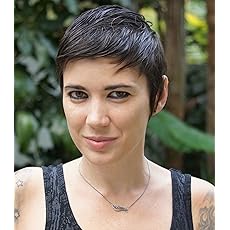
Monster Librarian reviewer Dave Simms recently had the opportunity to interview Steph Post, the author of the recently published book Miraculum, reviewed here.
Steph is also the author of A Tree Grown Crooked (Polis Books, 2018), a semifinalist for the Big Moose Prize, and the Judah Cannon crime novels Lightwood (Polis Books, 2017) and Walk in the Fire (Polis Books, 2018). Her short fiction has appeared in a number of publications and anthologies, and her short story “The Pallid Mask” was a nominee for the Pushcart Prize. She has published many book reviews and author interviews and is currently the writing coach at Howard W. Blake High School in Tampa, Florida. You can visit her website at stephpostfiction.com.
This is a really fun interview, so definitely take the time to read it and enjoy! You also might want to check out her website now, as she is running a contest for art from the book through March 31st.
******************
DS: Miraculum was written between two of your Judah Cannon books Why is this your third/fourth book and not second? Crazy publishing world or by design– or both?
SP: Definitely the crazy ins-and-outs of the publishing world, but I think the timing actually worked out perfectly. I sort of exist between different genres, so I think it worked out in my favor to establish a base with the crime fiction community before jumping over to fantasy/literary/historical/whatever we’re calling Miraculum today. Also, from the writing standpoint, I like to switch genres with every book I write. That way, there’s no chance of getting bored! I just finished up the last of the Judah Cannon books this past year and now I’m back to a novel that much more resembles the style of Miraculum, so I’m sticking to my zig-zagging path.
DS: Your art related to Miraculum is fascinating. Any thought to doing something professional with this? Art show? Illustrated version of the book? Booth at a local carnival?
SP: Thank you! I don’t consider myself a professional artist by any means, but I do love painting and printmaking. I especially love that it’s not a career in the way writing is for me. I can just mess around, without any of the pressure I put on myself when it comes to my novels. I’ve sold paintings in the past, and will be selling these Miraculum pieces as well, but mainly this project was a way for me to reconnect with a book I wrote three years ago, and also to connect with readers and fans. I wanted folks reading Miraculum to see some of the additional layers in the story that might not be obvious between the actual covers of the book. In a way, the paintings are a peek behind the curtain. I’m running a contest on Instagram right now— anyone who sends in a photo of the book (audio, Kindle, library book, doesn’t matter)—is entered in a drawing to win their choice of paintings. The contest ends March 31st and once the two winners (plus a winner of a custom piece) have chosen their paintings, I’ll put the rest up for sale. The contest is also a way to interact with readers and so I’m loving the project all around.
DS: I absolutely love your tattoos – and Ruby’s. The symbolism of her ink gives the novel a very cool dimension of character. Which of yours means the most to you? I intend on getting one for every novel published. Two down so far. What’s your view on them?
SP: Well, thank you again. Speaking of… that reminds me. I need to make a tattoo appointment…. There’s no way I could pick one tattoo of mine that means the most to me—I don’t even know how many I have! My most recent tattoo is a quote from ‘The Little Prince’ in honor of all the dogs I’ve loved who have passed away. Every tattoo is hugely important to me, whether in what it means or in where I got it (I like to get tattooed when I travel), or in why I got it. I think everyone has different reasons for getting tattoos, no one reason better than another, but for me, it’s like a record of my life. A visual story, in a way, that only I understand, but that keeps me grounded.
DS: Ruby reminds me of a badass version of Ray Bradbury’s The Illustrated Man. Where did the inspiration for her come from?
SP: See above…. I think the tattooed part of Ruby comes from me. What I love about her tattoos, though, is that they are a doorway to discovering herself and her power. They’re a mystery, but a Pandora’s box once unlocked and opened.
DS: A Tree Born Crooked, Lightwood, and Walk in the Fire live in the crime genre. Was there a conscious decision to jump back in history for Miraculum‘s semi-historical realm? I understand that you’re going further back for the next novel. Do you think this could be a trend for you?
SP: Oh yes. The novel I’m currently working on is set in the 1890s. I love studying history and I think time periods of great change (such as the 1920s, the 1890s, etc.) are especially fascinating. Above all, though, the story has to rise above the setting of the novel, and this is something I’m really having to learn to balance, the farther I go back in time to write. I’ve got a long way to go on this new book, so I haven’t yet seen the book that will follow it. But I really like playing around on the fringes of fantasy/history/horror/adventure etc., so we’ll see how it goes.
DS: Influences? Who has shaped your writing, personality, and soul? Beyond writers, what musicians or artists impacted your creativity?
SP: Oh wow, that’s a weighted question. I’m going to just stick to those who have influenced my writing: definitely Michael Ondtje, David Eddings, Sheri Reynolds and Dorothy Allison. I’m sure there a million more, but I was reading those writers back when I first started to consider the idea of one day becoming an author myself, and so I think they had a huge impact on defining my direction.
DS: What’s next for you? Don’t feel obligated to stop at books, although what I read about the story set in 1890 sounds intriguing.
SP: While I’m still promoting Miraculum, of course, most of my energy is now going into the new book, which will most likely consume me for the next nine months. When I’m working on a book, I tend to get hyper-focused, and so I’m not one of those talented authors who can juggle a dozen creative endeavors at once. But when I do come up for air, I’m busy with dogs, chickens, gardening and, of course, art projects.
DS: You are very active on social media promoting other writers, both new and established. That is amazing – and not something that’s common enough in writing. We’re good with the support overall, but to publicly do so is refreshing. Writers’ groups and organizations rarely help much (although ITW has done wonders for me and others). Your thoughts on this?
SP: When I was first starting out, I reached out to a few other writers, on social media, because I had absolutely no physical writing community. I don’t have an MFA, I’ve never been part of a writing group, I’m a very lone wolf when it comes to the actual writing process. I didn’t know the ropes at all and I started asking to interview writers as way of making connections and trying to learn what the hell I was doing. And I was stunned by how many writers, famous writers, were so warm and kind and open. They instilled in me the need to always, always, support other writers first. Not just because it will usually come back around to help you one day (and it has for me), but because it’s the right thing to do. There is not a finite amount of author success out there in the world that we need to scrabbling over. When one of us succeeds, we all succeed. And we should use any bit of success we might be fortunate enough to find to help pull up other writers, just as we ourselves were pulled up.
DS: What do you want readers to take away from Miraculum?
SP: I hope they get lost a little bit in the magic of storytelling. There’s a million layers to Miraculum and from what I’ve seen, all types of readers are taking away different things. But I hope everyone who reads it is reminded of why storytelling in and of itself is so vital. And so much fun.






Follow Us!