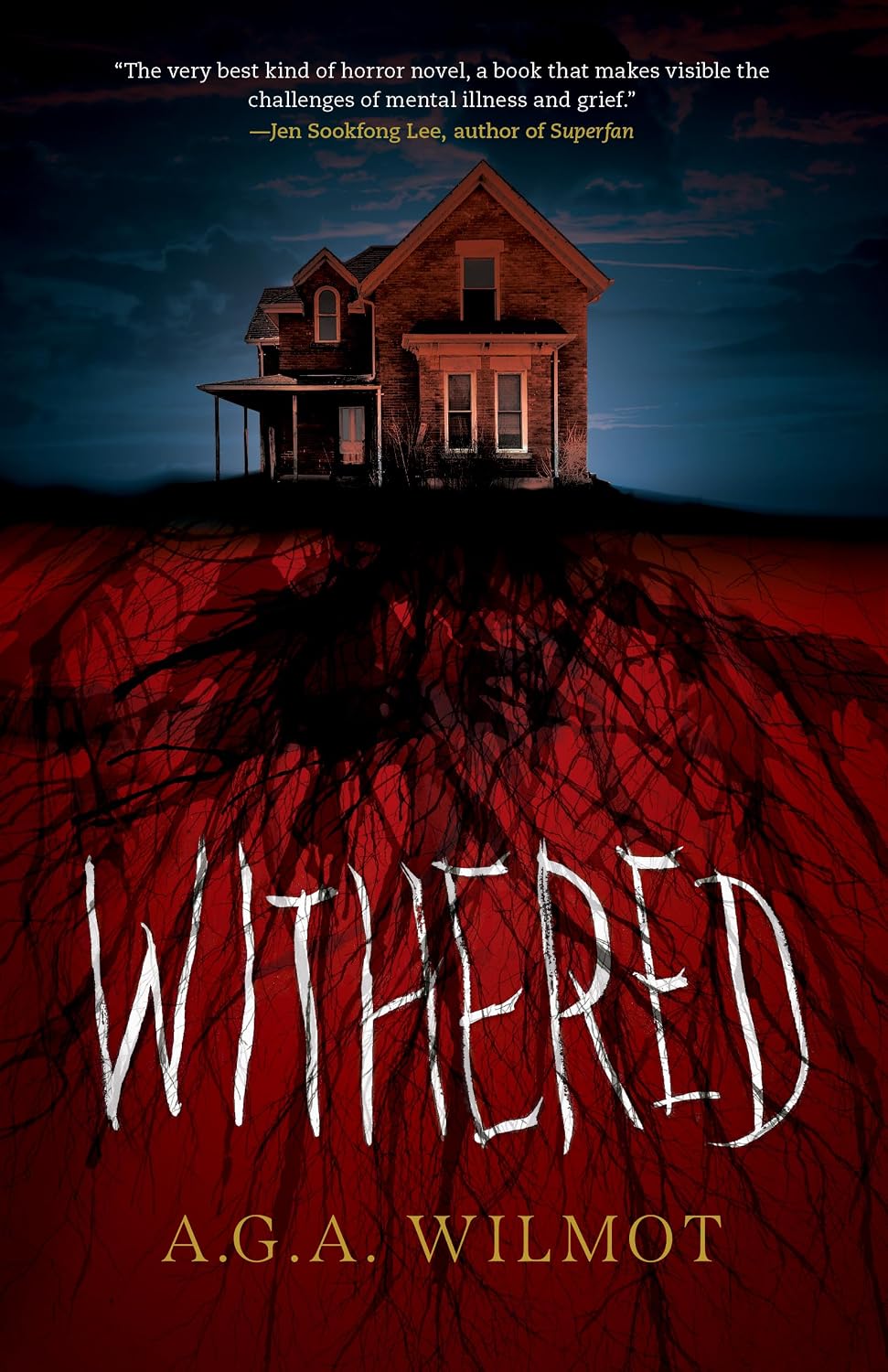
Withered by A.G.A. Wilmot
ECW Press, 2024
ISBN-13 : 978-1770417038
Available: Paperback, ebook edition, audibook
Buy: Bookshop.org | Amazon.com
Although I live in the Midwest now, my parents still reside in the Southern California city where I spent most of my childhood. They’ve since moved to a more affluent neighborhood in the same city, but whenever we visit, I always drive my kids past the houses where I grew up. I love showing them where I used to play dodgeball or mix “potions'” out of backyard flowers. A wave of excitement always stirs in me when I see those old spots even if my kids don’t quite share the sentiment. A.G.A. Wilmot understands the deep, undeniable connection between our homes, our history, and who we are now. They write in Withered, “Over years, as a mattress takes on weight from dead skin and oils, so does a house grow dense with memories of all who’ve dwelled within.” (Intermission One).
Withered is a queer psychological horror novel centered on a haunted house and the generations of inhabitants who have lived and died within its walls. Although the story is told through the eyes of the protagonist, Ellis Lang, who recently moved into the home with their mother, the house itself functions as the true main character. The narrative structure mirrors this haunting presence, alternating between chapters focused on Ellis’s current experiences and intermissions that offer flashbacks to past residents whose lives and deaths shaped the house into what it is today.
What makes Withered so compelling is that it completely rejects a simple “good vs. evil” binary. Those who wish to destroy the house and those who fight to preserve it are both driven by their own deeply held convictions of what is right. Even the manifestation of Death avoids the traditional, menacing Grim Reaper trope, appearing instead as an impartial force of nature simply trying to maintain a necessary balance.
This rejection of strict binaries perfectly reflects the core theme of the novel: liminality. Derived from the Latin word limen, meaning “threshold,” a liminal space or state represents an in-between holding area. It’s a point of transition between two conditions. Ellis embodies this threshold state in nearly every aspect of their identity and circumstances. Firstly, as a non-binary individual, Ellis exists gracefully between traditional gender binaries. Secondly, in terms of grief, Ellis is suspended in deep mourning about their father’s death, a psychological limbo where one is surrounded by loss yet forced to keep living, Ellis’s eating disorder acts as a biological threshold, hovering between life-giving sustenance and the physical deprivation of life. Finally, moving from the bustling city to the isolated countryside triggers a profound “relocation depression.” Ellis is caught in the painful gap where the old home is gone, but the new house does not yet feel like home.
This thematic liminality even bleeds into the broader narrative. The central romance features two teenagers navigating between childhood and adulthood, and the book itself sits right on the publishing threshold blurring the line between Young Adult and Adult fiction. The supernatural maternal presence in the house describes itself, “She was no afterlife– of this she held no illusion. What she’s become, she realized, was a haven. A limbo.” (Intermission Six)
While the pacing is initially slow, due to a web of mysteries that aren’t resolved until the second half, the book eventually takes off. The author masterfully gathers all the narrative threads to show you the big picture before slowly untangling them. You have to commit to the slow burn, but the resolution is well worth the wait.
Reviewed by Lucy Nguyen




Follow Us!