Home » Archive by category "Uncategorized" (Page 90)

Book Review: When Things Get Dark: Stories Inspired by Shirley Jackson edited by Ellen Datlow

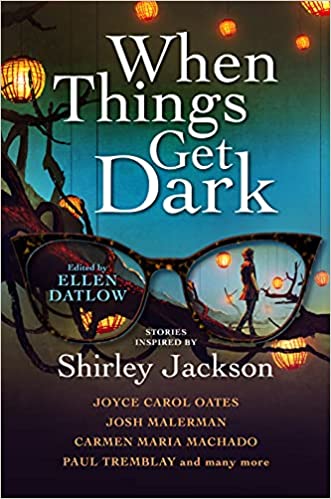
cover art for When Things Get Dark edited by Ellen Datlow

When Things Get Dark: Stories Inspired by Shirley Jackson edited by Ellen Datlow

Titan Books, 2021

ISBN-13 ‏ : ‎ 978-1789097153

Available: Hardcover, Kindle edition, audiobook Bookshop.org  | Amazon.com  )


Shirley Jackson couldn’t have known the impact her writing would have on the horror genre, speculative fiction, and literature in general: she was writing to pay the bills. Yet her work has resonated with readers and writers for both its depictions of domesticity, such as her fictionalized memoir, Life Among the Savages, and of the uncanny, seen in short stories like “The Lottery” and her most famous novels, The Haunting of Hill House and We Have Always Lived in the Castle (and sometimes both together). In When Things Get Dark, well-known anthology editor Ellen Datlow has collected tales by talented writers of horror, the uncanny, and the weird, inspired by Shirley Jackson’s work.


A number of stories take place within suburbia, with the uncanny just beneath a placid surface. Laird Barron’s “Tiptoe” focuses on uneasy family dynamics and the necessity of keeping up appearances, and “For Sale By Owner” by Elizabeth Hand, is a meandering story about three elderly women with a habit of breaking into empty summer houses who hold a sleepover in an empty, beautiful old house, which turns out to be a disorienting and disturbing experience. In Richard Kadrey’s “A Trip to Paris”, a nod to We Have Always Lived in the Castle, a recent widow planning her escape from her mundane life has her nefarious actions revealed by a stubborn, growing patch of mold on her wall, while Jeffrey Ford’s “The Door in the Fence” documents the strange and surprising changes in the narrator’s next door neighbor after her husband dies.


Some stories take direct inspiration from Jackson’s work, such as Carmen Maria Machado’s “A Hundred Miles and a Mile”, which references the “cup of stars” from The Haunting of Hill House, and stories such as “Quiet Dead Things” by Cassandra Khaw and “Hag” by Benjamin Percy that describe insular communities and their deadly rituals like the one in “The Lottery”.

With others, it’s sometimes hard to see the connection, although the stories are interesting. In Seanan McGuire’s dark fairytale “In the Deep Woods; The Light is Different There”, a woman escaping an abusive husband retreats to her family’s lake house, where she discovers the caretakers are not what they seem. John Langan produces a compelling, surreal tale of family, the occult, and mythological creatures in “Something Like Living Creatures”. In the dread-inducing “Money of the Dead”, Karen Heuler addresses the problems with resurrection and obsessive love; Joyce Carol Oates’ “Take Me, I Am Free” is a bleak, heartbreaking story about a child whose angry mother attempts to throw her away; in Josh Malerman’s dystopian “Special Meal”, a young girl discovers the difficulties, and consequences, of hiding knowledge. Genevieve Valentine’s “Sooner or Later, Your Wife Will Drive Home” is a cleverly constructed story about smart women in unlucky situations they can’t escape, something Jackson could certainly relate to. There were a few stories that didn’t hit the mark: “Funeral Birds” petered out at the end, “Refinery Road” and “The Party” left me confused, and “Pear of Anguish” didn’t seem to fit the theme or mood of the anthology.


While there are many excellent stories, the three that stood out to me were the previously mentioned “Tiptoe”; “Take Me, I Am Free”, a bleak, heartbreaking story about a child whose angry mother attempts to give her away; and Kelly Link’s “Skinder’s Veil”, a strange tale about a graduate student struggling with writing his dissertation who takes a housesitting job in rural Vermont, with the only rules being that anyone knocking at the back door must be invited in, but the front door should never be opened. Those who come to the back door are an unusual bunch, and the consequences of that summer are significant for him.


It’s not necessary to be a fan of Shirley Jackson to enjoy this book, but it does help, especially with Machado’s story, which depends on context from The Haunting of Hill House. If you do pick up When Things Get Dark without having read Jackson first, you will want to by the time you finish. Recommended.


Contains: self-harm, torture, suicide, murder


Reviewed by Kirsten Kowalewski


Book Review: Beasts and Beauty: Dangerous Tales by Soman Chainani, illustrated by Julia Iredale

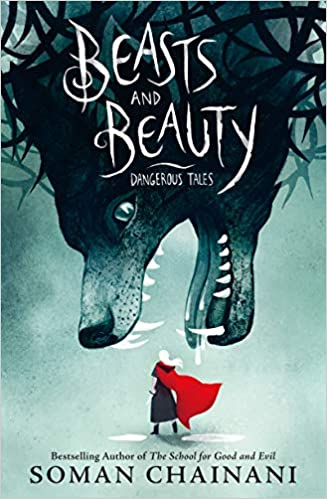
cover art for Beasts and Beauty: Dangerous Tales by Sonan Chainani

Beasts and Beauty: Dangerous Tales by Soman Chainani, illustrated by Julia Iredale

HarperCollins Children’s Books, 2021

ISBN-13 ‏ : ‎ 978-0062652638

Available: Hardcover, Kindle edition, audiobook Bookshop.org  |  Amazon.com )


In Beasts and Beauty: Dangerous Tales, Soman Chainani brings us tales so sharp they cut, with teen protagonists who seize their agency, and subversive, unexpected re-visionings of 12 familiar stories.

The standout story in this collection for me is “Bluebeard”, a lush and bleeding horror story. Chainani has altered the story so that instead of courting a wife, Bluebeard chooses boys from an orphanage as his victims. Unfortunately for him, one boy, Pietro, is wise to what’s going on.

“Bluebeard” is just one of many excellent stories. Chainani’s version of “Red Riding Hood” would do Shirley Jackson proud, with its rejection of conformity and tradition.  “Hansel and Gretel” set in India, is very different from the original tale, although you can clearly see its roots.  This was a beautifully done variation with a very satisfying ending, if you’ve ever wanted the stepmother to get her comeuppance.  “Cinderella” is an entertaining story where a girl in love with the prince, who has been hexed into a mouse, convinces Cinderella to go to the ball and take her along. The story definitely does not go where you think it will! “Snow White” takes on racism with an unusual reversal, and disrupts the structure of fairytale narrative. “Beauty and the Beast” also addresses racism and classism in its commentary on seeing past appearances, with a prickly, bookish, Chinese “Beauty”.  “Sleeping Beauty” is genderswapped, with lyrical, gorgeous writing threaded with horror. The relationships in this were particularly troubling as Chainani was not clear on the issue of consent or its lack that is central to Sleeping Beauty stories.

Chainani does a good job taking a traditional tale and giving it just a little bit of a twist, as well. Rapunzel uses her brain instead of her hair to get what she wants; Jack grows a beanstalk hoping to find his missing father at the top; the sea witch lectures the Little Mermaid on the folly of giving up a long life and self-respect for the possibility of love.  Other stories include “Rumplestiltskin” and “Peter Pan”.  Overall, it’s a great collection that pays a creative homage to traditional stories.  Art by Julia Iredale throughout, including full-page color illustrations, complements the stories perfectly as it’s integrated into the design of the book.

Teens who grew up reading Adam Gidwitz, the Sisters Grimm, or Chainani’s School for Good and Evil series, or who enjoy fairytale adaptations such as those by Anna-Marie Macklemore (Blanca & Roja)  Emily Whitten (For The Wolf) and Emma Donoghue (Kissing the Witch) should enjoy this collection. Highly recommended for ages 10+.


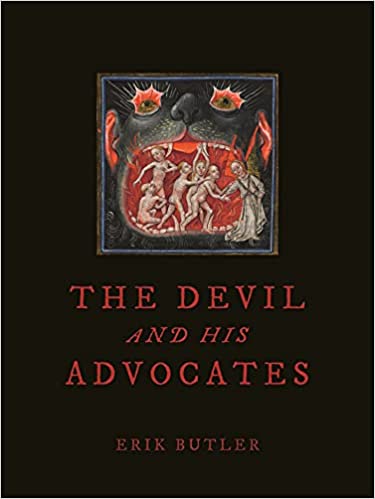
Book Review: The Devil and His Advocates by Erik Butler

cover art for The Devil and His Advocates by Erik Butler

The Devil and His Advocates by Erik Butler

Reaktion Books, 2021

ISBN-13: 9781789143737

Available: Hardcover, Kindle edition  Bookshop.org  |  Amazon.com )


In Erik Butler’s The Devil and His Advocates, the author argues that Satan is not God’s enemy in the Bible, but that he has been misinterpreted. In fact, he has been doing God’s bidding rather than acting as his own entity all this time. Butler uses the Old and New Testament, especially the trial of Job, to analyze the figure of Satan in literature, music, theology, and visual art from antiquity to the present. Butler asserts that Satan has been tasked by God to test human beings, whose piety leaves room for doubt. Butler argues that while Satan can be manipulative, he facilitates what mortals are inclined to do anyway, and he’s right.


In addition to biblical sources, Butler uses works of literature from Dante, Chaucer, Christopher Marlowe, Robert Burton, Jules Amédée Barbey d’Audervilly, James Joyce, Isidore Ducasse, Oskar Panizza, William Butler Yeats, Fyodor Dostoyevsky, Gian Pietro Lucini, Gottfried Benn, C. S. Lewis and more to unveil the nature and depiction of Satan, or the satan (which is an eye-opening discussion itself in the first chapter) to discuss why and how Satan’s role, position, and even personality have been, essentially, misinterpreted or reinterpreted. Butler includes a chapter on music as well.


Butler includes references, an index, and illustrations in The Devil and His Advocates. While this isn’t a work of horror, The Devil and His Advocates has the potential to be a valuable research tool for anyone who wants to focus on Satan in their fiction. It could also be useful for numerous classes, such as literature, drama, religious studies, fiction writing, and more. Highly recommended.


Reviewed by Lizzy Walker