Home » Archive by category "Uncategorized" (Page 7)

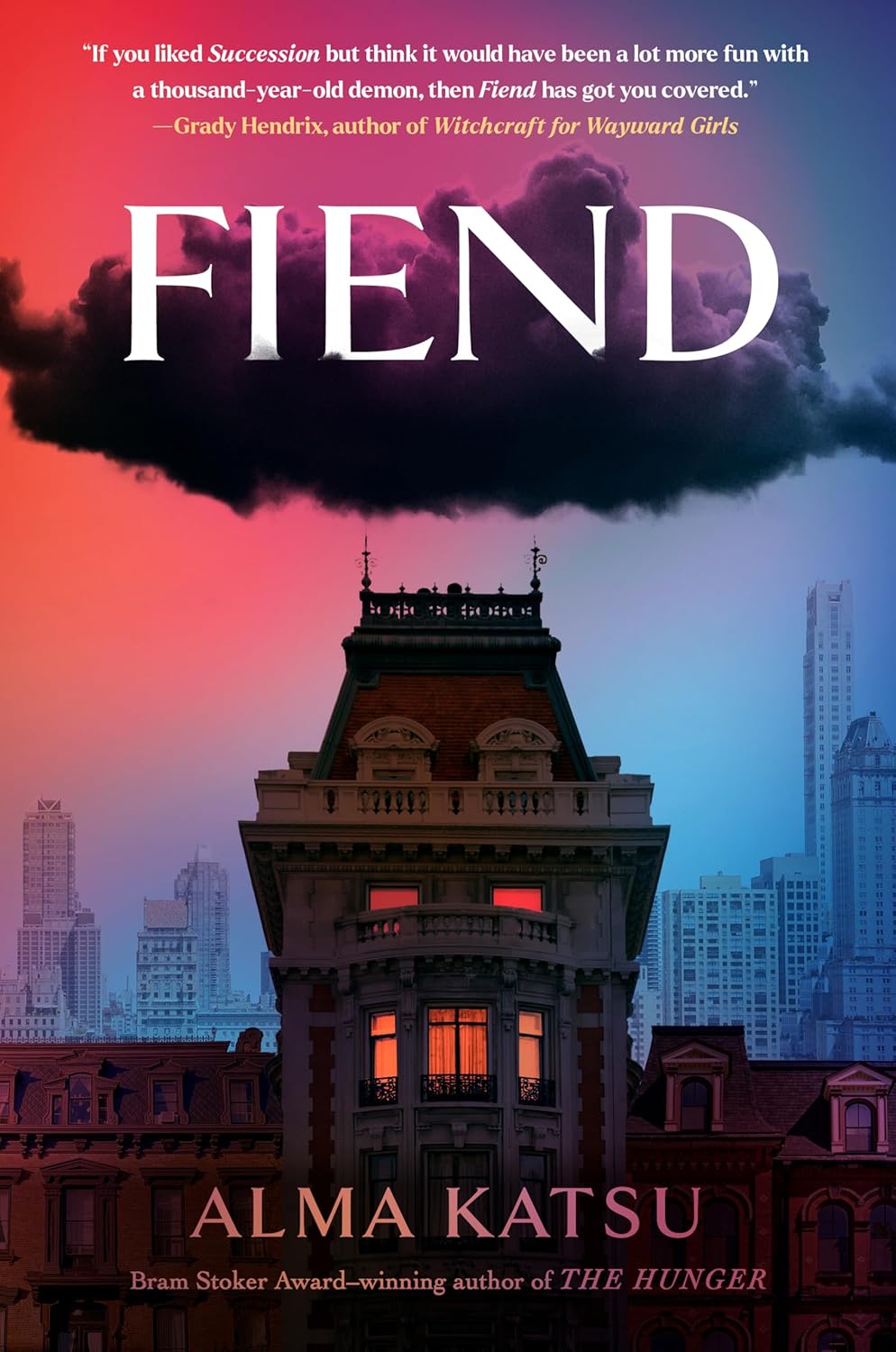
Book Review: Fiend by Alma Katsu

cover art for Fiend by Alma Katsu

Fiend by Alma Katsu

G.P. Putnam’s Sons, 2025

ISBN-13 ‏ : ‎ 978-0593714348

Available: Hardcover, Kindle edition, audiobook

Buy: Bookshop.orgAmazon.com 


Not being wealthy or influential myself (though I would be somewhat, if you pick up this book based on this review), it’s fun to read about wealthy, ruthless families getting their comeuppance. The only reason why I am not on a superyacht right now is because I have not made a pact with any supernatural force to acquire immense wealth beyond what I can spend in my lifetime, oppress the working class, and wreak havoc on the environment.


Fiend centers around the Berisha dynasty. The clan has existed for over a thousand years, and through arranged marriages and corrupt business practices, has kept the Albanian bloodline and family fortune flourishing. Zef is the cruel and unscrupulous head of household and your stereotypical super-powerful rich guy. Then there’s Olga, his beautiful, unassuming wife, a Melania Trump figure, who stays out of her husband’s politics but is complicit in what she does know. Dardan, the eldest, is weak and ineffectual, but has been primed to take over the family business. He is probably the most empathetic character in the family because he wants to break away from the hold the family has on him, but at the same time,  he won’t totally give up his money and privilege. Next there is Maris, the ambitious daughter who has all the horrible characteristics of her father, Zef, and seems to be the most logical replacement. But Maris can’t compete with Dardan since Dardan’s crowning achievement is being born with a Y chromosome, and she is expected to follow in the Berisha female tradition of keeping house and siring more Berisha babies. Finally, there is Nora, the unstable emo socialite who would rather party than have anything to do with the Berisha empire.


The novel goes back and forth (“Then” and “Now”) of memories the Berisha children have of growing up in a house seemingly possessed by a supernatural force, a fiend known as The Protector, which keeps the Berisha clan rich and powerful while their competitors are suspiciously afflicted with horrible diseases and accidents. 


Under strange and mysterious circumstances, Maris is finally given the chance to break away from her Jan Brady status and the “Dardan, Dardan, Dardan” shadow to take over the business, and, in effect, the whole Berisha legacy. Little does she know that there are responsibilities that she will inherit that are not in her official job description. 


Fiend is a deliciously fun book to devour after a day of business meetings, synergizing, estimating bandwidth and defining deliverables, doing deep dives but still picking low hanging fruit, and talking about circling back to things that you know will never be addressed. Alma Katsu is known for her historical fiction novels such as The Hunger (based on The Donner Party) and The Deep (based on the sinking of the Titanic). Fiend is instead inspired by the television series Succession, about Logan Roy, the patriarch of the powerful and dysfunctional Roy family and owner of a NYC based global media conglomerate and the power struggle by his four children to take over as his health declines. Katsu reimagines the characters and their background and throws in a splash of her signature supernatural, horror talents to create an entertaining novel that will make readers forget all the tech debt that their company has pushed aside until it’s all hands on deck when the whole system comes crashing down. I think I have been working too much because a book about corporate greed and demonic possession makes perfect sense. Recommended. 


Reviewed by Lucy Molloy

Book Review: Somewhere Quiet, Full of Light by Henry Corrigan


cover art for Somewhere Quiet, Full of Light by Henry Corrigan

Somewhere Quiet, Full of Light by Henry Corrigan

Slashic Horror Press, 2025

ISBN: 9781763725607

Available: Paperback, Kindle edition

Buy:   Bookshop.orgAmazon.com


Somewhere Quiet, Full of Light will probably get categorized as just another haunted house tale, but it is a good deal more. The reader watches a strong family unit disintegrate, due to the influence of a house with its own abilities and desires. It’s a smartly written tale that shows that Corrigan is an author to watch. He creates real tension throughout, while using very simple elements. Corrigan realizes that real scares often come not from fear of the supernatural, but from what people fear in each other– and themselves. This is a story that will stick with you long after the final page is turned.


The plot itself is simple enough: Mike and Joe Tillman want to move their two young kids away from the city, but have limited funds. They buy a fixer-upper in a remote location, planning to turn it into their dream home, but the house has other ideas. 


Corrigan is very adept at building tension without going over the top. No shrieking banshees or flying body parts with buckets of blood are needed: he keeps it straightforward. That’s very difficult to do, and it works beautifully. Just an occasional shadowy figure, a creak in the house here, a movement there…small stuff, but due to Corrigan’s writing style, very effective and unsettling. The story isn’t about creating big scares (although the ending is a real banger) but instead creates a constant feeling of dread that lingers throughout the pages.


Right when the family first arrives at the house, you’ll feel that something is distinctly off with the whole situation, but it won’t be shown to you in any obvious way. Throughout the entire book, the suspense level increases like a tightly-wound string, that finally snaps in the last few pages. Writing suspense and keeping it constant is not an easy task, but Corrigan does it with ease.


The house itself plays a large role in the story, and that gives the book a decidedly different flavor. It’s like a living, breathing entity, and a number of chapters are written from the perspective of the house itself. You’ll feel its pain as it goes through renovations, and its joy at seeing parts of itself repaired. When the house has to move something by itself, be it a floorboard or panel, it feels like an immersive experience. It’s another of the reasons the book is a cut above the rest.

Bottom line: just read this one: you won’t be disappointed. Hopefully, the author will write a full length novel at some point. As good as this story was, at just 150 pages I wanted more. Definitely a case of a great story that most readers would have wanted to continue longer. Most certainly recommended!


Reviewed by Murray Samuelson

Book Review: That Very Witch: Fear, Feminism, and the American Witch Film by Payton McCarty-Simas

cover art for That Very Witch by Payton McCarty-Simas


That Very Witch: Fear, Feminism, and the American Witch Film by Payton McCarty-Simas

Luna Press Publishing, 2025

ISBN-13: 9781915556608

Available: Paperback, Kindle edition

Buy: Bookshop.org | Amazon.com


Payton McCarty-Simas’ That Very Witch: Fear, Feminism, and the American Witch Movie analyzes the cinematic witch’s evolution and relationship to feminist movements from the 1960s to the 2020s. Using historical, social, and feminist models for basis of analysis, they examine how the witch became viewed as both the feminist representation of empowerment and fear. McCarty-Simas’ analysis of the witch film reveals how the witch has been portrayed over time, reflecting significant changes in American culture and politics.


A brief history of early European witches, and their associated witch hunts, or “crazes,” driven by bigotry, misogyny, and racism, creates the basis for the contents of the book, as these are central to the concept of the witch. The author addresses the concept of the witch as a symbol in feminist circles, what can be learned from various witch cycles through history, whether witches through time can be considered feminist figures, and more, in their analysis of witch films.


In Part 1, “Season of the Witch: The Countercultural Witch Films of the Long Sixties,” the author explores witch films from 1960 through 1973, including the birth and death of the witchsploitation film in the context of the sociopolitical climate of the era. Part 2, “Unpleasant Dreams: Feminism, Satanic Panic and the Witch Films of the 1980s,” takes the reader through the rise and decline of the Satanic Panic. McCarty-Simas expands on how this era’s witch films responded to the earlier witch cycle film, the Panic’s effect on the figure and evolution of the witch and Satan, and antifeminist rhetoric pushed by conservatives that the role of working women, as well as the innovation of home video technology and the VHS, were to blame for Satanic cults lurking around every corner. Particularly interesting in this section is that McCarty-Simas highlights the “Satanic Panic specials,” framing them as horror comedies. For readers who have seen clips or the full version of such shows, you know why the author includes these as horror comedies. Over-the-top “reporting,” alleged experts on Satanic Ritual Abuse who spread disinformation, and decrying explicit material in horror movies while in the same show describing in great detail what happened to alleged victims, are just a few of the reasons the author correctly includes them here.


“Interlude: Notes on the Postfeminist Witch Film (1990-2013)” focuses on the witch film in terms of Third Wave feminism, Riot Grrrls, girl power, the commodification of witches to teenagers, and the bitchification of the witch. The author presents an insightful analysis of
The Craft a
nd its overall failure at intersectionality, and discusses girl and women witches in the Harry Potter franchise. The author includes some television series from this time period as examples of dark fairy tales, highlighting American Horror Story: Coven and its successful portrayal of feminism, race, and intersectionality.


Part 3, “Gender, Genre, Psychedelics, and Abjection in the 2010s ‘Witch’ Horror Cycle,” examines 2010s witch films, tying the “demonic woman” to the cycles in previous chapters. A major visual the author uses as a tool for analysis is the smile of the heroine or final girl at the end of horror films, comparing them to how the meaning of this expression can be interpreted on the face of a witch at the end of her film.


I would be remiss if I did not address a significant issue with the text, that being the “Works Cited” section. There are links that point the reader to academic library databases where an account is needed to access the articles or books, Google Books links, and broken links, rather than using DOIs (digital object identifiers) or stable URLs. Correct citations bolster the text and provide readers with further information. This includes directing readers to the resource itself.


Regardless of the problems with the citations, That Very Witch would be a good resource for readers interested in the history of the American witch film in terms of particular political climates, social movements, and historical context. It provides an extensive film and mediography that has increased my watch list. Recommended.


Reviewed by Lizzy Walker