Home » Archive by category "Uncategorized" (Page 58)

Into the Forest: Tales of the Baba Yaga edited by Lindy Ryan with a foreword by Christina Henry

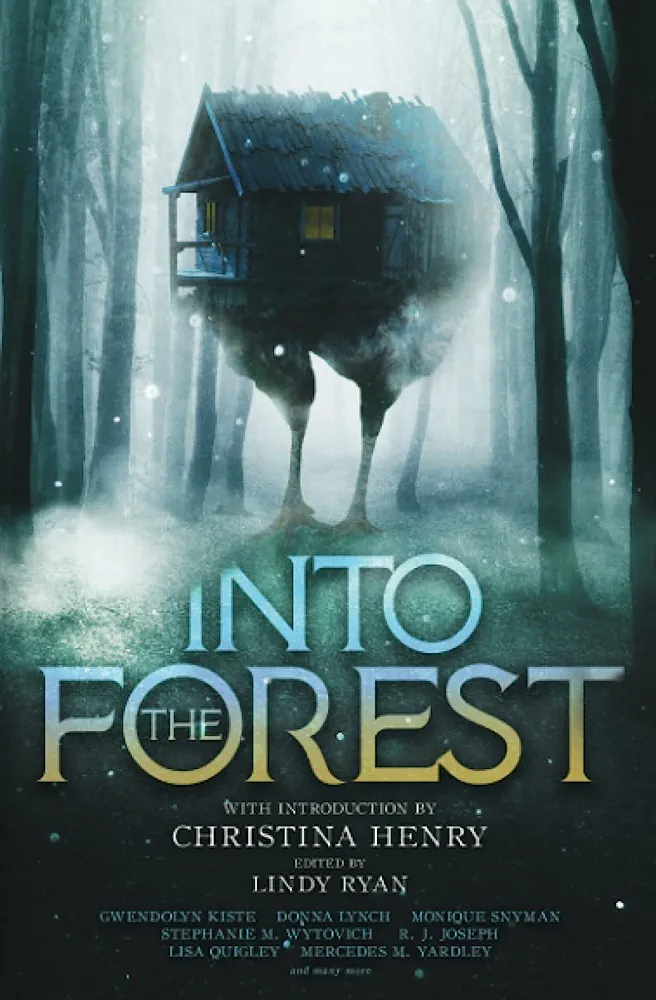
Cover art for Into the Forest; Tales of the Baba Yaga edited by Lindy Ryan

Into the Forest: Tales of the Baba Yaga with a foreword by Christina Henry, edited by Lindy Ryan

Black Spot Books, 2022

ISBN-13 ‎978-1645481232

Available: Paperback, Kindle edition, audiobook, audio CD  Bookshop.orgAmazon.com )


This anthology collects stories inspired by the Slavic folk character Baba Yaga, a child-eating witch with iron teeth who lives deep in the woods in a house with chicken feet, rides in a mortar and pestle, and can either help or hurt visitors, especially women, for a price, and depending on her whim. All the stories are by women writers of horror.


Standout pieces include Stephanie M. Wytovich’s vivid poem “Dinner Plans with Baba Yaga”; Gwendolyn Kiste’s “Last Tour into the Hungering Moonlight”, a real estate pitch that draws neighborhood women into the woods; Sara Tantlinger’s “Of Moonlight and Moss”, a fairytale that isn’t; “Wormwood” by Lindz MacLeod, and “Flood Zone” by Donna Lynch, both with the witch as justice-bringer, in very different ways; “Sugar and Spice and the Old Witch’s Price” is a dread-inducing counterpart to Kiste’s earlier story; “Herald the Knight” by Mercedes M. Yardley is Baba Yaga’s love story; Jill Baguchinsky’s “All Bitterness Burned Away” is an interesting reversal of Hansel and Gretel; “A Trail of Feathers, A Trail of Blood” by Stephanie M. Wytovich is a heartbreaking story that explores the true meaning of sacrifice; “Baba Yaga Learns to Shave, Gets Her Period, and Comes Into Her Own” by Jess Hagemann reflects the teenage girl’s experience of being trained to conform;  EV Knight’s memorable and powerful “Stork Bites”, in which Roe vs Wade has been dismantled, leaving an unusual method of illegal abortion, with disturbing consequences, as the only resort for ending a pregnancy; “Where The Horizon Meets the Sky” by R.J. Joseph is a sort of “Monkey’s Paw” tale; the vivid and gruesome “Maw Maw Yaga and the Hunter” by Alexandrea Weis; and the descriptive, poetic stories “Baba Yaga in Repose” by Heather Miller and “Shadow and Branch, Ghost Fruit Among The Lullabies” by Saba Syed Razvi.

There is a lot of variety in approach and interpretation. If you have an interest in Baba Yaga, witches, folklore, or supporting women writers, this is a collection to enjoy. Recommended.


Reviewed by Kirsten Kowalewski
Graphic Novel Review: The Night Eaters, Volume 1: She Eats The Night by Marjorie Liu and Sana Takeda


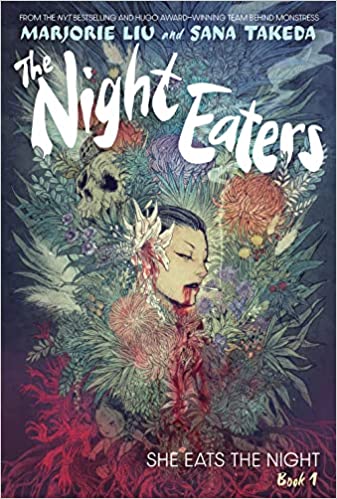
Cover art for The Night Eaters Book 1: She Eats The Night by Marjorie Liu and Sana Takeda


The Night Eaters: Volume 1, She Eats the Night by Marjorie Liu and Sana Takeda

Abrams Comicarts, 2022

ISBN-13: 9781787739666

Available: Hardcover, paperback, Kindle edition, Bookshop.org  |  Amazon.com  )


The creative team behind the Monstress comic series have created another world for readers to visit in The Night Eaters: She Eats the Night, the first in a trilogy.


Chinese-American twins Milly and Billy are in their early 20s and own their own business. They struggle to keep their restaurant afloat while navigating COVID-19. They also struggle with personal relationships and life in general. Billy spends his free time locked away killing virtual monsters, while Milly comes to terms with dropping out of med school and pining for her ex-boyfriend, who she still visits. Their parents, emotionally distant mother Ipo and laid-back father Keon, are in town for their annual visit. Ipo and Keon, immigrants from Hong Kong, have supported their children throughout their lives, but the parents worry that their support has hindered rather than helped their children. 


To test their strength and fortitude, Ipo forces Billy and Milly to help her clean the house across the street, which was the scene of a grisly murder, and where dolls move on their own. Ipo has been hiding a deadly secret from them their entire lives. In the span of one night, everything is revealed to the twins, but they are left with more questions than answers.  


Liu’s storytelling is great. The family dynamic is well-written, with tension, love, and humor, and the four of them are just dealing with each other at the forefront of the story. Milly and Billy have a believable sibling relationship, with antagonistic details on display. We get glimpses of Ipo and Keon’s relationship told in a series of flashbacks. We gradually find out more about them as a couple, as well as who they really are as people. Ipo spends more time with her plants than she does with her children, something which infuriates Milly. Keon is at times insufferably relaxed about situations that would send others into a panic or downright anger. Yet, they work as a couple, and their children are stronger than they are given credit for, especially by Ipo.


Takeda’s artwork is something I have sought out since I started reading Monstress. Her comic panels are beautiful. There are a few illustrations that feel like they were rushed, but her skill is still evident. Liu and Takeda give us another beautifully haunting, and haunted, in The Night Eaters: She Eats the Night. The next volume will be released in 2023. Highly recommended.


Reviewed by Lizzy Walker

Musings: The Disconnect Between What Kids Want and What Teachers Recommend

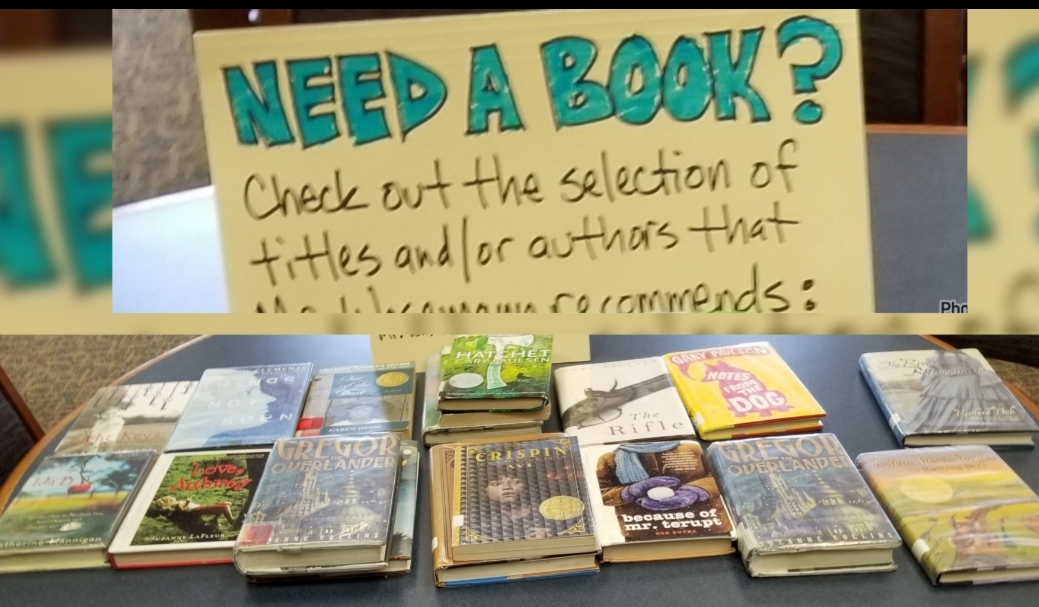
Table with sign that says "Need a Book? Check out thes authors and titles that Mr. ____ recommends" with a number of books face up on the table.

The reason I went back to school after working as a children’s librarian in a public library was that I noticed that sometime around grade four kids stopped coming to the library, They were too busy, they had too much homework, they had stuff going on. Even programs carefully designed around their interests weren’t attracting those kids.


I wanted to reach those kids. And I was willing to quit my job and go back to school to reach them where they were– school– a captive audience I could finally reach. And I did. But even in 2005, the librarians were the first ones to go when the budget got sliced.


In grad school and through 2005 I was part of a children’s choice committee for grades 4-6. We had a list of books proposed that we had to read, evaluate, discuss, and eventually choose 20 books for our nomination list. Kids who read at least 5 could vote for their choice for  best book. And the book with the most votes won the award.

Where am I going with this?

I currently volunteer in my kids’ former middle school library.

In early February I was asked to pull teacher favorites for a display. These included many of what would be considered classics- To Kill a Mockingbord, Night, The Call of the Wild, 1984, The Adventures of Huckleberry Finn. Only two of them had been written since 2005.


In mid-February, a teacher put a table of best books out on a table These were great choices I would have no problem recommending.  But I recognized almost all of them as books I had read while on the children’s choice committee. Only a few had been written in the last five years. One (Scythe) is taught as required reading at the high school.


We are not reaching teachers. They may be tolerating or even accepting horror in their classrooms but many aren’t promoting or providing horror genre titles to their students. And teachers have a huge influence on what gets checked out. It has to be a cooperative effort. The media specialist had a virtual visit with students with Lorien Lawrence in February, but on the day I came in, his books were still on the shelf.


I have helped the media specialist pull and promote scary and horror-themed books in the past. At the elementary, there’s time for storytelling to shape readers. But that isn’t enough at the secondary level. How do we reach teachers, especially at a time when giving kids books is so dangerous?  It’s time to think outside the box.


Editor’s note: I have had this characterized as a “diatribe against teachers”. It’s not. Teachers have a difficult job that is being made harder by conservative school boards and state legislatures. There is currently an effort to pass a law that would criminalize teachers and librarians for giving students “inappropriate” books in my state. Many school and classroom libraries have been cleared away elsewhere. 

Teachers face the difficulty of finding reading material their students will find relevant and engaging within challenging restraints. 20 years ago I was working to convince other school librarians horror was relevant and had the potential to be engaging to their students. Today there’s a Librarian’s Day at StokerCon: librarians are engaged in collection development  and promoting the horror genre. I am asking, where do we, as members of the horror community, go from here? What can we do to help?