Home » Archive by category "Uncategorized" (Page 5)

Book Review: Lichtenberg by Tom O’Connell

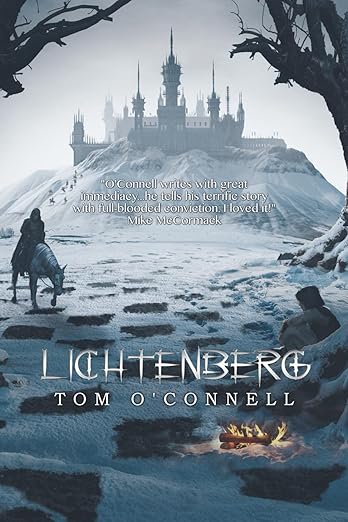
cover art for Lichtenberg by Tom O'Connell

Lichtenberg by Tom O’Connell

Temple Dark Books, 2025

ISBN: 9781068250736

Available: Hardcover, Kindle edition

Buy: Amazon.com  | Temple Dark Books


Lichtenberg is a grim, bleak dystopian tale that keeps the reader interested throughout, because it always maintains a flicker of hope throughout the novel.  For the readers out there that enjoyed books like Cormac McCarthy’s The Road, this should be a perfect read.   The book is written in the present tense from the perspective of Riven, a soldier in the Corps, the group tasked with protecting the City of Raidon from the Ramasites. Raidon is one of the remaining bastions of civilization, and all inhabitants have one fear: that the Ramasites, humans trying to survive outside the city, will one day band together and destroy it.  No matter that none of the city’s inhabitants remember the time before whatever calamity happened, it’s just what they have been told, and it’s what the historical archives tell them.


The job of the Corps, a loosely disciplined army of troops that love violence, is simple: patrol the countryside, and kill anyone they find.  Men, women, children– all are a threat, and must be eliminated.   The plot centers on Riven, and the doubts he starts having with the validity of the mission of the Corps, which of course is its only reason for existence.  The narrative is really more about Riven and how he sees things.  That’s why the first-person present tense (a style I normally loathe) actually works for this book.  It lets the reader get into Riven’s head in an immersive and immediate way. A significant amount of the writing concerns Riven’s thoughts and feelings regarding the Corps and what they do.  It’s a fairly in-depth character study, and it is well done.  The story doesn’t provide any information from before Riven’s time, or after it, since he is the focal point of the story.  This is one of the few times I have read a book written in this style that actually works, since too many books written in the present tense come off like bad movie scripts.


This is not just a detailed psychological novel: there are plenty of things happening in the story, more than enough to keep the pages flipping.  The interactions between the Corps and Ramasites provide a good deal of the action, as well as some of the basis for Riven’s discontent.  There are violent gun battles that show the inhumanity of the Corps members, and some of the training that takes place inside the walls of Raidon helps explain how the soldiers became what they are.  When you are raised on violence, you are likely to do the same to others, as they demonstrate on the Ramasites.  It all builds to a very satisfying conclusion that hits with a bang, and Riven’s fate is quite dramatic: it would look incredible on the silver screen.  The only thing I didn’t understand was the brief epilogue chapter, The way the book ended before that was perfect as it was: open ended, but with hope for the future.   In closing, definitely a good one, and worth checking out. Recommended.


Reviewed by Murray Samuelson

Book Review: The Witch of Willow Sound by Vanessa F. Penney

The Witch of Willow Sound: A Novel

The Witch of Willow Sound  by Vanessa F. Penney

ECW Press, 2025

ISBN-13 ‏ : ‎ 978-1770418424

Available: Paperback, Kindle edition, audiobook

Buy: Bookshop.orgAmazon.com


The story starts with the burning of a woman. Author Vanessa F. Penney details the fire singeing the feet and its expansion as it rises up her body, the crackling sound of the fire, the color of the smoke, the logistics afterwards, the small rituals that have to be done when you burn a witch. It is easy to get rid of the flesh, but what to do with the bones? The prologue yanks you into this novel about the disappearance of Madeline Luck, the local witch, though the rest of the book is a slow burn (no pun intended).


Madeline Luck has been missing for three months. Her niece, Phaedra, also known as Fade, is given the task of finding her, due to the family’s rightful distrust of the local police department. Even though she used to be very close to her aunt, especially when she lived with her at Willow Sound, Fade hasn’t seen her for over 20 years. 


The reader follows Fade’s steps as she makes her way up unmarked paths to get to her aunt’s house, atop a secluded cliff in Nova Scotia, and works through the mystery of her disappearance. As Fade gets deeper and deeper into the case, she exposes shocking town secrets, uncovers literal skeletons in the closet, and learns the deep history of witchlore from a bumbling but lovable historian named Nish, who becomes Fade’s sidekick in solving the mystery. The novel keeps you guessing until the very end to find out if it was Fade’s aunt, Madeline, that was burning at the stake at the beginning of the book, or if she was the one that set the fire. 


The book moves at a slow pace, with each detail mentioned being an important clue to the final resolution. The author has a gift of bringing you into the woods where Madeline’s ethereal house stands, with a haze over the sound and a large shadow cast upon the nearby, distrustful town of Grand Tea. The town is literally under a shadow of a huge rock which threatens to fall and crush the residents. The air is full of suspicion and tension, directed at Madeline, who the townsfolk blame for all their misfortunes. Fade will not find any help from them.


The Witch of Willow Sound  is a delightful book that transports you into the landscape of Nova Scotia. It explores witchlore, and feminist ideas of the suspicion of women who do not conform to the gender norms expected of them. Even though it is labeled as horror, I would say it’s more of a mystery, with historical and gothic elements. It is a sweet tale about memory and expressing your appreciation of people before they are gone. Fortunately, Fade discovers this before the end of the novel.


This would make a great book for a reading club and would spark great debate about how society views women who live just for themselves. Men living alone in the woods are “self-sufficient” but somehow women living on their own are viewed with suspicion and labeled as witches who need to be taken into the fold. Labels such as cat lady (witches are also known to have black cats) and spinster (an occupation of spinning wool into yarn which was a way for unmarried women to support themselves during the Middle Ages) have similar attributions. Why can’t some of us just like animals more than people and be left alone with our hobbies without fear of being burned at the stake? Is that too much to ask for? Recommended. 


Reviewed by Lucy Molloy


Book Review: Witchcraft for Wayward Girls by Grady Hendrix

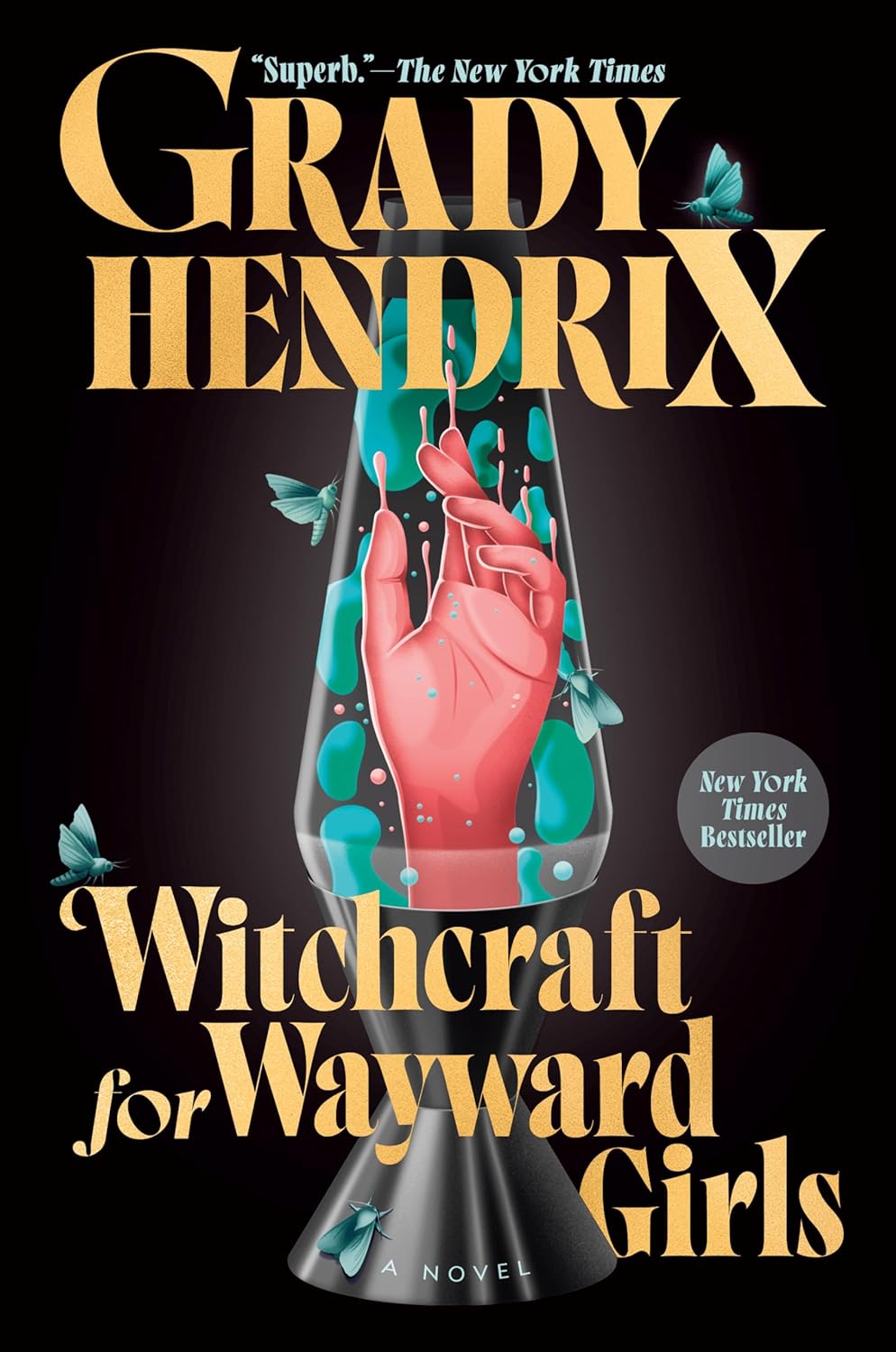
Witchcraft for Wayward Girls by Grady Hendrix

Berkley, 2025

ISBN-13: 978-0593548981

Available: Hardcover, paperback, Kindle edition, audiobook

Buy:   Bookshop.org | Amazon.com


It’s 1970. Neva is 15, pregnant, and lost. Her father leaves her at the Wellwood Home in St. Augusta, Florida, a maternity facility for pregnant teens. Miss Wellwood, the proprietor, runs her home with strict rules and reprimands the girls about their loose morals and poor decisions. the adults in charge include Diane, a social worker who guides the girls through their time in the Home;  Dr. Vincent, a cold elderly man with traditional views on women’s healthcare, who prescribes restrictions and other cures for the girls, with a focus on the babies; Nurse Kent, who minds the girls at night and when needed; Hagar, a Black woman who runs the kitchen; and Hagar’s sister Miriam, who instructs the girls on their domestic roles, such as proper cleaning of the Home.


The adults are not the focus of the story, of course. It is the girls, renamed by Miss Wellwood as flowers, as though she is tending a special garden. Neva is renamed Fern. Rose, a radical hippie who wants to keep her baby Blossom, is a force to be reckoned with in the Home. Always on strike, she fears nothing and no one… until she does. Holly has been through terrible trauma in her short life, at the hands of a powerful member of the community. She’s wild, refusing to allow people to get close to her, and remaining mute until she finds her voice. Zinnia is a musician who loves the father of her baby, swears they will marry upon her return home, and tries to ignore what she was put through at the hands of her mother when her parents found out she was pregnant. There are other girls, and as one leaves, she is replaced by another flower.


One hot summer day, the local library’s bookmobile arrives with librarian Miss Parcae at the wheel. She presents Fern with a book called How to Be a Groovy Witch, a powerful tome that opens a new world for Fern, Holly, Rose, and Zinnia. There is something special about this book, and it reveals more to them the deeper they go as they form their own small coven and cast their first spell. The unassuming librarian is more than she seems. As Fern and the girls become more involved with witchcraft and the librarian, they find their newfound power comes at a painful price.


Witchcraft for Wayward Girls is powerful. I read the ARC, hardcover, and audiobook versions. Author Grady Hendrix opens the ARC with a letter to the reader, while the published version includes a statement in the acknowledgments, where he provides a brief history of these homes, and shares the experiences of his own family members. There are visceral depictions of body horror in terms of giving birth, which I had a difficult time getting through. Medical horror, especially regarding women’s health and trauma, is difficult for me to read.


Hendrix’s ability to write about and from the perspective of girls and women is incredibly effective and well-executed. Readers who enjoy this book may also enjoy his other books, especially The Southern Book Club’s Guide to Slaying Vampires, My Best Friend’s Exorcism, and We Sold Our Souls.  Highly recommended.


Reviewed by Lizzy Walker