Home » Archive by category "Uncategorized" (Page 335)

Ten Years of Monster Librarian


Tomorrow marks the tenth anniversary of Monster Librarian.
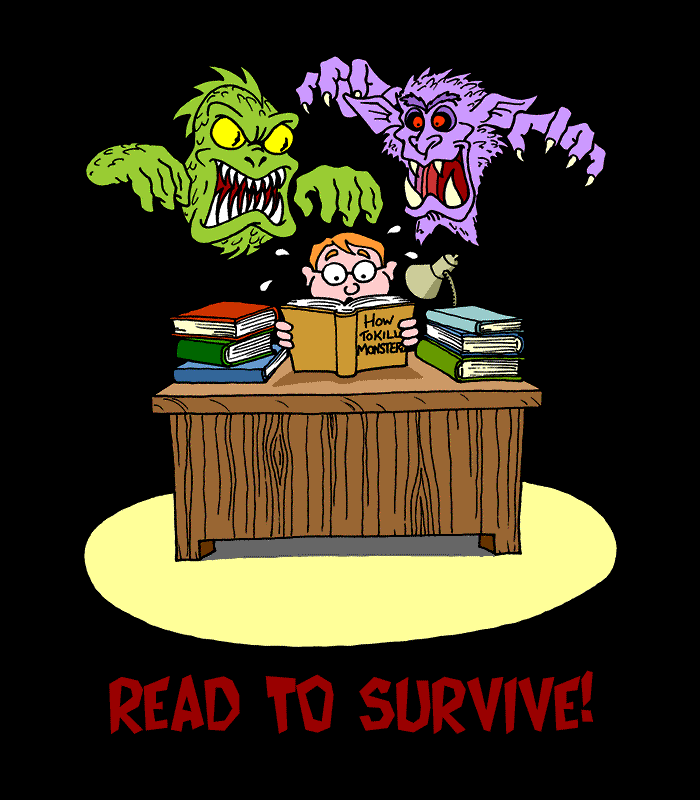
The first review was published on January 1, 2006. The Monster Kid had just recently joined the family, and Dylan was working two jobs and going to school part-time to earn a master’s degree in library science. His internship in a public library, and his experiences in library school, showed him how disregarded the horror genre was in libraries, and as a lover of genre fiction he felt this was a real disservice to both readers and libraries.  There is also research showing that horror and suspense are successful hooks for reluctant readers, and developing lifetime readers is essential for both individuals and society (this is part of why our original logo is of a kid literally reading to survive). But mostly he just wanted to connect readers of all kinds and all ages with books, and since most of the librarians he encountered had no interest in or knowledge of horror fiction beyond the most perfunctory, he felt that a resource like this was a need for the library community.

Much has changed since then. A lot of the debate over ebooks and self-publishing has been put to rest. The Internet has made small presses more accessible. Mainstream publishers, who had more or less abandoned the horror genre, are publishing horror again. Vampires have ceded their popularity to zombies, and all kinds of people have embraced horror tropes in popular culture, across a variety of media. The horror genre is more diverse and welcoming than it was ten years ago, and that’s really fantastic. What hasn’t changed is our desire to help match readers to books that will make them want to keep reading, to paraphrase S.R. Ranganathan, and to celebrate the love of reading whatever you love as reflected in our Genre Reader’s Bill of Rights.

Now is a good time for reflection and for input from you, our readers. Where should we go from here? What is most useful to you? Is there something you’d like to see here that we haven’t covered? Comment here or on our Facebook page, or email me at monsterlibrarian@monsterlibrarian.com and tell me what you’d like to see.

Here’s to a great 2016!


Book Review: Z-Boat by Suzanne Robb

Z-Boat(Z-Boat Book 1) by Suzanne Robb

Permuted Press, 2013

ISBN-13: 978-1-61868-2-345

Available: Trade paperback, multiformat ebook edition (Kindle,Nook, Smashwords, Kobo)

Experienced submarine captain Brian Kingston has accepted a search and rescue mission– a simple enough job for him and his crew. The huge payoff– half up front and half upon completion– is enough to silence any warning thoughts. The target is The Peacemaker, one of the most impressive submarines in any fleet, that is essentially an underwater laboratory. A distress call had gone out from the scientists inside, sent to study decayed things underwater, and Kingston’s orders are to find The Peacemaker, obtain an unidentified item and collect any survivors.

The idea behind ZBoat was really cool. In addition to the events of the rescue mission, the personality conflicts and intensity of emotions in a closed environment built up the tension, and I wondered how the story would play out in the submarine. While the action was fast-paced, it didn’t feel like the story took off until well into the book. Too much time was devoted to setup and background: I wanted to get on the zombie sub long before the author let me.

The description was well-done, and the characters Robb developed were interesting, although there were so many characters that occasionally they blended together for me. The biggest issue is that the book needs editing. There are multiple instances of missing words and odd turns of phrase that really made it tough for me to get into the story. There were also a couple of instances where the captain’s name, Brian,  was misspelled as “Brain”: funny and ironic but not appropriate. Overall, Z-Boat is an okay read with an interesting scenario that needs a bit more work. I have not read this author’s work in the past.

Contains: Gore, Swearing

Reviewed by Aaron Fletcher

Book Review: Memory of Water by Emmi Itaranta

Memory of Water by Emmi Itaranta

HarperVoyager, 2014

ISBN-13: 978-0062326157

Available: Hardcover, paperback, Kindle edition

For a novel in which it seems that very little happens, Memory of Water packs an unexpected punch. The story takes place in a dystopian future that seems all too likely: one in which climate change has completely altered geography, shortages of oil and gas caused terrible wars, our fragile technology is broken, books have been destroyed, and the only uncontaminated water is controlled by the military and the government.

Noria, the first-person narrator, is the daughter and apprentice of the tea master in her village, and she has been entrusted with a secret– the tea master is the guardian of an illegal hidden spring of clear water, a crime punishable by execution. The new military leader, Commander Taro, is suspicious, but unable to find evidence. When Noria’s father dies, she becomes the guardian of the spring, but as the military closes in on her village and clean water becomes more and more severely rationed, she has to decide whether to share the secret.

Noria and her friend Sanja are both curious about past technology, and during a scavenging expedition they uncover evidence from an earlier time that there may be reserves of uncontaminated water, and, with their new knowledge, decide to leave on an expedition of exploration. Unfortunately, Noria’s movements have been observed, and she is separated from Sanja and isolated from the community in an effort to convince her to give up the location of the spring to the military.

Finnish author Itaranta communicates the history and present of her complex world without depending on long passages of exposition. The details of daily life, and the rituals of the tea ceremony, give structure and believability to the story without overwhelming it. This is a slow, deliberately told story, using lyrical and vivid language. Noria’s strong feelings about her relationships with her parents and Sanja, and about freedom and survival, bring it alive. The love and strong friendship between Noria and Sanja, while not the main focus of the story, is a powerful force within it. Because we only see through Noria’s eyes, and learn what she knows, the end of her story has an unusual impact. The end of Noria’s story is not the end of the story, though. Itaranta switches to third person narration that fills in many of the blanks, and ends on a bittersweet note of hope.

Memory of Water isn’t a horror novel, but it is powerful and imaginative. In a crushing world like the one Itaranta describes, one might not expect to find that there is still room for small acts make a difference, and a possibility of hope. It is easily one of the best books I’ve read this year.

The next time someone argues that dystopian fiction is bad for society,  hand them this book as evidence that sometimes it’s where we find hope for the future.

Reviewed by Kirsten Kowalewski