Home » Archive by category "Uncategorized" (Page 243)

Musings: A Ghost Story That Isn’t A Ghost Story: Long Way Down by Jason Reynolds

Long Way Down by Jason Reynolds

Atheneum, 2017

ISBN-13: 978-1481438254

Available: Hardcover, paperback, Kindle edition, audiobook


Fifteen-year-old Will’s brother Shawn has just been shot and killed by a member of a local gang. Will knows the rules: don’t cry, don’t snitch, and if someone you love gets killed, find the person who killed them and kill that person. Grieving and angry, he pries open a stuck drawer in his brother’s dresser and takes the loaded gun hidden inside so he can take his revenge. Will lives on the top floor of his apartment building, though, and he has to take the elevator down… and it’s a long way down, because on every floor, Will is forced to face the consequences of living with the rules, and of shooting to kill.

There is absolutely nothing about this book’s front, back, or inside cover that suggests that it is a ghost story.  It is dedicated to teens in detention centers. I didn’t have a clue what it was about when I initially picked it up, I just had read good things about Jason Reynolds and knew the book had won a number of awards, including the Newbery Honor (not sure how I feel about that– the audience for the Newbery is children up to age 14, and Will is 15– this is really YA). But in describing it to my mom, who has an interest in teens and gun violence, I had to explain to her that Will is confronted by ghosts while he is trapped in the elevator(ghosts are a turnoff for her).  Will’s “ghosts” aren’t very ghostly, though, which is one of the things that makes them so disorienting– Will is never quite sure whether they are alive or dead at first.

Long Way Down is a verse novel. There are frequent line breaks and plenty of white space on the page. The language is spare and powerful. Reynolds strips down feelings like grief, shame, anger, and sadness to the essentials by limiting how he puts words down on each page. Despite the pared-down text, Reynolds manages to draw the characters of Will’s ghosts with enough detail and emotional impact that readers will invest in discovering their relationships. Reynolds hasn’t written a horror story here, but it is a gripping and horrific story illustrating how this vicious cycle repeats, and the ambiguous ending is dread-inducing and heart-stopping. Highly recommended for middle, high school, and public libraries, and for readers 14-adult.

Note: Long Way Down has won a Newbery Honor Award, Coretta Scott King Honor Award, a Printz Honor Award, and is a National Book Award finalist.

Book Review: Everdead by Rio Youers

Everdead by Rio Youers

Audible Studios, 2013

ASIN: B00CPAMSY4

Available: Audiobook, MP3 CD


Luca, a nomadic vampire, is being pursued by the ancient original vampires. He finds himself on the beach front resort island of San Antonio,  where youths around the world come to drink, dance, and party.   Two vacationing partiers, Toby and Cass, come across Luca as he kills a young girl.  Furious at the interruption, Luca hunts down the couple to exact revenge.  

While Youers goes into Luca’s origin tale, he doesn’t try to paint him as a sympathetic victim. Rather, Youers shows Luca as a man who hounds another vampire to turn him, knowing full well that he will have to kill people to survive.   Youers does a good job of fleshing out the character of Toby, who has finally overcome his insecurities in approaching girls to finally meet Cass.  Everdead is a competently written vampire tale. It is currently not available in print format but is available in audiobook format.

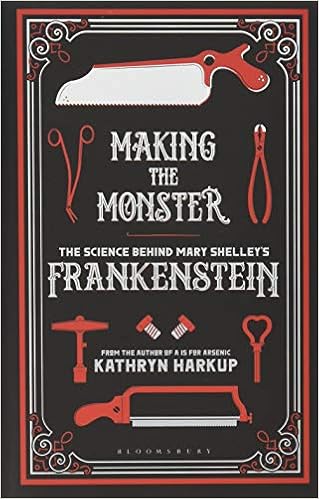
Book Review: Making the Monster: The Science Behind Mary Shelley’s Frankenstein by Kathryn Harkup

Making the Monster: The Science Behind Mary Shelley’s Frankenstein by Kathryn Harkup

Bloomsbury Sigma, 2018

ISBN-13: 978-1472933737

Available: Hardcover, paperback, Kindle edition, audiobook, MP3 CD


The primary takeaway I got from Making the Monster: The Science Behind Mary Shelley’s Frankenstein is that Frankenstein really truly is science fiction. There are things implied in the book that science today still isn’t able to accomplish! I think in today’s world we don’t really have the ability to imagine the time that Mary Shelley was writing, when the way people saw the world was in flux, with alchemy only very reluctantly ceding its way to the barely understood beginnings of chemistry, biology, and physical science, and the materials for experimentation not easily available. The potential of science to change what makes us human, as exciting and mysterious as it was, also activated anxieties and fears that, while they have changed in specifics, still affect us today. The mystery of what science could accomplish, though, was so profound at that time that Shelley’s novel of an ambitious, obsessive scientist has so little actual science in it, and so little of the text actually devoted to creating the monster itself.

Harkup breaks her topic down by first summing up the life of Mary Shelley to the point at which she wrote Frankenstein, and then, about 80 pages in, addressing the specific aspects of science and experimentation described in the text. She does a good job of recreating the gruesome aspects of science at that time, and the enthusiasm scientists had that sent them past the point of what we would consider ethically acceptable. She covers some fascinating people and ideas, such as anatomist John Hunter (evidently the model for both Dr. Doolittle and Dr Jekyll); foundational chemist Antoine Lavoisier; serial killers William Burke and William Hare, who sold the bodies of their victims to anatomy schools; and Luigi Galvani and Alessandro Volta, the major players in the debate on the role of electricity in animal and human bodies, among others. Bodysnatching, graverobbing, transplants, preserving body parts in jars, the creation of batteries, chimeras, body decomposition, electroshock therapy, acromegaly, transfusions, feral men, Lamarck’s theory of genetics, all are covered in the pages as the flotsam surrounding educated (and not as educated) people at the time, often simultaneously as entertainment and education.

Making the Monster is interesting, even compelling at times, but there were some stretches that took me a long time to get through. I got impatient when Harkup moved too far into the past or too close to the current day, and much of what she said about where Shelley got her ideas was farfetched supposition. That is, not that Mary couldn’t have encountered these ideas and people, but that she might have encountered (for example) John Hunter’s ideas because of a one-time encounter between Hunter and her father. Despite it running only 274 pages, I ended up picking it up and putting it down several times.

As it’s the 200th anniversary of the novel, this is a good addition to a Frankensteinia collection, and some of the stories about the science of the times make for interesting reading if you are interested in the history of science in the 1800s. Making the Monster is a mostly enjoyable read, but outside of the specific applications of science that tie into the novel, it treads some pretty familiar ground, so it’s not an essential item for most collections.  Recommended for large public library collections and Frankenstein lovers.