Home » Archive by category "Uncategorized" (Page 192)

Book Review: Ghost Stories: Classic Tales of Horror and Suspense edited by Lisa Morton and Leslie S. Klinger

Ghost Stories: Classic Tales of Horror and Suspense edited by Lisa Morton and Leslie S. Klinger

Pegasus Books, 2019

ISBN-13: 978-1643130200

Available: Hardcover, Kindle edition


‘Tis the season for ghost stories, and with so many out there, Lisa Morton and Leslie S. Klinger had some difficult choices about what to include in this anthology. They have chosen eighteen tales of the supernatural with varying tone, from comic to terrifying, by authors well-known for their ability with supernatural fiction, authors from both Europe and America, authors well-known for their other works who also wrote supernatural fiction, and some authors barely known to the reading public at all.  There is a brief introduction, and each story is preceded with a short paragraph about the author and his works. When necessary, the editors included annotations, but the annotations do not impede the flow of the story; rather, they enrich it.

The anthology begins with a ballad, “Sweet William’s Ghost”,  which is followed by a gothic tale by Johann August Apel, whose work may have inspired the beginnings of Mary Shelley’s Frankenstein. Sir Walter Scott’s “The Tapestried Chamber”, which Morton and Klinger identify as the first modern ghost story, is next.  They then cross the ocean to America for the next two stories, “The Gray Champion” by Nathaniel Hawthorne and “Ligieia” by Edgar Allan Poe. Certainly no one can argue with either Poe’s brilliance or madness in his writing, and both are depicted in full force here.

Three lesser-known  women writers of supernatural fiction all write powerfully of ghosts driven by their emotions towards the ones they left behind. “Since I Died” by Elizabeth Stuart Phelps is a compelling vision of what follows death, narrated by a just-deceased woman observing her lover’s grief, and is one of the outstanding stories in the book. “The Shell of Sense” by the little-known Olivia Howard Dunbar, details the vengeance, and eventually forgiveness, of a recently-deceased wife on her husband and sister when she discovers they have fallen in love.  In Georgia Wood Pangborn’s “The Substitute”, a lonely woman is visited by a friend who is desperately in need of her help.

Charles Dickens, M.R. James, Edith Wharton, Henry James, and Charlotte  (Mrs. J.H.) Riddell all tell stories of mysterious and terrifying ghosts.  Ambrose Bierce creats a nightmarish, fantastical world in “An Inhabitant of Carcosa”, and Frank Stockton’s “The Philosophy of Relative Existences” is almost science-fictional in nature, a thoughtful puzzle of a story.  Arthur Machen’s “The Bowmen” , based on actual news reports, described a battle during World War I where one of the British servicemen summoned St. George and his bowmen to defeat the Germans. The brief descriptions of the war, and the detail in which Machen is able to vividly portray the men and their despair in very few words, are very powerful. One of my favorites, a surprise to me, was Mark Twain’s “A Ghost Story”, which had me laughing out loud.

The variety in this collection of ghost stories is impressive, and I really appreciated the inclusion of both lesser-known women writers of supernatural fiction, and supernatural stories by writers better known for other work. Over the past several years I have done a lot of reading on my own on early women writers of supernatural fiction and until very recently it’s been difficult to find any work by some of them at all– and for those who are better known for their other writing, their supernatural tales have often been disregarded or kept under wraps. It would be easy to lean back on just a few authors already known for their ghost stories, but the effort that went into making sure this carefully curated anthology was varied in its authors and contents is something I really appreciate. Ghost Stories: Classic Tales of Horror and Suspense is a perfect read for this Halloween season.
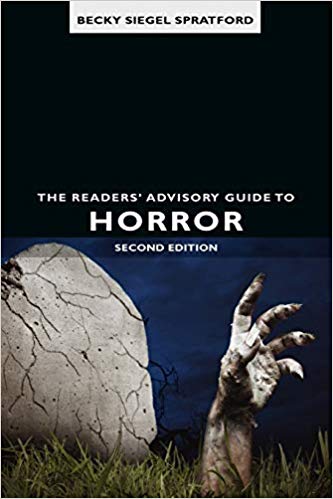
Book Review: The Readers’ Advisory Guide to Horror, Second Edition by Becky Siegel Spratford

Since Monster Librarian has been around for quite some time, we actually reviewed reader’s advisory reference books in horror before there were many reader’s advisory books on the horror genre and even before social media became all-consuming. Most of these are on a page on our original website titled “Librarian Resources”. It’s pretty sparse, because anything published after 2014 will be found on this blog instead of the original site, and there really wasn’t much in existence then. What was once a fairly restricted community of readers and writers has grown like crazy, and the past few years have really boomed in terms of providing all kinds of helpful resources.

So it was a very big deal when Becky Siegel Spratford wrote a second edition to The Readers’ Advisory Guide to Horror, which was published in 2012. This month I saw her announce that the third edition will be coming out next year (wow!) so I’m republishing our review of the second edition now. She has kept it updated through her blog  RA for All: Horror.  If you visit now, Becky is counting down the days until the announcement of the titles for the HWA’s summer reading program, Summer Scares, for 2020.

With the horror genre having expanded its reach and audience considerably I will be curious to see the changes in the third edition!


rahorror

The Reader’s Advisory Guide to Horror, Second Edition by Becky Siegel Spratford

American Library Association, 2012

ISBN-13: 978-0838911129

Available: Paperback, Kindle edition


The Reader’s Advisory Guide to Horror, Second Edition, is the updated version of The Reader’s Advisory Guide to Horror, part of the American Library Association’s Reader’s Advisory series on genre fiction,. That is, the major professional organization for librarians endorses this as the authoritative text on reader’s advisory in the horror genre. The author, Becky Siegel Spratford, is a reader’s advisory librarian with a particular interest in the horror genre, and in promoting horror in the library– and is someone I admire very much. Updates for this edition can be found at her blog, RA for All: Horror. 

        The Readers’ Advisory Guide to Horror, Second Edition is an important book for a couple of reasons. First, because it’s published by the American Library Association, it is likely to reach a wide audience of librarians, and because it’s part of an established series on readers’ advisory, it has credibility as a resource for librarians who may not know much about(or like) the horror genre that other resources may not have. That opens a door for connecting a lot of people to books they may like. Spratford does a nice job of providing a concise history of horror, introducing some prominent authors, and addressing the classics. Spratford also mentions that many horror readers prefer to read only within one subgenre (such as werewolf books), and has set up the book to provide annotated lists for recommended titles in popular subgenres,. She also includes a chapter on horror resources and marketing, which does a very nice job of offering tools and strategies for growing and promoting library horror collections, not just during October but throughout the year. This is a topic that really needed (and needs) to be addressed– horror readers don’t just read horror as Halloween rolls around, and if your horror novels are shelved with the rest of the fiction they may not even know what the library has. I’m glad that Spratford specifically addressed this in her book.

        However, there are aspects to the book of which librarians should be aware. Spratford chose to define horror as “a story in which… unexplainable phenomena and unearthly creatures threaten the protagonist and provoke terror in the reader”.  That’s a very narrow definition. I recognize that for purposes of writing a reader’s advisory guide it’s necessary to set limits of what qualifies as belonging to a genre, but reader’s advisory librarians attempting to serve horror readers should be aware that many horror readers don’t require there to be a supernatural or unexplainable element in their reading. Because of the way she defines horror, Spratford’s breakdown of subgenres is sometimes problematic. For instance, in her chapter on “shape-shifters”, she included not only werewolf titles but killer animal books, and these two types of books appeal to different audiences. Many killer animal books have no supernatural aspect at all, such as Cujo, Stephen King’s novel about a rabid dog terrorizing his neighborhood (Spratford writes that Cujo “comes under the spell of demonic forces”, but that is not the case). Her chapter “Monsters and Ancient Evil” also combines in one list books that will appeal to different audiences- Lovecraftian fiction and more modern monster novels. In addition, Spratford leaves out the notable category of human horror. Books in this category aren’t literary novels of psychological suspense- they display the worst of human nature, without needing to employ the supernatural. Usually they have graphic gore, violence, and sexual situations (such as in the work of Wrath James White). This category doesn’t fall under Spratford’s definition of horror, and so it isn’t addressed in the book. Spratford  is covering a huge amount of territory in a limited number of pages, but it would really have benefited users, and readers, to have these particular issues dealt with, and hopefully we will see that in the next print edition. In addition to covering a wide variety of authors and subgenres, Spratford addresses whole collection reader’s advisory and mentions several categories of books outside the genre that horror readers might also enjoy, I especially appreciated her mention of nonfiction, as there are a lot of appealing nonfiction titles that horror fiction readers will probably never find on their own.

        Horror is a very difficult genre for both collection development and reader’s advisory. It doesn’t get much respect, or even recognition. The Reader’s Advisory Guide to Horror, Second Edition, although not a perfect tool, does a great job providing resources to librarians serving horror readers. Highly recommended for purchase by public and academic libraries.

Review by Kirsten Kowalewski


Book Review: The Third Corona Book of Horror Stories edited by Lewis Williams

The Third Corona Book of Horror Stories edited by Lewis Williams

Corona Books, 2019

ISBN: 978-1-9996579-4-9

Available: Paperback, Kindle edition


It seems that every horror collection published always has an introduction detailing how the publisher worked very hard to put only the greatest stories into print.  Sometimes it’s true, and sometimes it’s just lip service.  Corona Books boasts that they selected only the “best of the best” from over 800 submissions.   Thankfully, in this case it’s not an idle boast.  The stories tend towards the short side, but the quality is extremely high.  All the stories are good: there isn’t a bad, or even just fair, story in the lot.  If this collection isn’t nominated for a Stoker award in the “Anthologies” category this year, then the whole nominating process should be called into question.


Many of these stories clock in at only fifteen pages, and some at ten or less.  However, there’s a lot of good, concise writing packed in to that short space.  There are a few with some blood and gore, but it’s minimal.  The publishers realized that mental torture and anguish is just as effective, if not more so, then the standard hack and splatter model that is in vogue right now.  Physical pain is only temporary, but mental agony can go on for a long, long time.  In some of these stories, it lasts forever.  Seeing the fate that some of the characters in these stories are condemned to makes for a truly unsettling read.  Sue Bentley’s “Old Gods”  is a prime example.  Treasure hunter/thief Edward Cranby gets way more then he bargained for when hunting for riches in the jungles, and the true torture is that his punishment will NEVER be lightened, or end… ever.  John Haas’s “The Debt” has a less prolonged fate, and a bit more physical punishment, but it’s just as effective.  Drawing on Shylock’s  “a pound of flesh”  in Shakespeare’s “The Merchant of Venice”, the interactions between a mad doctor and the man who caused his family untold misery are truly horrifying: this  may be the best story in the book.


The two above stories are the best in the anthology, but the others are also extremely effective. There is no one unifying thread in this collection, other than the high quality.  The lack of a common theme makes the book that much stronger, as the ideas are quite diverse.  Molly Thynes’s  “Worse Things” takes aim at a favorite target—politicians– and shows the wretched lengths that some will go to in order to remain in power. It’s a lot more frightening than anything a real politician has been responsible for.  “The Barber”, by A.P. Sessler, is the only story written in the rarely used second person point of view.  It’s difficult to write in the second person, but Sessler uses it well in this cross between Sweeney Todd and Face/Off.  Viktoria Faust’s “Roxy” and Richard A. Shury’s “Gamer” both take a look at the warped future that may await humankind when it comes to organ donations and virtual reality, respectively. Jeremy Megargee’s “Scythe” details the fear of being old and waiting to die…when you can literally see the end coming for you.  The story ideas come from everywhere, and every one is extremely well written and effective.  This review only covers a few of the stories: there are plenty more in the book for the reader to devour.


This is the finest short story collection to come out in a long time, and it’s worth the price ten times over.  If short horror stories that make you squirm and keep you awake at night are your thing, you need this book on your shelf.  Highly recommended.


Contains: mild violence.


Reviewed by Murray Samuelson