Home » Archive by category "Uncategorized" (Page 155)

Book Review: Kiki Macadoo and the Graveyard Ballerinas by Colette Sewall

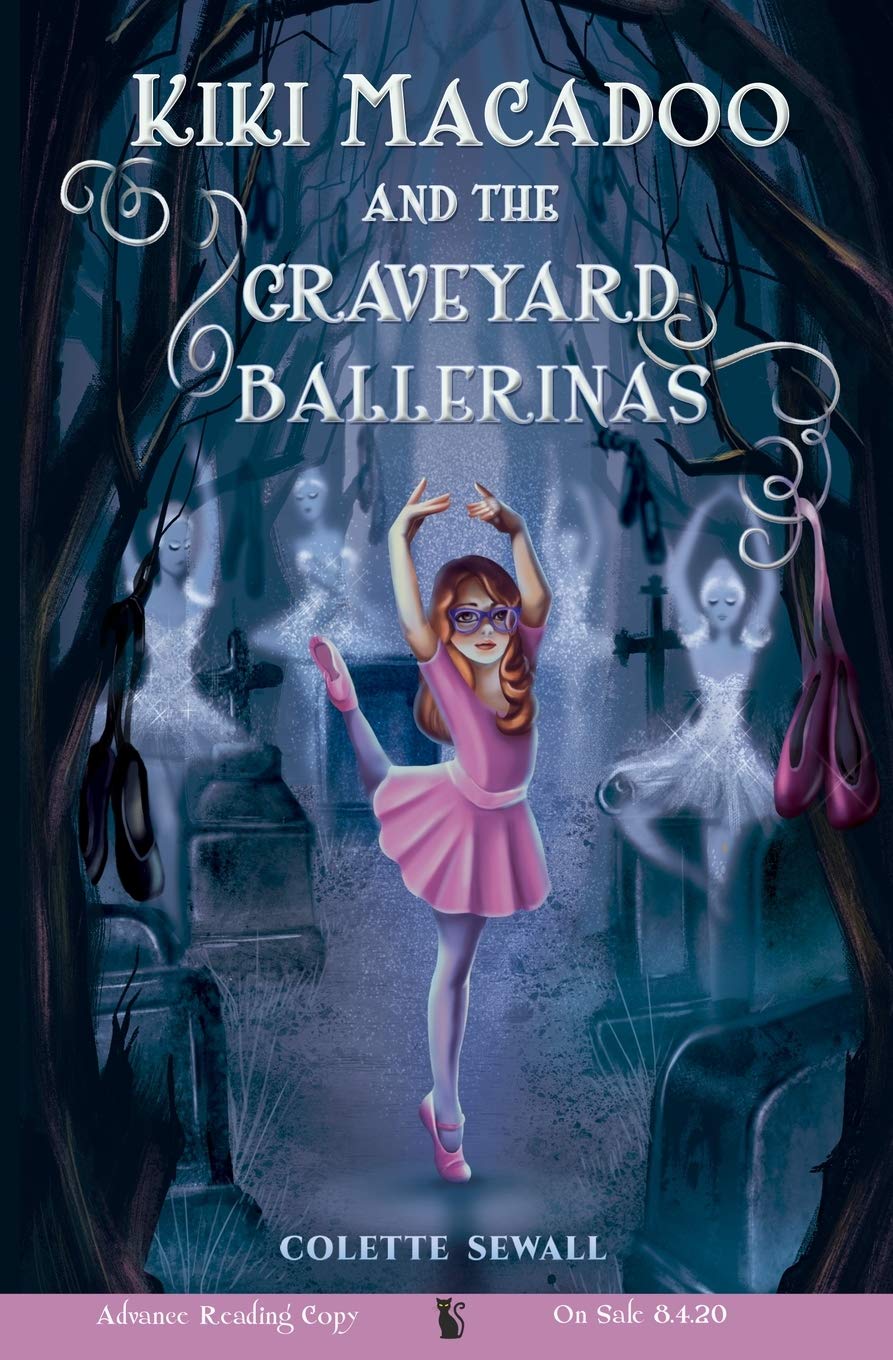
cover for Kiki Macadoo and the Graveyard Ballerinas

Kiki Macadoo and the Graveyard Ballerinas by Colette Sewall ( Amazon.com )

Owl Hollow Press, 2020

ISBN-13: 978-1945654558

Available: Paperback, Kindle edition


Kiki Macadoo, age eleven, and her teenage sister Alison, are going to a special ballet summer camp housed in a Gothic castle in a remote area surrounded by dense forest. Kiki loves ballet but is terrible at it, while Alison is very talented. While both of them are excited about camp, Kiki is nervous, and Alison is bummed because she’ll be spending the summer away from her boyfriend, Dylan.

Despite the camp’s setting, the kids seem pretty normal– they’re there because they want to excel in dance. Sewall writes naturally about ballet and dance, without making the terminology intimidating. Kiki is placed in the lowest dance class, with 8 year olds, but she’s lucky in that she has a pretty good relationship with Alison, her roommate is kind and friendly even though she’s a much better dancer, and the dance teacher is understanding and helpful. The camp director, Madame Dupree, is elderly, forgetful, and a bit eccentric (there’s a subplot where her son’s fiance attempts to have her committed so he can sell the property to developers, but it doesn’t really go anywhere), but she’s also thoughtful and generous. When she learns that Alison will have her sixteenth birthday at camp, she enlists Kiki in helping plan a surprise party for Alison. It’s  refreshing to see a school story, especially one involving teenagers and middle-schoolers, where the main character isn’t bullied because of physical flaws or struggles with learning.  It’s also nice to see the conflicting feelings Kiki has about dance and about her sister– she may struggle but she perserveres.

While the campers have been forbidden from going into the forest, it doesn’t stop Kiki. Her lessons end earlier than Alison’s or her roommate’s, leaving Kiki plenty of time to explore. One of the boys at the school, Oliver, lives on the grounds and tells her she needs to be careful because fairies and spirits live in the woods (Oliver isn’t mocked for dancing; we have come a long way since Oliver Button Is a Sissy). At first she doesn’t believe him, but it turns out that Kiki is one of a rare few who can see them, because she has “ghost eyes”, two different-colored eyes. Kiki and Oliver become friends and explore the forest together (it is almost a character in its own right), and between Oliver’s stories and hints dropped by Madame Dupree, Kiki learns that in addition to harmless spirits, there are some dangerous ones as well. The wilis, water sylphs who died of broken hearts while at ballet camp, draw in any young woman with a broken heart and force her to dance to her death, at which time she becomes one of them. There is a graveyard filled with the bodies of girls who died dancing and became wilis.

The surprise party for Alison does not end well. Alison’s boyfriend shows up with bad grace and she discovers he’s seeing another girl; broken-hearted, she runs into the forest where she is drawn in to the wilis’ dance. As terrifying as they are, it is up to Kiki to break her sister away from the wilis’ spell.

I really liked the author’s choice to make the wilis her dangerous spirits. They are part of Slavic folklore and are not commonly known, but they do appear in the ballet Giselle, which is tragic and terrifying. Giselle is maybe not as well known to the average kid as The Nutcracker or Swan Lake, but that makes the story extra cool in integrating the ballet theme into the story.

As it is a middle grade book, things end well, but the path to getting there has its frightening moments, and definitely magical ones. The door is left open to a sequel, and I’ll be interested to see if one happens and, if it does, where it takes Kiki, Alison, and Oliver next. Recommended for ages 8-13.
Book Review: Double Barrel Horror, Volume 3 edited by Matthew Weber

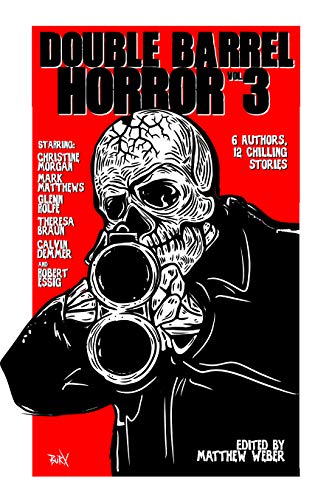
cover image for Double Barrel Horror Volume 3

Double Barrel Horror, Volume 3 edited by Matthew Weber (  Amazon.com  )

Pint Bottle Press, 2020

ISBN: 978-1-945005-01-5

Availability: Paperback, Kindle edition


Double Barrel Horror, Volume 3 is a 182 page collection of horror shorts by six different authors, two stories by each one.  Most of the stories clock in at around the 10-15 page mark, and the quality is all over the map.  There are some good ones, but some clunkers as well.   Or, in keeping with the “shotgun” theme of the book title, there are some good rounds of double-aught buck in here, but there is also a fair amount of birdshot and blanks mixed in.


Calvin Demmer is the most consistent author out of the six; his “Highway Hell” and “Motel Madness” are entertaining romps, concerning how roadkill is really removed from the highways, and what happens to a bad, but not truly evil, person when they are tossed into purgatory.  Robert Essig’s “From Unclean Spells” is a decent story of necromancy gone wrong.   If nothing else, the belch-and-barf-fest (literally) in the story is quite amusing.  Essig comes up big with “Fuel for the King of Death”, which scores high both in terms of originality and excitement.  How does a freaky little Museum of Death keep getting new video footage for the museum?  Read on and find out.  Mark Matthews adds “Goodwin”, which is an entertaining take on the joys of necrophilia, from a corpse’s point of view.  The most chilling story in the book certainly comes Glenn Rolfe.  His “The House on Mayflower Street” is a terrifying look at what happens when nosy neighborhood brats start investigating the classic “abandoned house” in a suburban neighborhood.  As the kids find out, curiosity is not only painful, it’s a lot worse than death.  This one would make a good movie; it alone is almost worth the price of admission.


As for the rest of the stories…meh.  They aren’t necessarily bad, but they aren’t that interesting either.  The writing quality for all of them is fine, there just really isn’t anything in the stories to capture and hold the reader.  They are okay for a quick moment, but there is nothing that will make the stories truly memorable for the reader.  If you have the money to spare, you may want to consider picking this up for the good stories it does contain.  Anyone on a limited budget, though, would be better off investing in The Third Corona Book of Horror Stories or Lost Highways: Dark Fiction From the Road.


Contains: violence, profanity, gore


Reviewed by Murray Samuelson

Book Review: My Sister, the Serial Killer by Oyinkan Braithwaite

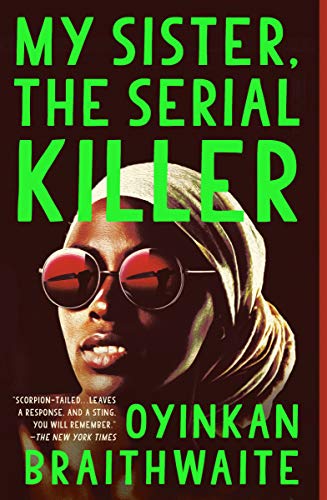
cover for My Sister, the Serial Killer

My Sister, the Serial Killer by Oyinkan Braithwaite ( Bookshop.org  |  Amazon.com )

Doubleday, 2018

ISBN-13: 978-0385544238

Available: Hardcover, paperback, audiobook, Kindle edition


My Sister, the Serial Killer, by Nigerian author Oyinkan Braithwaite, is set in Lagos, Nigeria. Korede is the dutiful, protective, perfectionist older sister to beautiful, selfish, lazy, and possibly sociopathic Ayoola. Ayoola has “accidentally” stabbed three different boyfriends to death, and each time she has called Korede to help with the cleanup. According to Ayoola, each time has been self-defense, but, Korede wonders, why is she always carrying a sharp knife if it’s accidental? Korede, following through in covering up the murder, reads his blog and sees his social media. He wrote poetry and obviously had friends and family who are worried about his disappearance. He seems like a nice guy, and Korede wonders if Ayoola really had to act in self-defense.

Korede is a nurse who is very good at her job.  She has a long-standing crush on one of the doctors,  who has always been a nice guy, and thinks she is finally getting somewhere with him when Ayoola breezes through the door,  making an unforgettable impression on him.  When Korede expresses her frustration with this, Ayoola tells her there’s no such thing; even so-called “nice guys”  like the doctor are after beauty more than they care about anything else, and she’ll prove it.  Ayoola then proceeds to sweep him away with her beauty, despite her selfishness, cheating on him, and criticism of him.  Korede, worried that he may become Ayoola’s next victim, attempts to warn him and instead of taking her seriously, he accuses her of jealousy, spite, and a lack of sisterly love, confirming Ayoola’s assertion that he isn’t really a “nice guy” after all.

Flashbacks to their childhood and current family relationships reveal that their father was an abusive man who punished Ayoola for being attractive to boys and men, and Korede has been protective of her since then. What’s going on now is clearly tied to the early damage done by the men in their lives. My Sister, the Serial Killer is darkly funny, but it’s also an indictment of the horrors caused by the patriarchy and a solid response to the frequent assertion that “not all men are bad guys”.  The nicest guy in this book is completely blind to the harm he’s doing to both Korede, with his accusations, and Ayoola, with his obsession over her beauty. A compelling, disturbing, perceptive, and satirical book, My Sister, the Serial Killer gets inside your head and stays there. Recommended.


Contains: murder, blood, violence, child abuse, implied sexual assault.