Home » Archive by category "Uncategorized" (Page 150)

Graphic Novel Review: Mary Shelley Presents: Tales of the Supernatural Vol. 1 by Nancy Holder, art by Amelia Woo

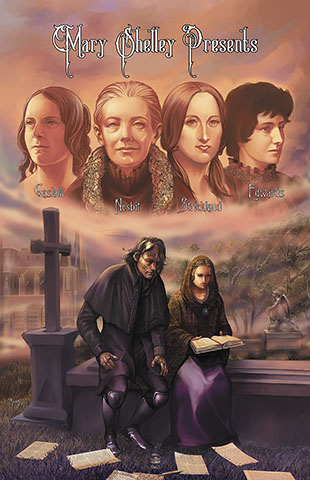
cover for Mary Shelley Presents Vol. 1

Mary Shelley Presents: Tales of the Supernatural Vol. 1 by Nancy Holder, art by Amelia Woo (available only through Kymera Press)

Kymera Press, 2020

ISBN: 978-0-9965558-0-7

Available: Hardcover, trade paperback


Mary Shelley Presents: Tales of the Supernatural #1 is the first in a series from Kymera Press adapting stories by Victorian-era women writers of supernatural fiction. With a foreword by Lisa Morton, who just published her own anthology of Victorian women’s supernatural fiction, followed by Isabelle Banks’ poem “Haunted”, this first volume adapts “The Old Nurse’s Tale” by Elizabeth Gaskell, “Man-Size in Marble” by Edith Nesbit, “The Case of Sir Alister Moeran” by Margaret Strickland, and “Monsieur Maurice” by Amelia B. Edwards.  Each story is preceded by a short introductory paragraph from the publisher and the author, Nancy Holder, and then introduced by a spectral Mary Shelley, accompanied by her Creature. These authors have written some wonderful, chilling stories , but they do get wordy for an impatient, modern audience. Holder’s adaptations slim the stories down while preserving the quality of the storytelling, and Amelia Woo’s gorgeous color illustrations are a perfect accompaniment. The brilliant ghosts, period clothes, and detail in darkened woods and cemeteries pull the reader right in. Each adaptation is followed by the full text of the story. As someone with poor eyesight I could have wished the text was a little larger, but some of the original stories are very long– it took skill and collaborative effort to be able to successfully adapt them.

This is a great way to introduce readers to some excellent women writers who, until very recently, had not received recognition for their supernatural fiction, as well as a treat for those of us already familiar with these authors, who would love to see them gain a larger audience.  I’m hoping we won’t have to wait too long for volume 2. Highly recommended for ages 12+.


Editor’s note: In the interests of full disclosure, I backed the Kickstarter for this book.


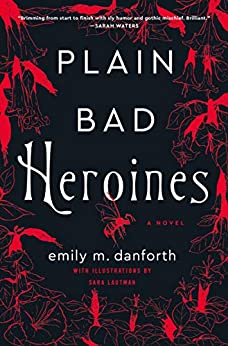
Plain Bad Heroines by Emily M. Danforth illustrated by Sara Lautman

Cover of Plain Bad Heroines by Emily M. Danforth

Plain Bad Heroines by Emily M. Danforth illustrated by Sara Lautman

William Morrow & Company, 2020

ISBN-13: 978-0062942852

Available: Hardcover, Kindle edition, audibook, audio CD ( Bookshop.orgAmazon.com )


Emily M. Danforth, author of the YA novel The Miseducation of Cameron Post, stretches her boundaries in this unsettling, haunted novel that reveals a buried history of queer romance and horror and some seriously creepy hornets.

The story moves smoothly from events in 1902 that led to the deaths of three students at the Brookhants School for Girs, tied to an uninhibited and shocking memoir by openly bisexual feminist Mary McLane, to a present day where author Merritt Emmons has written a book about the deaths that is about to be made into a sapphic “Blair Witch” style horror movie.

Two of the girls who died were co-founders of a club called The Plain Bad Heroines, which admires Mary’s unapologetic attitude, are found dead in the woods with a copy of the book,  attacked by a swarm of hornets in an orchard of rotting fruit. The third acquires it after their deaths and is literally poisoned by reading it near a plant in the campus greenhouse where she is caretaker. The headmistress confiscates it, convinced that it is cursed. As the students abandon the school, both the headmistress and her relationships begin to disintegrate, and trapped almost alone in a snowstorm, it’s hard to tell how much of a grip on reality she has left.  She’s also left remembering her college days, where a love affair led to her eventual inheritance of Brookhants, chosen by her husband because of its reputation as a spiritually important location, in a very strange manner.

The horror movie based on Merritt’s book will star the popular actress Harper Harper and the less well-known actress Audrey Wood. Merritt initially is starstruck by Harper and they hit it off; her interactions with Audrey are more negative. The movie will be filmed at the actual Brookhants School and on the grounds, adding atmospheric creepiness.  Once the filming starts, it seems nothing can go right– it’s almost like the production is cursed. This leaves Harper, Audrey, and Merritt, a lot of time for exploration on the Brookhants estate. Black apples, rotting vegetation, and ominous swarms of hornets in the woods ratchet up the tension, and eventually the story behind the Brookhants curse is revealed.

This is a doorstop of a book. After its tense begining, it slows down for some time and, had I not known there would be a payoff, I might have set it down. I think a large chunk of the Hollywood segment could have been easily eliminated  to slim it down. This is where a lot of the present day characters’ personalities are established, and Merritt’s romantic interests start to develop, but it is just too drawn out.

Danforth isn’t subtle about centering lesbian and bisexual characters. It is even a point of contention in the casting of the movie, where Merritt objects to Audrey playing a lesbian role, assuming she must be straight, to have Audrey come out and say she’s bisexual. The headmistress’ memories of inheriting the school are all related to the romantic love she and her partner had for each other. even as she turns on her.

Plain Bad Heroines is also about as metafictional as you can get; it’s a fictional story inspired by a book by a real person, containing illustrations and images of what I’m pretty sure are news articles about the book, that a fictional author has written a fictional nonfiction book about, that is being made into a fictional movie being filmed found-footage style, as if it is nonfiction. Both the director and Harper Harper use social media to affect the narrative, so Harper’s Instagram posts document the movie shoot and all of its “cursed” problems for her followers, creating a Blair Witch effect of convincing the audience for the movie that the haunting is real. Even the people around Audrey and Merritt are in on the gaslighting, so that none of them know whether they can trust each other or reality. It’s clever, and the unreliability of the people around them and the way the reader knows the three women are being manipulated is distracting, but it doesn’t detract from the sense of atmospheric creepiness, dread, and tension, with hornets and rotting vegetation always around. You will never feel the same about hornets after reading this book.

Danforth actually has an author’s note where she discusses her discovery of Mary Maclane in researching hidden sapphic history, and that she wanted to bring that to light through Plain Bad Heroines. I never had heard of her and I found this fascinating. Unlike The Miseducation of Cameron Post this is not a YA novel, although it might be appreciated by some older YA readers, but certainly it is an original book with plenty of dread and some well-drawn lesbian and bisexual characters that will draw in readers of historical and metafictional horror, Hollywood, and haunted houses. It won’t be for everyone, but this book will certainly find its audience. Recommended.


Contains: violence, murder, body horror, sexual situations, insects
Book Review: Burn Our Bodies Down by Rory Power

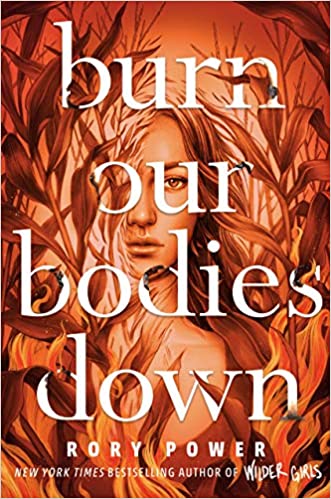
cover for Burn Our Bodies Down by Rory Power

Burn Our Bodies Down by Rory Power

Delacorte Press, 2020

ISBN-13: 978-0525645627

Available: Hardcover, Kindle edition, audiobook, audio CD  (  Bookshop.org  | Amazon.com  )

Seventeen-year-old Margot, trapped in a disturbing codependent relationship with her abusive mother, finally finds an escape after discovering she has a grandmother living just outside Phalene, a small town only a few hours away. Arriving in Phalene, Margot quickly meets Tess, daughter of a wealthy landowner whose property is next to Margot’s grandmother’s farm, and Tess’ friend Eli. Tess and Eli tell Margot her grandmother has a reputuation as an eccentric, but offer to walk her to her grandmother’s house. On the way, the three teens discover the property is on fire, and Eli carries a girl out of the fire who is identical to Margot in looks and age, but who Margot has never seen before. The police are suspicious and take all three to the station to question them, but are clearly focused on Margot, especially because this isn’t the first fire to take place on her grandmother’s property, and the two girls are so identical it’s hard to believe Margot doesn’t know her.

A significant part of the book has to do with Margot’s developing relationship with her grandmother. At first, her grandmother is loving and welcoming, if inflexible, but early on Margot realizes that her grandmother is also being evasive and, at times, outright lying to her. The reader will see clearly the similarities between the behaviors of Margot’s grandmother and mother; it becomes clear early on why Margot’s mother never wanted to speak about her family. Margot also begins a close friendship with Tess, which has the marks of the beginnings of a crush on her, but this is never followed through on. Margot, Tess, and Eli are determined to solve the mystery of the girl who died and how that might be related to the earlier fire, and Margot as well wants to learn about her family’s past. There is clearly something going on that her grandmother is hiding, and a diary Margot finds contains clues as to what led to her mother’s behavior and some of the reasons she may have passed the trauma of her own childhood on to Margot.

The science-fictional twist at the end leads to some particularly gruesome body horror, and thoughtful readers may still find themselves disturbed by the long-term consequences of not eliminating all of the loose ends. Burn Our Bodies Down punches up the action faster than Wilder Girls but meanders in the middle, until it reaches its fast-paced and gory conclusion. Power has done a great job of showing the effects generational trauma and the difficulty of breaking that cycle. Even in relationships that haven’t sustained the kind of damage as the family in this book, there are very few girls who want to grow up to be just like their mothers, and Burn Our Bodies Down does an excellent job of portraying a time of life when most girls are separating to explore and form their own identities.