Home » Archive by category "Uncategorized" (Page 143)

Book Review: The Girl Who Builds Monsters by Brian James Freeman, illustrated by Vincent Chong

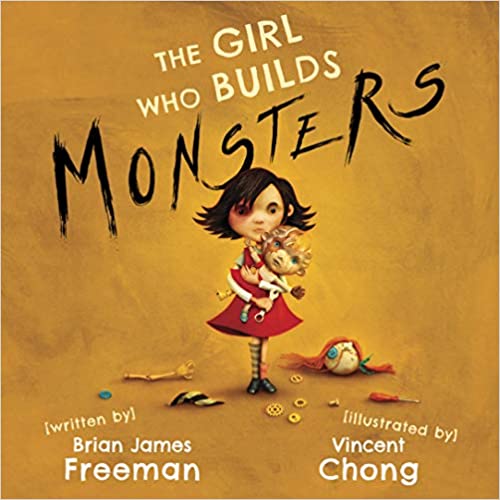
cover art for The Girl Who Builds Monsters by Brian James Freeman, illustrated by VIncent Chong

Bookshop.org  |  Amazon.com )

The Girl Who Builds Monsters by Brian James Freeman, illustrated by Vincent Chong

Cemetery Dance, 2020

ISBN-13 : 978-1587677656

Available: Hardcover


Emma is lonely. The kids in town think she is a monster because of the birthmark on her face. She lives with her  grandfather, who owns a doll factory where he designs and manufactures beautiful dolls, with perfect faces and bodies, for sale. One day, Emma finds a room of rejected and damaged machinery and doll parts, and starts to create dolls herself. They are imperfect, even monstrous, but Emma loves them, and takes them home, where she already has beautiful dolls her grandfather has made for her. At night, when Emma is asleep, all the dolls come alive. Unlike the kids in town, the perfect dolls welcome the monster dolls, and they all play together happily. The monster dolls are more adventurous and confident than the perfect dolls, though, and when robbers break into the house one night, the monster dolls come up with a plan to trap the thieves and protect Emma and her grandfather. Knowing they are supposed to keep their nighttime activites secret, the monster dolls charge the thieves, terrifying them into falling through a trapdoor in the hallway floor and saving the day. Looking monstrous on the outside doesn’t stop them from either being loved or acting out of love. On its own, it’s a sweet little story.

However, Vincent Chong’s illustrations really up the creepiness factor. It’s one thing to write about dolls, and another to draw them. I saw some aspects in the illustration, design, and use of font in the book that reminded me a bit of some of Dave McKean’s illustrations in The Wolves in the Walls. The people in the book are not realistically depicted, but the dolls seem much more real.  In sharing this book with my daughter, the absolutely creepiest moment for her was the two-page spread of the brightly drawn automated doll assembly line (although the monster dolls’ nighttime attack on the thieves was a close second), so it’s likely that the dolls’ uncanny nature may cause unease in some children, Emma herself is an adorable, if mostly sad, little girl. Chong shades her birthmark in while not letting it define her face or personality, and it is really wonderful to see her imagination at work as she takes ownership of turning damaged pieces into imperfect dolls that she can relate to. In Chong’s illustration of the dolls seen through Emma’s eyes, the monster dolls don’t seem monstrous.

For me, one of the things that makes this an absolutely outstanding book and a choice I would recommend for anyone working with elementary aged children is that it is one of the few picture books out there that depict disability in a positive and respectful way. Too often picture books about disabled people are educational texts describing a child’s disability for abled peers, and in the few fictional picture books, disabled people are rarely depicted as multifaceted individuals with positive characteristics. In fiction in general, disabled people are usually presented stereotypically, as either someone to feel sorry for (like Beth in Little Women), someone inspirational (think Auggie from Wonder), someone with “magical” abilities (Charles Xavier of the X-Men), or a villain. In horror in particular, villainy is frequently signified by disfigurement or masking (some of the classics in horror fiction include the Phantom of the Opera, the Invisible Man, and Dorian Gray ).  Brian James Freeman has done a great job at subverting the trope of disability and disfigurement as villainous and monstrous, and celebrating imperfection, and it’s really exciting to see this. Highly recommended for grades K+.
Book Review: Night of the Mannequins by Stephen Graham Jones

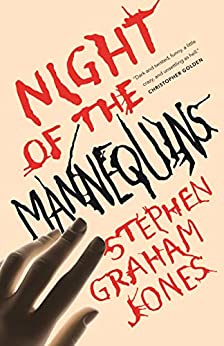
cover art for Night of the Mannequins by Stephen Graham Jones

Night of the Mannequins by Stephen Graham Jones (  Bookshop.org  |  Amazon.com )

Tor.com, 2020

ISBN-13 : 978-1250752079

Available: Paperback, Kindle edition


Night of the Mannequins is a short book, a rocket-fuel ride from beginning to end. It is narrated by teenage Sawyer, one of an offbeat, close-knit group of friends who have known each other forever and are about to graduate high school and go their separate ways. Stephen Graham Jones does a genius job with Sawyer’s narrative voice: it really feels like he is talking right to you. After they’re thrown out of a movie theater where their friend Shanna works, the friends come up with the idea of sneaking a discarded mannequin in to prank Shanna and the manager. Instead, the prank fizzles, the mannequin disappears, and Sawyer is certain he saw it walk out of the theater. After one of the Shanna is killed, along with her family, when a truck plows into her house, Sawyer is convinced the mannequin is the culprit and that he and his friends and their families are all in danger of death by mannequin. He is certain he has seen the mannequin and that the mannequin is stealing and eating Miracle-Gro to turn into a gigantic monster. Sawyer decides he has to act before the monster mannequin can. Jones takes us far down the rabbit hole in this surreal and disturbing tale as Sawyer’s perceptions become more and more skewed,  especially once he starts covering his face with a mannequin mask.

We don’t get to know the other friends well, but Sawyer’s feelings for them seem genuine, so you feel for them and their families when gory tragedy strikes. And wow, does it strike. Sawyer describes it in detail, and Jones does not pull his punches.

This is not intended to be a YA book but it very easily could appeal to YA horror readers looking for a bite-sized read. It’s short, fast-paced, and, unusual in YA horror these days, has a teenage boy as protagonist. With Night of the Mannequins you could hook someone who loves slasher movies but hasn’t shown much interest in reading.  Recommended for ages 15+


Book Review: Don’t Turn Out the Lights: A Tribute to Alvin Schwartz’s Scary Stories to Tell in the Dark edited by Jonathan Maberry

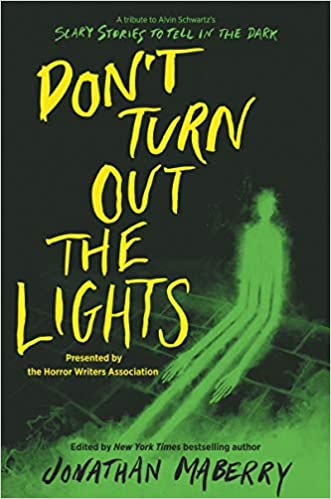
cover art for Don't Turn Out The Lights: A Tribute to Alvin Schwartz's Scary Stories to Tell in the Dark edited by Jonathan Maberry  ( Bookshop.org  |  Amazon.com )

Don’t Turn Out the Lights: A Tribute to Alvin Schwartz’s Scary Stories to Tell in the Dark edited by Jonathan Maberry

HarperCollins, 2020

ISBN-13 : 978-0062877673

Available: Hardcover, paperback, Kindle edition, audiobook


Don’t Turn Out the Lights is an anthology of stories by a variety of diverse horror writers, mostly of YA horror, inspired mainly by their nostalgia over Alvin Schwartz’s notable collections of urban legends and folktales, Scary Stories to Tell in the Dark (writers include Linda Addison, Amy Lukavics, Courtney Alameda, Tannarive Due, Kami Garcia, and R.L. Stine). Schwartz’s writing was spare, providing just the bare bones of the stories he shared, and Stephen Gammell provided terrifying black-and-white pen and pencil drawings to accompany each one It is unfortunate that the artist for the book is not credited, so far as I can tell. Nobody can be Stephen Gammell, but the interior illustrations suggest the artist studied his style. The artwork is outstanding and integrates well into the design of the book and the storytelling.

Unlike Schwartz’s collections, there aren’t a lot of jump-scares or gruesome rhymes: these are tribute stories rather than an attempt to recreate his work. As expected in a collection of 35 stories, each by a different author, some are better than others. Some stories stick closer to Schwartz’s style and choice of subject, with the feeling of a folktale, such as T.J. Wooldridge’s “The Skelly-Horse”, or “Jingle Jangle”, while others, like “The Funeral Portrait” were more reminiscent of Poe. A few manage to stick to the urban legend feel of the original while updating it for tweens today, like “Tag, You’re It,” by N.R. Lambert, which plays on social media anxieties, and “The House on the Hill”, which brings mystery emails and cell phones into play in a tale of peer pressure and surveillance in a haunted house. “The Neighbor” managed the fine line of evoking Schwartz’s tales in a contemporary context beautifully. Editor Jonathan Maberry’s introductory essay was very interesting, as he did not grow up with the stories but read them as an adult.

One of this book’s greatest faults is its length. The original Scary Stories books were relatively short in length, with plenty of white space and relatively large print on each page. Stories were usually very short and heavily illustrated. Don’t Turn Out the Lights is over 400 pages long, with most stories obviously intended to be read on the page instead of told at a campfire.  While the Scary Stories books are read by kids as young as third grade, the length of the book and of the stories suggests to me that Don’t Turn Out the Lights is aimed at a slightly older audience of tweens and middle-schoolers, and also the adult audience feeling the same kind of nostalgia for the Scary Stories books that the authors did. Recommended for grades 4+.

Contains: gore, violence, body horror, murder


NetGalley temporarily provided a review copy of this book.