Home » Archive by category "Uncategorized" (Page 13)

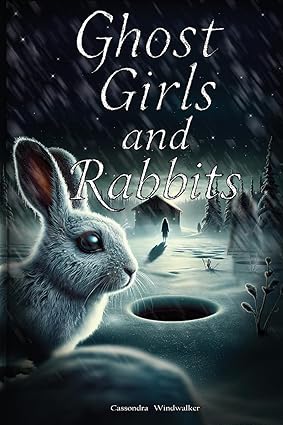
Book Review: Ghost Girls and Rabbits by Cassondra Windwalker

Ghost Girls and Rabbits by Cassondra Windwalker

Polymath Press, 2025

ISBN: 9781961827097

Available: ebook, paperback

Buy: Bookshop.orgAmazon.com


Noni Begay, a young Athabascan woman, has just been elected as the United States senator for Alaska when she disappears. Her campaign manager, Mary Nelson, has a daughter, Ryska, who has been missing for 10 years, and thinks Noni’s disappearance, as a beautiful, popular politician from the powerful Athabascan tribe, can be used to bring renewed attention to Ryska’s case. She is certain Ryska is still alive, and as Noni’s campaign manager and friend she is able to keep media attention on them. But keeping Ryska’s story in the public eye means Noni can’t reappear until Ryska is found. Alaska’s a big state, though, and Mary has a cabin in the woods that is off the beaten track.


Mary tortures Noni, starting with burial alive, to prevent her from attempting escape, and dehumanizes her by thinking of her only as “the seal pup”.. Mary is compartmentalizing, still publicly playing the part of  Noni’s grieving friend and campaign manager and working as a political operative, but that can’t last forever, and slowly she crumbles inside, with only the “seal pup” and life in the cabin to comfort her. I’m not sure why Mary wasn’t questioned more after Noni’s disappearance or how she could have gone back and forth so frequently without notice. But maybe the lack of treatment for mental illness or support for grieving parents, and even the lack of notice of her trips back and forth, illustrate the invisibility of indigenous women.


Noni’s struggle to preserve her identity and sanity, and even plan for the future in the midst of isolation, uncertainty, terror, and Mary’s erratic behavior, plays with storytelling, imagination, language, and mythology. Windwalker’s poetic writing flows here.


Windwalker approached the issue of missing and murdered indigenous women and girls from an unexpected angle, with one indigenous woman kidnapping and tormenting another to draw attention, as typically the crimes against these women are committed by white men. :This is not an easy read– unreliable narrators force the reader to question what’s going on, and it does get very dark at times– but it has moments of magic as well.  Highly recommended.


Reviewed by Kirsten Kowalewski


Book Review: Diathesis (Descent, Book 1) by Ishmael A. Soledad

Diathesis by Ishmael A. Soledad

Diathesis (Descent, Book 1) by Ishmael A. Soledad

Temple Dark Publishing, 2025 (release date April 18)

ISBN: 2370015765491

Available: Hardcover, ebook edition (preorder)

Buy:  Amazon.com


With Diathesis, author Ishmael Soledad has taken a quantum leap forward in science fiction writing.  His debut, Sha’kert, was good, but also hinted at the potential of better to come.  With Diathesis, that potential has been fulfilled.  The book is a phenomenal tale of science and the ethical questions that come with it, used to propel a gripping story.  This one should easily be on the shortlist for awards this year, if not the outright winner.  If you are looking for a futuristic tale that will keep you pondering over the dilemmas posed for weeks afterwards, don’t miss this one.  It’s a must-read for sci-fi fans.


Diathesis is written in the present tense, told in the first person from multiple character perspectives.  Similarly to Sha’kert, it has intriguing plotlines that use moral questions as one of the foundations of the story.  However, the ethics are not the overriding reason for the story, they are simply part of it and used to advance the overall narrative, while making the reader think at the same time.  In this case, the main question concerns the genetic engineering of humans, deemed necessary to complete Earth’s first interstellar flight.  The genetically engineered humans are a big part of the story, and you’ll follow them as they deal with the fact that despite all the money and effort poured into making them superior, they are still considered expendable, nothing more than items designed for a purpose.  In other words, humans who aren’t considered human.  The author weaves their struggles into their training regimen over the years with impeccable skill, making for an enthralling story.


The engineered humans are not the only part of the story: other characters are equally as compelling, with problems of their own.  Maria, the scientist who creates the cryogenic sleep system needed to allow for interstellar flight, must compromise everything she believes in order to continue her research.  For her, the price may eventually become too high, and Maria has to decide whether to sit on the sidelines or do something about it, possibly destroying everything she worked for her entire life.  It makes her character compelling.  How much is too much?


Li Quao’s plot thread provides a nice counterpoint to the other characters, since he could be politely classified as having an extreme self-interest streak, or, more accurately, as a borderline sociopath.  His part in the narrative isn’t established by the end of the book, but he’s clearly going to play an important role later.  His Jekyll/Hyde personality can be terrifying, as he eliminates anything in his way, but on the surface he plays the role of a morally centered person perfectly.  He’s the one character that never has any qualms about doing anything wrong, since he believes himself incapable of it.


All the above cover the story arc, from the original planning of the interstellar mission and the obstacles encountered, up through the initial launch.  There’s a lot of material here, but it’s not the “hard science” type. The author prefers to concentrate on the characters instead of the technical aspects.  That’s where his main skill is, and it’s doubtful that there is anyone else out there who does it this well.  It’s a character-driven story that pulls you in hard and never eases up, while giving you plenty to think about over the course of reading it, and long after.  This is sure to be one of the best of 2025.  This is beyond highly recommended, and certainly gets the Samuelson seal of approval!


Reviewed by Murray Samuelson


Musings: The Trouble with Young Adult Fiction

And now for something completely different.


Elisabeth Wheatley is an indie author of  fantasy romance who also makes videos, and most recently she addressed a question from the  parent of girls aged 12 and 14: why does every YA book seem like it has smut? Part of her video had to do with the way other readers piled on that person (as in, don’t be a jerk),  but her answer is interesting, and so are the comments that followed the video. And what I found interesting about the comments was that there are many people who have a different idea of what YA books are and who their target audience is than those of us who are librarians, writers, and publishers. These are people who read extensively in their genre, and I assumed we were all working off a common definition.


Granted, the boundaries are a little muddled: A Court of Thorns and Roses was originally marketed as a YA title and is often shelved with YA books, but is definitely not YA (this is likely how it frequently ends up challenged) but to me the surprising thing to me is the number of readers who think young adult books are for readers in their 20s– who would actually be described as young adults- instead of for teenagers. YA fiction has a lot more adult readers than it used to, but this is the first time I’ve actually come across a significant group of readers who believe YA is not for teenagers.

Have you come across this belief that young adult books are actually for readers who are in their 20s? I”ve been reading YA books since the 1980s and I never would have predicted there would be confusion over this. What do you think about the way books are being marketed over this “blurred line”? Do you think it matters, not just in terms of “smut” but in terms of violence?  I’d love to know.