Home » Archive by category "Uncategorized" (Page 101)

Book Review: Liar: Memoir of a Haunting by E.F. Schraeder

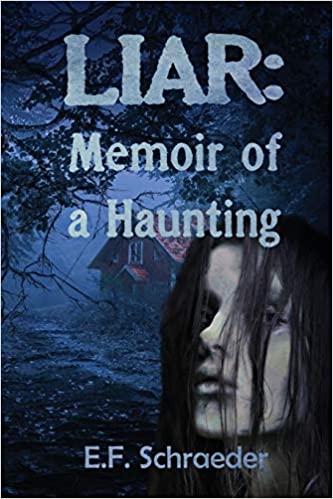
cover art for Liar: Memoir of a Haunting

Liar: Memoir of a Haunting by E.F. Schraeder

Omnium Gatherum, 2021

ISBN-13 ‏ : ‎ 978-1949054347

Available: Paperback, Kindle edition Bookshop.orgAmazon.com )


Alex and Rainey, a lesbian couple ready to escape their home in the hostile Midwest, embark on a long process of visiting Vermont and searching for a house so they can move there. Each house they visit has an ominous feel or dark history… that is, until they visit the Sugar House, a beautiful but isolated property with the primary disadvantage being that it is in a cell phone black hole. Together, they decide to buy the house and move there. Or do they? Told in alternating points of view, piecing together what actually happened is difficult to do. Rainey talks about having misgivings over the house and Alex talking her into it, with the understanding that they’ll live there together. Alex says she never planned to move there and talks about Rainey saying she wanted the peace and quiet of an off-grid life. Rainey finds herself living there alone as Alex travels for work and cares for her mother, who has dementia, in their hometown. It turns out that vacationing in Vermont as a couple is much different than being a lesbian living alone in an insular community and an isolated area, without a reliable way to communicate with the outside world, and gun-toting men frequently knocking on your door to ask if you are home alone and have a working phone. Rainey, who has worked hard to deal with past trauma, finds that it is emerging again. She develops insomnia, becomes obsessed with the trees over the house and local disappearances, and begins to sound more and more paranoid and lost. Despite regular calls, she isn’t getting though to either her therapist or to Alex about how disorienting and disturbing both her exterior and interior lives are becoming.


Alex, tied up with work, travel, and caring for her mother, is discovering the Rainey she knew is changing into someone who is exhausting to talk to and deal with. Alex is becoming frustrated– how terrible can it really be to live in peace and quiet with nature all around you? Her weekends in Vermont are no longer relaxing: they’re taken up with chores. When Rainey suddenly goes quiet and Alex receives a phone call from a neighbor, she rushes to the Sugar House to search for Rainey and finds and reads her journal for clues. On Rainey’s mysterious return, they both acknowledge that there is some kind of presence in the Sugar House.


You would think that these major miscommunications and red flag behaviors would be a death knell for a relationship. Rainey, a humanities professor, gets meta when Alex suggests writing about the experience as a haunted house story, noting that in haunted house stories it’s practically a trope for the story to document the fracturing of a self or of a relationship. Certainly we do see the cracks into Rainey’s sense of self, but while Rainey and Alex’s relationship struggles, the two of them never talk about breaking things off. Rather than discuss what they’re thinking or feeling with each other, they paper it over. People in relationships do this, but it was so frustrating that nothing was resolved.


Schraeder writes with vivid descriptions of the outdoors. I could almost see the snow and hear the aspens shaking. I did feel like the ending got a little confusing, and feel like it could have been fleshed out a little more. Rainey’s thoughts and experiences as she went down the rabbit hole seemed very believable. Liar: Memoir of a Haunting is definitely a different take on the haunted house story.


Reviewed by Kirsten Kowalewski
Book Review: Whisper Down the Lane by Clay McLeod Chapman

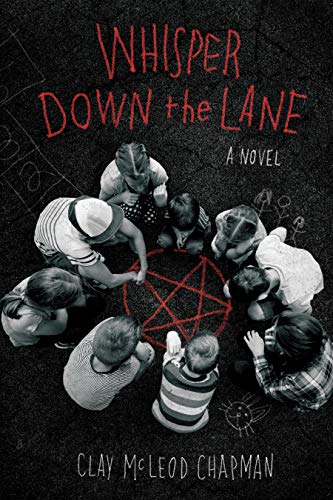
cover art for Whisper Down the Lane by Clay Mcleod Chapman

Whisper Down the Lane by Clay McLeod Chapman

Quirk Books, 2021

ISBN-13: 9781683692157

Available: Hardcover, paperback, Kindle edition, Audible audiobook Bookshop.orgAmazon.com )


Whisper Down the Lane, a true-crime based horror novel inspired by the McMartin preschool trial and Satanic Panic of the 1980s, is the second book by Clay McLeod Chapman I have read and it just makes it clear that I should find more of his work.


This story is told from two points of view in two different time periods. Richard Bellamy is married to the woman of his dreams, has a chance to raise a family, is employed as an art teacher…and doesn’t have a past. One morning, the discovery of the body of a ritualistically murdered rabbit appears on the school playground with a birthday card for someone named Sean. Richard’s blood runs cold and he tries to track down the sender.


The date shifts from 2013 to 1983. Sean is a five-year-old boy who has moved to Virginia with his newly single mother. She’s worried about the typical adult things like coping with her new role as sole caregiver to her son, money, childcare, and putting food on the table, as well as the threat of something happening to Sean. After Sean’s school sends a letter to the parents revealing that his favorite teacher is under investigation, the child tells a little lie that turns into something much bigger, stirring paranoia and suspicion in the minds of the local community and eventually the nation. Allegations of child ritual abuse and Satanic murder capture the nation’s imagination and unleashes a witch hunt on an epic scale. Thirty years later, someone knows Richard’s secret, and wants him to pay dearly for his sin.


Paranoia is explored in several aspects. Early in the novel, Sean’s mother is a nervous single mother. Discussion of the large scale paranoia of the public is alluded to, and since the story is told from the perspective of a young child it would be realistic that it be told in this manner. Richard’s paranoia as an adult with the past rearing its ugly head in his direction is a significant representation of this theme. Interestingly, it is the adults in the story who experience the ever increasing paranoia of the world gone mad. Between the police, the therapist, and even his own mother at times, Sean ultimately tells the adults what they want to hear, what the pressure him into telling really. Sean, wanting to appease the grownups around him, makes a false accusation that he doesn’t realize has horrible effects for innocent people. Richard’s paranoia increases as his past catches up with him, effecting his family and employment.


The story is fast-paced and compelling, especially for readers interested in the disturbing period of US history that was the Satanic Panic. Highly recommended.


Reviewed by Lizzy Walker


Book Review: Other Worlds: Peasants, Pilgrims, Spirits, Saints by Teffi, edited by Robert Chandler, translated by Robert Chandler and Elizabeth Chandler

cover art for Other Worlds: Peasants, Pilgrims, Spirits, Saints by Teffi

Other Worlds: Peasants, Pilgrims, Spirits, Saints by Teffi, translated by Robert Chandler and Elizabeth Chandler

New York Review Book Classics 2021

ISBN 978-1681375397

Available: Paperback, Kindle Bookshop.orgAmazon.com )


Nadezhda Lokhvitskaya (1872-1952), known as Teffi, wrote distinctively Russian short stories drawing on her culture and its folklore and legends. These intriguing stories demonstrate Teffi’s ability to show how the supernatural coexists with the commonplace in the lives of ordinary country folk struggling to deal with the deprivation, superstition, dangers, and evils of their place and time.


Teffi’s characters are people who have seen it all and expect the unexplainable to happen. They are deeply spiritual but not necessarily religious. They have an eerie insight into the ways that supernatural good and evil touch human life. They are also preternaturally aware of the strange and frightening signs that tell them certain human beings are not what they seem and that unusual incidents are not random and harmless but are warnings, and even evidence, of hazards that must be confronted or at least recognized. Teffi’s characters do not live in a relatively stable world that is knocked out of shape by horror; they live in the midst of it – so much so, that its existence is chillingly normalized.


The stories in this collection, except for the first few, are built around characters and settings that feel sinister and menacing. In “Shapeshifter,” a doctor is thought to be “some sort of were-creature” whose “big stone house” was the site where a girl had previously been confined alive in a wall, and ten banknote forgers had been suffocated in the cellar to keep them from being found by the authorities. A woman experiencing a “Wild Evening” takes shelter at an old monastery that local children’s nannies use as a threat to keep their little charges in line.


In “Witch,” a couple struggles to be free of a servant who is said to have secured her job indefinitely by ritually burning scraps of paper and “blowing smoke” up the chimney. A priest’s vampire child threatens people’s safety in “Vurdalak,” and the “House Spirit” is up to its traditional tricks that might have to be taken as a serious warning against evil this time. In “Leshachikha” we hear “a kind of story that simply doesn’t happen anymore” about a widowed count with a “hard, yellowish nail of extraordinary length” who has a “malevolent” daughter with very odd ways. Several other tales focus on traditional Russian characters and their familiar stories:  the house spirit, the water spirit, the bathhouse devil, the rusalka, and shapeshifters of all sorts, including those in the form of dogs, cats, and “she-wolves” (who are actually women who have been confined for far too long by controlling husbands). Even the famous Baba Yaga makes an appearance.


The Foreword, Afterward, and additional notes on Russian names and translation methods are helpful to readers who are unfamiliar with Russian folklore and tradition. However, some of the translation choices, such as mirroring period dialect in English, are distracting and negatively affect the mood and tone of the stories. Nevertheless, this collection is a blast from the Russian past that suggests, in an unsettling way, that perhaps these old stories are the best, because they come closer to revealing the often discounted darker truths of life we dismiss as old fashioned ways of perceiving reality. Recommended.


Reviewed by Nova Hadley