Home » 2023 (Page 7)

Book Review: Girls from the County by Donna Lynch


Girls from the County by Donna Lynch

Raw Dog Screaming Press, 2022

ISBN: 978-1947879478

Available: Paperback, Kindle edition

Buy:   Bookshop.org  |  Amazon.com


The city and the country are not the only dangerous places for a woman, according to Donna Lynch’s Girls from the County. In these poems, girls create a permanent connection to their landscape through the memories of places that “want to kill you” and the tragic deaths that result from ignoring ghostly warnings.


Lynch depicts the county as a haunted setting where people continue to tell the stories of horrible events involving nameless women whose lives have been destroyed there or, conversely, whose names became famous only because of the grisly details of their death. These are old stories, but also current ones, which show that some things do stay the same and that the only thing between you and disaster might be, as Lynch tells us, the words of your wise grandmother who knows how to survive. 


The county girl, as Lynch points out, soon realizes that what passes as tradition, ritual or symbol is darker than it seems and even darker when you trace it to its roots. Men play a big role in this hidden evil – of violence by the river,  “animal screams” mixing with unidentified screams in the woods, and things known by county girls that can’t be proven in order to save them or get them the justice they deserve. Even ordinary parties are characterized as events where county girls are likely to be “devoured” by men.


There is an occult connection between these horrors and old parts of a county – old burial grounds, old home sites now vacant, old houses where someone might think there was “something” scary in the window, old quarries and old cars that might be hiding dead bodies, and even gatherings of women trying to use the dark arts to protect themselves or to take revenge, not knowing whether they are really unleashing even more destruction.    


Lynch’s short, free verse poems that often read like prose narratives describe the county as a place where girls are held “in captivity” and want to escape, where the “beauty queen” finds out how her good looks are also a curse, and where people talk to you one day and disappear or abandon you the next. There are threats that make these girls stay silent about what they know, that warn them to avoid being “dramatic” by not making accusations without “evidence,” that cause them to be concerned about their safety if they are “pretty” or “sad” because being perceived in those ways opens them up to being targeted by a predator.


With menacing poem titles like “The Thing about Girls with Hammers” and “When the Cloud Comes for You,” a reference to a Dorothy in Oz who does not want to go home, Girls from the County depicts the county as a place where there is a barely contained fear, a lurking anxiety, a sense that every person, location, and situation is a potential threat to girls. In “Thirty-two Years (Eighteen Years Reprise)” the speaker worries, “What if / what we really saw / were all the things / we could not escape” and realizes that, ultimately, the “hurt” “waited for us in the trees,” and so, these girls have no choice but to run while the past always follows closely behind.


Reviewed by Nova Hadley
 

Book Review: The Monsters We Defy by Leslye Penelope


The Monsters We Defy by Leslye Penelope.

Redhook, 2022

ISBN-13 ‎978-0316377911

Available:  Paperback, Kindle edition, Audible

Buy:   Bookshop.org  Amazon.com


The Monsters We Defy takes place in an alternate Washington, D.C. during the Harlem Renaissance. This world has Enigmas (similar to demons) who will offer you a gift (Charm) always in company with a catch (Trick). Clara has the second sight. Her Charm is a mystery, but her Trick is to help anyone who asks. A woman brings her son, who has become unresponsive, to Clara for help, but there is a ward around the cause that prevents her from helping. The condition spreads through the poor Negro population, with the “Afflicted” then being collected in trucks and disappearing. The Enigma who holds Clara’s debt, the Empress, tells her a ring worn by Miss Josephine, an opera singer in cahoots with the mob, is the cause of the Afflicted. The Empress says she will clear Clara’s debt and that of any who help her acquire the ring, except the Enigma called the Man in Black.


Clara meets Israel Lee, a musician in debt to the Man in Black, who also wants the ring and to prevent the Empress from getting it. Israel’s gift is to be able to hypnotize with his music and be admired by all, but his Trick is that he cannot have true friends. In addition, she meets Jesse Lee, who can erase memories, at the expense of his true love being able to recognize or remember him, and Aristotle, an actor who can play any role but never be seen as himself. They, and Clara’s albino roommate, a former circus freak, plan to take back the ring at a party for the Luminous 400, the wealthy Black upper class.


Clara is based on Carrie Johnson, a 17 year old girl , who shot and killed a detective who broke into her bedroom during the Red Summer of 1919. She was convicted, but got a second trial where she was freed. Langston Hughes also appears as a minor character. There’s also a “drag bsll” which is pretty cool! Zelda is a really fun character and learning about Black albinism was really interesting. Penelope had challenges with researching during the pandemic, but the world-building is great, and this is a fascinating read. Recommended.


Reviewed by Kirsten Kowalewski


Book Review: You Can’t Kill Snow White by Beatrice Alemagna, translated by Karin Snelson and Emilie Robert Wong


You Can’t Kill Snow White by Beatrice Alemagna, translated from French by Karin Snelson and Emilie Robert Wong

Unruly, 2022

ISBN: 978-159270381

Available: Hardcover

Buy: Bookshop.org


You Can’t Kill Snow White puts a spin on the traditional story of Snow White by telling it from the Queen’s point of view. Alemagna reminds us of the darkness of the original Grimms’ tales and attempts to recapture and extend it by exposing the Queen’s evil plans, demented intentions, and murderous mind. We see her relishing the liver and lungs of the boar killed in place of Snow White that she believes are her victim’s and celebrating how “alive” and “renewed” she feels after feasting on them.


Although the idea of focusing on the Queen as narrator has great potential for enhancing the terror of the story and forcing the reader to feel the fear that children are protected from by modern re-tellings, Alemagna’s version does not go far enough. The fact that the focus on the queen cannot be maintained because she is not present at key points, like when the huntsman decides not to murder Snow White, causes breaks in the build up of tension. These breaks become longer and more difficult to bridge when the dwarves enter the picture and we are told by the queen that her heart is filled with “unspeakable pain” and she is full of “dread.” Are we meant to sympathize with her or to see her as so damaged that she is dangerous? Either way, the lack of development of the character does not shed much more light on her than we have had in the past.


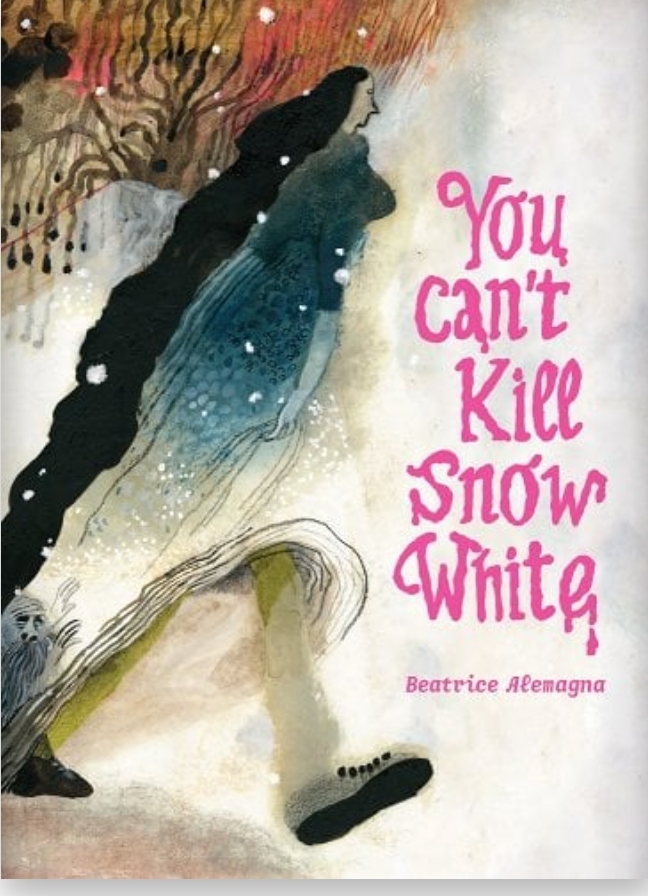
It seems that rather than creating a new take on the story of Snow White, Alemagna has used it as an opportunity to showcase her art. The illustrations are plentiful and create a dark moodiness in a palette primarily of murky browns, reds, blues and golds with jolts of reds and pinks. The dwarves are Eastern European folkloric type figures, mainly bearded. The human beings typically suggest nightmares with elongated bodies, impossibly long hair, gaping mouths, and giant hands. There is much frenetic movement: sweeping, gorging, and screaming that is a much stronger portrayal of emotion and much more effective at eliciting it from the reader than the writing is able to do.


You Can’t Kill Snow White is published by Enchanted Lion Books under their new picture book imprint, “Unruly,” intended for older readers and adults. These publishers are on the right track by engaging the many readers who have, even since childhood, loved the way in which illustrations add depth and beauty to storytelling. What better way to draw out our deepest fears than to experience on the page the horrible pictures  we can only imagine from descriptions?


Reviewed by Nova Hadley